Fabaceae
Hairy Thorny Broom: Full Sun Plant
Calicotome villosa
A hardy and low-maintenance Mediterranean plant. It prefers full sun exposure and well-draining soils, even poor or sandy ones. Very drought-resistant once established: water moderately every 1–2 weeks in summer, allowing the substrate to dry out between waterings; reduce further in winter. It does not require regular fertilization. Prune lightly after flowering to maintain a compact shape. Not suitable for container cultivation: it suffers from transplanting and root disturbance.
Every 14 days
Direct sun
-10° - 40°C
20% - 50%
Categories
What is Hairy Thorny Broom?
Hairy Thorny Broom (Calicotome villosa) is a easy-care plant from the Fabaceae family. The hairy thorny broom (Calicotome villosa) is a thorny evergreen shrub in the Fabaceae family, typical of the Mediterranean maquis and coastal garrigue. It grows between 1 and 3 meters in height with intricate, rigid branches ending in sharp spines; the leaves are trifoliate with oval, densely pube...
Hairy Thorny Broom grows up to 3.0m, spread of 200cm, watering every 14 days, -10°C – 40°C, 20–50% humidity. It is not suitable for indoor environments and safe for pets.
Unlike many tropical plants, Hairy Thorny Broom tolerates watering mistakes. Best for beginners. Unlike many popular species, Hairy Thorny Broom is safe to keep around pets.
How to Care for Hairy Thorny Broom?
TLDR: Hairy Thorny Broom needs Direct sun, watering every 14 days, and temperatures between -10-40°C with 20-50% humidity.
How Often Should You Water Hairy Thorny Broom?
Water every 10–14 days in summer, allowing the soil to dry out completely between waterings. Drastically reduce water intake in winter. It is a xerophilic plant that tolerates prolonged periods of drought; waterlogging is lethal.
How Much Light Does Hairy Thorny Broom Need?
Requires full sun throughout the day (at least 6–8 hours of direct light). It is a heliophilic species that does not tolerate shade: in low-light conditions, flowering is drastically reduced and the plant loses vigor.
What Is the Best Soil for Hairy Thorny Broom?
Prefers well-draining soils, including poor, sandy, or calcareous ones. It tolerates a pH from 5.5 to 8.0. Perfect drainage is the critical element: waterlogging causes root rot. Avoid compact clay soils and positions where water stagnates.
What Is Hairy Thorny Broom and Where Does It Come From?
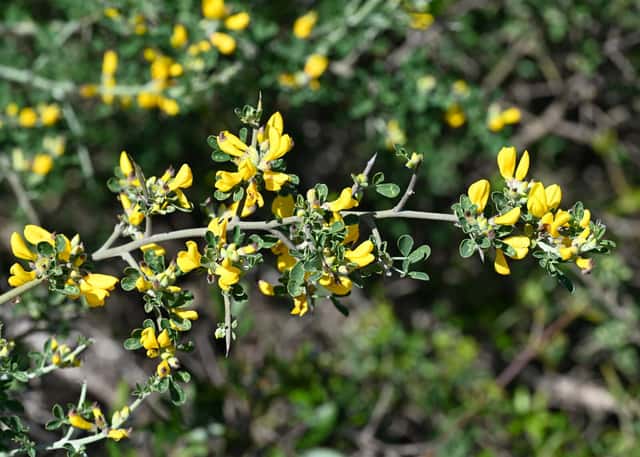
The hairy thorny broom (Calicotome villosa) is a thorny evergreen shrub in the Fabaceae family, typical of the Mediterranean maquis and coastal garrigue. It grows between 1 and 3 meters in height with intricate, rigid branches ending in sharp spines; the leaves are trifoliate with oval, densely pubescent leaflets. In spring (from January to April), it is covered with vibrant, intense yellow flowers that are highly fragrant and gathered in small clusters of 6–15. The fruits are hairy legumes 2–4 cm long. The plant is nitrogen-fixing thanks to symbiotic bacteria in its roots, helping to renew poor and degraded soils. It resists salt winds, prolonged drought, and short frosts down to -10 °C (14 °F).
How to Propagate Hairy Thorny Broom?
Sowing
Cuttings
How Big Does Hairy Thorny Broom Grow?
TLDR: Hairy Thorny Broom can reach up to 3.0m tall with Medium growth rate.
Max height
3.0m
Spread
2.0m
Growth rate
Medium
Foliage
Evergreen
Plant Uses
Ornamental
Great for decoration
Medicinal
Medicinal properties
Medicinal Uses
- The flowers and leafy stems show antimicrobial, antioxidant, antitumor, and cytotoxic activity (flavonoids isolated from the aerial parts)
- Traditionally used in poultices for boils, skin abscesses, and chilblains
- The flowers have been historically used to scent bath water
Culinary Uses
- The small flowers were traditionally used to flavor sesame oil and butter, with a pungent scent reminiscent of vanilla (traditional Arabic use)
Is your plant showing symptoms?
Click on the symptom to discover possible causes:
What Diseases Commonly Affect Hairy Thorny Broom?
TLDR: Hairy Thorny Broom is susceptible to 4 known diseases. Monitor regularly for early detection.
Root Rot
Root rot is a serious fungal disease that affects the root system of plants, causing them to decay and die. It is primarily caused by overwatering, poor drainage, or soil-borne fungi such as Pythium, Phytophthora, Rhizoctonia, and Fusarium. The disease thrives in waterlogged conditions where roots are deprived of oxygen, making them susceptible to fungal infection.
Powdery Mildew
Powdery mildew is a common fungal disease caused by various fungi species including Erysiphe, Podosphaera, Oïdium, and Leveillula. It affects over 10,000 plant species worldwide. The disease thrives in warm, dry climates with high humidity and appears as a distinctive white powdery coating on plant surfaces.
Aphids
Aphids are small, soft-bodied, pear-shaped insects (1/16 to 1/8 inch long) that feed by sucking nutrient-rich sap from plants. They reproduce rapidly and can quickly weaken plants, causing distorted growth and transmitting plant viruses. Aphids come in various colors including green, black, red, yellow, brown, and gray. They secrete honeydew, a sticky substance that attracts ants and encourages sooty mold growth.
Scale Insects
Scale insects are small sap-sucking pests that appear as brown, shell-like bumps on plant stems and leaves. There are over 25 species, divided into armored (hard) and unarmored (soft) scales. They feed by piercing plant tissue and extracting sap, which weakens the plant and can lead to yellowing, stunted growth, and even death if left untreated. They also excrete honeydew, which attracts ants and promotes sooty mold growth.
Meaning & Symbolism
In Mediterranean tradition, the hairy thorny broom symbolizes resilience, protection, and determination. Its spines make it an emblem of defense and boundaries; by blooming profusely in arid and rocky environments, it embodies the ability to thrive in adversity.
Compare with similar plants
| Attribute | Difficulty | Light | Watering | Pet Safe |
|---|---|---|---|---|
| Field Maple | Easy | Bright indirect | 14d | ✓ |
| Silver Birch | Easy | Direct sun | 14d | ✓ |
| Common Blanketflower | Easy | Direct sun | 10d | ✓ |
| Cushion Bush | Easy | Direct sun | 14d | ✓ |





