Plantaginaceae
Franciscan Hebe (Veronica × franciscana) Care Guide
Veronica × franciscana
This tough, low-maintenance shrub needs little more than well-drained soil and occasional watering. It flowers reliably from early to late summer and needs only a light trim after blooming to keep its neat, rounded shape.
Every 10 days
Bright indirect
-5° - 30°C
40% - 70%
Categories
What is Franciscan Hebe?
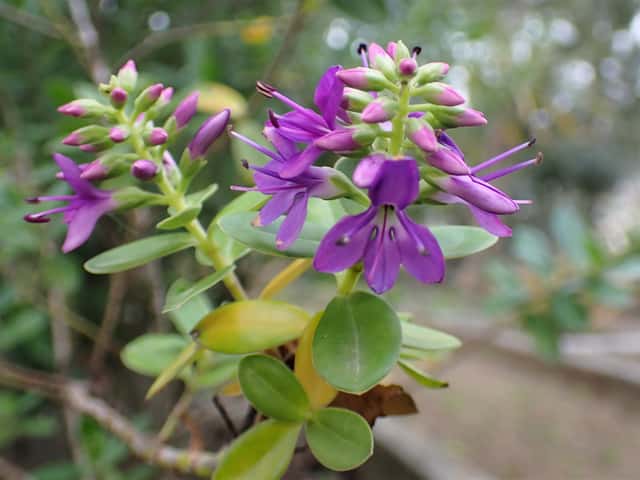
Franciscan Hebe (Veronica × franciscana) is a easy-care plant from the Plantaginaceae family. Franciscan Hebe (Veronica × franciscana) is a dense, rounded evergreen shrub prized for its glossy oval leaves and short spikes of purple summer flowers. A garden hybrid between Veronica elliptica and V. speciosa, it thrives in coastal and mild-winter gardens, tolerating salt spray, wind and drought...
Franciscan Hebe grows up to 1.0m, spread of 100cm, watering every 10 days, -5°C – 30°C, 40–70% humidity. It is not suitable for indoor environments and not safe for pets.
Unlike many tropical plants, Franciscan Hebe tolerates watering mistakes. Best for beginners. Without precautions, ingestion can cause irritation in pets. Keep out of reach of cats and dogs.
How to Care for Franciscan Hebe?
TLDR: Franciscan Hebe needs Bright indirect, watering every 10 days, and temperatures between -5-30°C with 40-70% humidity.
How Often Should You Water Franciscan Hebe?
Water deeply but infrequently, letting the top few centimetres of soil dry out between waterings. Established plants are drought-tolerant and only need extra water during prolonged dry spells; avoid soggy soil, which quickly leads to root rot.
How Much Light Does Franciscan Hebe Need?
Give it full sun to light partial shade, at least 4-6 hours of direct sun a day, to keep growth compact and flowering generous. In hot inland climates, a little afternoon shade helps prevent leaf scorch.
What Is the Best Soil for Franciscan Hebe?
Plant in well-draining, poor-to-moderately fertile soil that is neutral to slightly alkaline. Sandy or loamy soils with added grit work best; heavy, waterlogged clay should be avoided or improved with organic matter.
What Pot Should You Use for Franciscan Hebe?
If grown in a container, choose a wide, sturdy pot with generous drainage holes and use a gritty, free-draining potting mix to replicate its preferred garden conditions.
Care Schedule
Fertilize
Every 365 days
What Is Franciscan Hebe and Where Does It Come From?
Franciscan Hebe (Veronica × franciscana) is a dense, rounded evergreen shrub prized for its glossy oval leaves and short spikes of purple summer flowers. A garden hybrid between Veronica elliptica and V. speciosa, it thrives in coastal and mild-winter gardens, tolerating salt spray, wind and drought once established.
How to Propagate Franciscan Hebe?
Semi-ripe stem cuttings
Use a sharp, clean blade to avoid crushing the stem, and keep the cuttings out of direct sun until well rooted.
- 1 Take 8-10 cm semi-ripe cuttings from non-flowering side shoots in mid to late summer
- 2 Remove the lower leaves and dip the cut end in rooting hormone
- 3 Insert into a free-draining mix of equal parts perlite and peat-free compost
- 4 Keep in a shaded, humid spot and mist occasionally until roots form
Materials needed:
How Big Does Franciscan Hebe Grow?
TLDR: Franciscan Hebe can reach up to 1.0m tall with Medium growth rate.
Max height
1.0m
Spread
1.0m
Growth rate
Medium
Foliage
Evergreen
Warning: Toxic Plant
This plant can be toxic if ingested. Keep out of reach of:
Plant Uses
Ornamental
Great for decoration
Is your plant showing symptoms?
Click on the symptom to discover possible causes:
What Diseases Commonly Affect Franciscan Hebe?
TLDR: Franciscan Hebe is susceptible to 6 known diseases. Monitor regularly for early detection.
Septoria Leaf Spot
Septoria leaf spot is a destructive fungal disease caused by Septoria lycopersici, particularly devastating during seasons of moderate temperature and abundant rainfall. The disease starts on lower leaves and progresses upward, causing small circular spots with tan to gray centers and dark brown margins. If left untreated, it can dramatically reduce plant yields and cause complete leaf blight.
Downy Mildew
Downy mildew is a fungal-like disease caused by oomycetes (water molds) that thrives in cool, wet conditions. It affects a wide range of plants, causing yellowing leaves with fuzzy white-gray growth underneath, leading to defoliation and reduced yields if left untreated.
Powdery Mildew
Powdery mildew is a common fungal disease caused by various fungi species including Erysiphe, Podosphaera, Oïdium, and Leveillula. It affects over 10,000 plant species worldwide. The disease thrives in warm, dry climates with high humidity and appears as a distinctive white powdery coating on plant surfaces.
Grey Mould
Meaning & Symbolism
In Victorian flower language, Veronica symbolizes fidelity and womanly grace, making it a traditional gift of loyalty and lasting affection.
Fun Facts
The species epithet franciscana references San Francisco, though the hybrid was actually raised in cultivation from New Zealand parent species.
It is one of the most wind- and salt-spray-resistant shrubs, widely planted as a hedge on the Isles of Scilly.
Despite its common name Hebe, modern taxonomy places this shrub back in the genus Veronica.
Frequently asked questions
Is Franciscan Hebe toxic to pets?
How often should I water Franciscan Hebe?
Does Franciscan Hebe need pruning?
Can Franciscan Hebe survive frost?
Compare with similar plants
| Attribute | Difficulty | Light | Watering | Pet Safe |
|---|---|---|---|---|
| Field Maple | Easy | Bright indirect | 14d | ✓ |
| Silver Birch | Easy | Direct sun | 14d | ✓ |
| Common Blanketflower | Easy | Direct sun | 10d | ✓ |
| Cushion Bush | Easy | Direct sun | 14d | ✓ |





