Rosaceae
Indian Hawthorn (Rhaphiolepis)
Rhaphiolepis
Plant in full sun with well-draining soil. Water moderately — drought-tolerant once established. Little fertilization needed. Light pruning after flowering maintains its naturally compact, mounding shape.
Every 14 days
Direct sun
-12° - 35°C
40% - 70%
Categories
What is Indian Hawthorn?
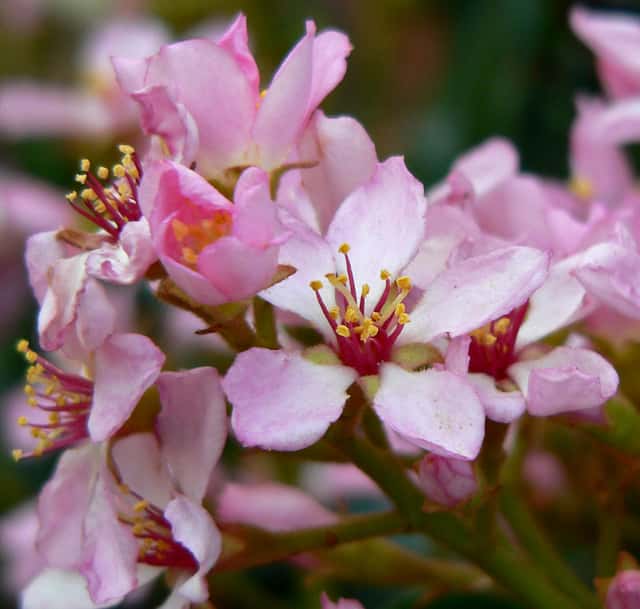
Indian Hawthorn (Rhaphiolepis) is a easy-care plant from the Rosaceae family. Indian Hawthorn (Rhaphiolepis) is an evergreen shrub in the Rosaceae family, native to southern China and Southeast Asia. Despite its common name, it does not originate from India. It produces clusters of fragrant white to pink flowers in spring and is widely cultivated as an ornamental plant for he...
Indian Hawthorn grows up to 1.8m, spread of 183cm, watering every 14 days, -12°C – 35°C, 40–70% humidity. It is not suitable for indoor environments and safe for pets.
Unlike many tropical plants, Indian Hawthorn tolerates watering mistakes. Best for beginners. Unlike many popular species, Indian Hawthorn is safe to keep around pets.
How to Care for Indian Hawthorn?
TLDR: Indian Hawthorn needs Direct sun, watering every 14 days, and temperatures between -12-35°C with 40-70% humidity.
How Often Should You Water Indian Hawthorn?
Water deeply but infrequently. Once established, the shrub tolerates dry periods well. Water at the base and avoid wetting the foliage to reduce the risk of leaf spot diseases.
How Much Light Does Indian Hawthorn Need?
Prefers full sun (6+ hours per day). Tolerates partial shade but flowers most abundantly and shows better disease resistance in full sunlight.
What Is the Best Soil for Indian Hawthorn?
Adapts to a wide range of soil types as long as drainage is good. Amend heavy clay soils with sand or perlite. Ideal pH 5.5–8.0.
What Pot Should You Use for Indian Hawthorn?
Ceramic or terracotta pot with drainage hole; suitable for large containers.
Care Schedule
Fertilize
Every 14 days
Misting
Every 3 days
Rotate
Every 7 days
Repot
Every 365 days
What Is Indian Hawthorn and Where Does It Come From?
Indian Hawthorn (Rhaphiolepis) is an evergreen shrub in the Rosaceae family, native to southern China and Southeast Asia. Despite its common name, it does not originate from India. It produces clusters of fragrant white to pink flowers in spring and is widely cultivated as an ornamental plant for hedges, borders, and mass plantings.
How Big Does Indian Hawthorn Grow?
TLDR: Indian Hawthorn can reach up to 1.8m tall with Slow growth rate.
Max height
1.8m
Spread
1.8m
Growth rate
Slow
Foliage
Evergreen
Plant Uses
Ornamental
Great for decoration
Is your plant showing symptoms?
Click on the symptom to discover possible causes:
What Diseases Commonly Affect Indian Hawthorn?
TLDR: Indian Hawthorn is susceptible to 9 known diseases. Monitor regularly for early detection.
Leaf Spot
Leaf spot is a common fungal disease caused by various pathogens including Alternaria, Ascochyta, Colletotrichum, Septoria, and Venturia. It primarily affects leaves, causing discolored spots that can lead to premature leaf drop if left untreated.
Anthracnose
Anthracnose is a fungal disease caused by fungi in the genus Colletotrichum that affects many plants, including vegetables, fruits, and trees. The disease thrives in cool, wet conditions, causing dark, sunken lesions on leaves, stems, flowers, and fruits.
Fire Blight
Fire blight is a highly destructive and contagious bacterial disease caused by Erwinia amylovora. It primarily affects plants in the Rosaceae family, including apple, pear, quince trees, and various ornamental plants. The disease can destroy an entire orchard in a single growing season under ideal conditions, with the bacterium moving approximately 11 inches per week in new growth.
Aphids
Aphids are small, soft-bodied, pear-shaped insects (1/16 to 1/8 inch long) that feed by sucking nutrient-rich sap from plants. They reproduce rapidly and can quickly weaken plants, causing distorted growth and transmitting plant viruses. Aphids come in various colors including green, black, red, yellow, brown, and gray. They secrete honeydew, a sticky substance that attracts ants and encourages sooty mold growth.
Meaning & Symbolism
Resilience and enduring beauty; often associated with good luck in Asian cultures.
Fun Facts
Despite the name 'Indian Hawthorn', this plant is native to southern China and Japan, not India.
It produces dark bluish-black berries in autumn that attract birds to the garden.
One of the most heat- and drought-tolerant flowering shrubs for coastal and Mediterranean gardens.
Compare with similar plants
| Attribute | Difficulty | Light | Watering | Pet Safe |
|---|---|---|---|---|
| Field Maple | Easy | Bright indirect | 14d | ✓ |
| Silver Birch | Easy | Direct sun | 14d | ✓ |
| Cushion Bush | Easy | Direct sun | 14d | ✓ |
| Peruvian peppertree | Easy | Direct sun | 14d | ⚠️ |





