Euphorbiaceae
Bleeding Heart Tree — Homalanthus Genus Care Guide
Homalanthus
Outdoor plant suited to tropical and subtropical climates. Thrives in partial to full sun with well-draining, organically rich soil. Water weekly during warm months and allow soil to partially dry between waterings. Fast-growing and benefits from periodic pruning to manage size.
Every 14 days
Partial shade
15° - 35°C
60% - 85%
Categories
What is Bleeding Heart Tree?
Bleeding Heart Tree (Homalanthus) is a medium-care plant from the Euphorbiaceae family. Homalanthus is a genus of fast-growing tropical trees and shrubs in the family Euphorbiaceae, native to Australia, Papua New Guinea, and Pacific islands. These pioneer plants rapidly colonize disturbed forest edges and clearings, playing a critical role in tropical forest regeneration. They feature...
Bleeding Heart Tree grows up to 6.0m, spread of 300cm, watering every 14 days, 15°C – 35°C, 60–85% humidity. It is not suitable for indoor environments and not safe for pets.
Without precautions, ingestion can cause irritation in pets. Keep out of reach of cats and dogs.
How to Care for Bleeding Heart Tree?
TLDR: Bleeding Heart Tree needs Partial shade, watering every 14 days, and temperatures between 15-35°C with 60-85% humidity.
How Often Should You Water Bleeding Heart Tree?
Water deeply once a week during hot periods. Allow the top 5 cm of soil to dry before watering again. Avoid waterlogging to prevent root rot.
How Much Light Does Bleeding Heart Tree Need?
Requires partial to full sun — at least 4–6 hours of sunlight daily. In very hot climates, morning sun with afternoon shade is ideal to prevent leaf scorch.
What Is the Best Soil for Bleeding Heart Tree?
Use loamy, well-draining soil rich in organic matter. Ideal pH between 6.0 and 7.5. Avoid heavy clay soils with poor drainage.
Care Schedule
Fertilize
Every 30 days
Misting
Every 7 days
What Is Bleeding Heart Tree and Where Does It Come From?
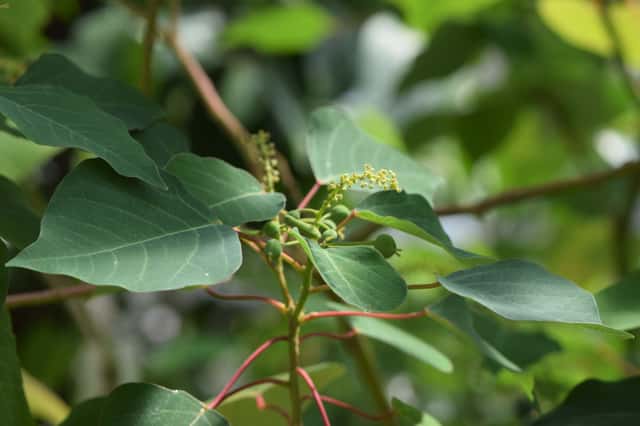
Homalanthus is a genus of fast-growing tropical trees and shrubs in the family Euphorbiaceae, native to Australia, Papua New Guinea, and Pacific islands. These pioneer plants rapidly colonize disturbed forest edges and clearings, playing a critical role in tropical forest regeneration. They feature large, heart-shaped leaves that turn vivid red before dropping, and produce milky white latex throughout their tissues. Several species, notably Homalanthus nutans, have attracted significant scientific interest for containing prostratin — a compound with demonstrated antiviral and anti-HIV activity derived from traditional Samoan ethnobotanical knowledge.
How Big Does Bleeding Heart Tree Grow?
TLDR: Bleeding Heart Tree can reach up to 6.0m tall with Fast growth rate.
Max height
6.0m
Spread
3.0m
Growth rate
Fast
Foliage
Deciduous
Warning: Toxic Plant
This plant can be toxic if ingested. Keep out of reach of:
Plant Uses
Ornamental
Great for decoration
Medicinal
Medicinal properties
Is your plant showing symptoms?
Click on the symptom to discover possible causes:
What Diseases Commonly Affect Bleeding Heart Tree?
TLDR: Bleeding Heart Tree is susceptible to 4 known diseases. Monitor regularly for early detection.
Powdery Mildew
Powdery mildew is a common fungal disease caused by various fungi species including Erysiphe, Podosphaera, Oïdium, and Leveillula. It affects over 10,000 plant species worldwide. The disease thrives in warm, dry climates with high humidity and appears as a distinctive white powdery coating on plant surfaces.
Scale Insects
Scale insects are small sap-sucking pests that appear as brown, shell-like bumps on plant stems and leaves. There are over 25 species, divided into armored (hard) and unarmored (soft) scales. They feed by piercing plant tissue and extracting sap, which weakens the plant and can lead to yellowing, stunted growth, and even death if left untreated. They also excrete honeydew, which attracts ants and promotes sooty mold growth.
Spider Mites
Spider mites are tiny arachnids (less than 1/20 inch long) related to spiders and ticks that feed on plant sap. They thrive in hot, dry conditions and can cause significant damage to ornamental and vegetable plants. During severe infestations, crop losses can reach 14% or higher as these pests disrupt vital plant processes including photosynthesis, carbon dioxide absorption, and transpiration.
Root Rot
Root rot is a serious fungal disease that affects the root system of plants, causing them to decay and die. It is primarily caused by overwatering, poor drainage, or soil-borne fungi such as Pythium, Phytophthora, Rhizoctonia, and Fusarium. The disease thrives in waterlogged conditions where roots are deprived of oxygen, making them susceptible to fungal infection.
Meaning & Symbolism
Symbol of forest restoration and ecological resilience; associated with natural healing and renewal in its native Australian and Pacific Island habitats.
Fun Facts
Homalanthus nutans contains prostratin, a compound with anti-HIV activity discovered through Samoan traditional medicine — one of the first documented cases of ethnobotany leading to a major pharmacological discovery.
The leaves turn brilliant red before falling, earning the genus its evocative common name "bleeding heart tree".
As pioneer species, Homalanthus trees are among the first to establish in disturbed tropical forests, creating conditions that allow other species to follow.
Compare with similar plants
| Attribute | Difficulty | Light | Watering | Pet Safe |
|---|---|---|---|---|
| Dark Fieldcap | Medium | Low light | 2d | ⚠️ |
| Azalea | Medium | Partial shade | 3d | ⚠️ |
| Bougainvillea | Medium | Direct sun | 7d | ⚠️ |
| Wild Lettuce | Medium | Direct sun | 7d | ⚠️ |



