Cannabaceae
Hops: Aromatic Plant
Humulus lupulus
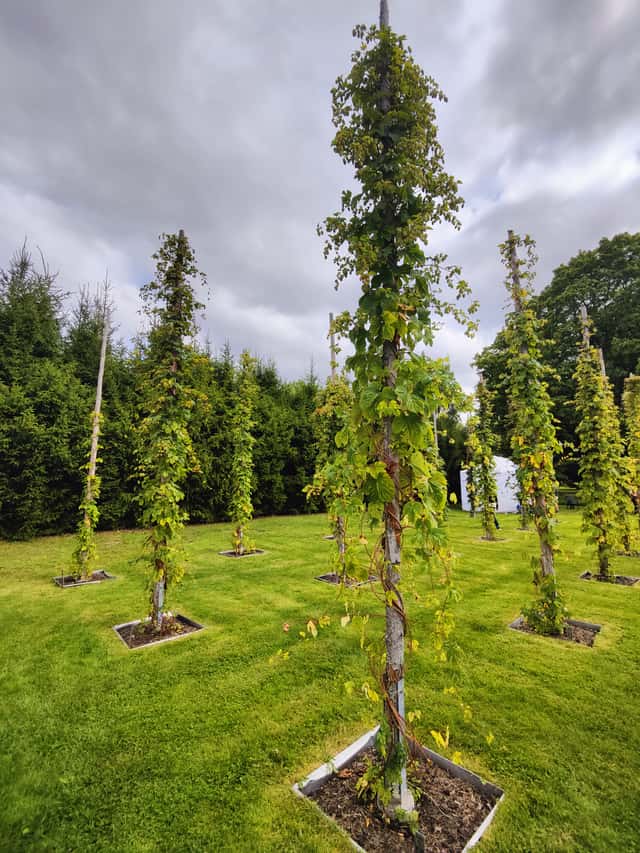
Hops are hardy and fast-growing plants that thrive best in full sun and nutrient-rich, well-drained soil. They require a sturdy trellis or support as the bines can become very long and heavy. The plant is very winter-hardy (down to -4 °F / -20 °C in dormancy) and is well-suited for temperate gardens. Water regularly and fertilize in early spring for optimal growth and cone production. Cut the bines down to ground level in the fall after the first frosts.
Every 7 days
Direct sun
-20° - 35°C
30% - 60%
Categories
What is Hops?
Hops (Humulus lupulus) is a easy-care plant from the Cannabaceae family. Hops (Humulus lupulus) is a vigorous, perennial climbing plant in the hemp family (Cannabaceae), native to Europe, North Asia, and North America. It is known for its impressive growth rate—under optimal conditions, shoots can grow up to 7 inches (18 cm) per day in early summer, and the plant can rea...
Hops grows up to 8.0m, spread of 200cm, watering every 7 days, -20°C – 35°C, 30–60% humidity. It is not suitable for indoor environments and not safe for pets.
Unlike many tropical plants, Hops tolerates watering mistakes. Best for beginners. Without precautions, ingestion can cause irritation in pets. Keep out of reach of cats and dogs.
How to Care for Hops?
TLDR: Hops needs Direct sun, watering every 7 days, and temperatures between -20-35°C with 30-60% humidity.
How Often Should You Water Hops?
Water the hops thoroughly once a week, equivalent to about 1 inch (2.5 cm) of water per week. Ensure the water penetrates 8–12 inches (20–30 cm) into the soil. Let the topsoil dry out slightly between waterings to avoid rot. During dry periods and during cone development (August–September), more frequent watering may be necessary. Avoid overwatering—hops are susceptible to root rot in stagnant, wet soil.
How Much Light Does Hops Need?
Hops thrive best in full sun and should receive at least 6–8 hours of direct sunlight daily. A sunny, warm, and sheltered location provides the best growth and largest cone yield. The plant tolerates light shade, but this will reduce cone production. Ensure good air circulation around the plant to prevent fungal diseases.
What Is the Best Soil for Hops?
Plant hops in deep, nutrient-rich, and well-drained soil with a pH between 6.0 and 7.5. Loam or sandy soil with plenty of added compost is ideal. Hops have deep roots and benefit from loose soil. Avoid heavy clay that retains moisture. Enrich the soil with well-rotted compost or manure at planting and add nitrogen-rich fertilizer in early spring.
What Pot Should You Use for Hops?
Hops are primarily best suited for planting in the ground. If grown in a pot, choose a very large container of at least 15–20 gallons (60–80 liters) with good drainage holes. Use a strong, nutrient-rich potting soil and set up a stable trellis. Keep in mind that hops in pots require more frequent watering and fertilization than those in the ground.
Care Schedule
Fertilize
Every 14 days
What Is Hops and Where Does It Come From?
Hops (Humulus lupulus) is a vigorous, perennial climbing plant in the hemp family (Cannabaceae), native to Europe, North Asia, and North America. It is known for its impressive growth rate—under optimal conditions, shoots can grow up to 7 inches (18 cm) per day in early summer, and the plant can reach 20–26 feet (6–8 meters) in length during a single growing season. The plant is dioecious: female plants produce the characteristic cone-shaped inflorescences rich in bitter substances (humulones and lupulones) and essential oils. These cones are indispensable in brewing beer, providing bitterness, aroma, and preservative properties. Hops have also been used medicinally in folk medicine for hundreds of years, particularly as a sedative.
How to Propagate Hops?
Rhizome cuttings
Softwood cuttings
Seed propagation
How Big Does Hops Grow?
TLDR: Hops can reach up to 8.0m tall with Fast growth rate.
Max height
8.0m
Spread
2.0m
Growth rate
Fast
Foliage
Deciduous
Warning: Toxic Plant
This plant can be toxic if ingested. Keep out of reach of:
Plant Uses
Ornamental
Great for decoration
Medicinal
Medicinal properties
Edible
Can be consumed
Aromatic
Pleasant fragrance
Medicinal Uses
- Sedative and sleep aid: hop cones are used for insomnia and nervous restlessness
- Antispasmodic: relieves muscle cramps and gastrointestinal spasms
- Diuretic: promotes urine excretion for minor urinary tract issues
- Antipyretic: folk medicine use against fever
- Antiseptic: external use of hop extract on wounds and boils
- Anti-inflammatory: humulones and lupulones have documented anti-inflammatory effects
- Note: Should be avoided during pregnancy and in estrogen-dependent conditions
Culinary Uses
- Brewing: hop cones are indispensable for bitterness, aroma, and preservation of beer
- Young shoots and leaves can be eaten cooked or raw as an asparagus-like vegetable in the spring
- Cones and leaves can be brewed into tea with a mild, bitter taste
- The seeds contain gamma-linolenic acid and can be used as a nutritional supplement
- Essential oils from the cones are used in the food industry as flavoring
Is your plant showing symptoms?
Click on the symptom to discover possible causes:
What Diseases Commonly Affect Hops?
TLDR: Hops is susceptible to 12 known diseases. Monitor regularly for early detection.
Downy Mildew
Downy mildew is a fungal-like disease caused by oomycetes (water molds) that thrives in cool, wet conditions. It affects a wide range of plants, causing yellowing leaves with fuzzy white-gray growth underneath, leading to defoliation and reduced yields if left untreated.
Powdery Mildew
Powdery mildew is a common fungal disease caused by various fungi species including Erysiphe, Podosphaera, Oïdium, and Leveillula. It affects over 10,000 plant species worldwide. The disease thrives in warm, dry climates with high humidity and appears as a distinctive white powdery coating on plant surfaces.
Aphids
Aphids are small, soft-bodied, pear-shaped insects (1/16 to 1/8 inch long) that feed by sucking nutrient-rich sap from plants. They reproduce rapidly and can quickly weaken plants, causing distorted growth and transmitting plant viruses. Aphids come in various colors including green, black, red, yellow, brown, and gray. They secrete honeydew, a sticky substance that attracts ants and encourages sooty mold growth.
Spider Mites
Spider mites are tiny arachnids (less than 1/20 inch long) related to spiders and ticks that feed on plant sap. They thrive in hot, dry conditions and can cause significant damage to ornamental and vegetable plants. During severe infestations, crop losses can reach 14% or higher as these pests disrupt vital plant processes including photosynthesis, carbon dioxide absorption, and transpiration.
Meaning & Symbolism
Hops symbolize sleep, rest, and healing in many European cultures. Historically, the cones were placed in pillows to promote sleep. In brewing traditions, hops represent strength, quality, and craftsmanship, and hop cones appear in the heraldry of many brewing regions. The plant is also associated with fertility and abundance due to its vigorous growth.
Compare with similar plants
| Attribute | Difficulty | Light | Watering | Pet Safe |
|---|---|---|---|---|
| Field Maple | Easy | Bright indirect | 14d | ✓ |
| Silver Birch | Easy | Direct sun | 14d | ✓ |
| Cushion Bush | Easy | Direct sun | 14d | ✓ |
| Peruvian peppertree | Easy | Direct sun | 14d | ⚠️ |





