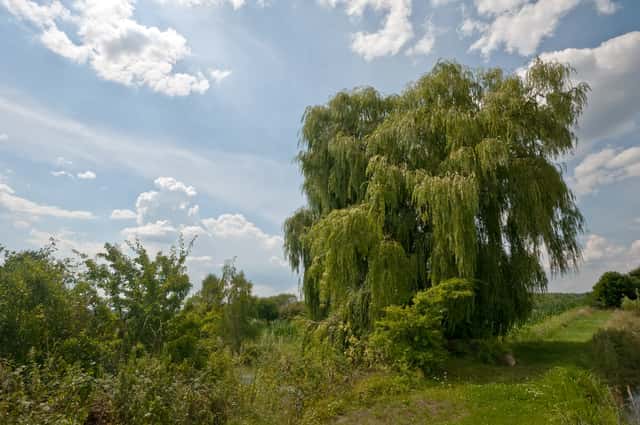
Salicaceae
White Willow: Full Sun Plant
Salix alba
Requires full sun and consistently moist soil. Water frequently, especially during dry periods. It is an outdoor tree, unsuitable for indoor environments. Prune during dormancy (late winter) to maintain shape and prevent brittle wood. Apply a balanced fertilizer in spring.
Every 5 days
Direct sun
-40° - 35°C
30% - 60%
Categories
What is White Willow?
White Willow (Salix alba) is a medium-care plant from the Salicaceae family. The white willow (Salix alba) is a fast-growing deciduous tree native to Europe, temperate Asia, and North Africa. It can reach up to 25 meters (82 feet) in height, with characteristic silvery-green lanceolate leaves, especially on the underside. It thrives in moist soils and near watercourses, maki...
White Willow grows up to 25.0m, spread of 1500cm, watering every 5 days, -40°C – 35°C, 30–60% humidity. It is not suitable for indoor environments and not safe for pets.
Without precautions, ingestion can cause irritation in pets. Keep out of reach of cats and dogs.
How to Care for White Willow?
TLDR: White Willow needs Direct sun, watering every 5 days, and temperatures between -40-35°C with 30-60% humidity.
How Often Should You Water White Willow?
Water generously 2 to 3 times a week in summer, keeping the soil moist. During rainy periods, watering can be reduced. Never let the soil dry out completely — the white willow is very sensitive to lack of water.
How Much Light Does White Willow Need?
Requires full sun for healthy growth — at least 6 hours of direct sunlight per day. Tolerates partial shade, but growth will be reduced, and the plant will be more vulnerable to diseases.
What Is the Best Soil for White Willow?
Prefers fertile, moist clay or loamy soils, with a pH between 5.5 and 8.0. Tolerates periodically waterlogged soils. Incorporate organic matter into the soil to improve moisture retention.
What Pot Should You Use for White Willow?
For gardens and outdoor spaces. Not suitable for indoor pots due to its large size.
Care Schedule
Fertilize
Every 90 days
What Is White Willow and Where Does It Come From?
The white willow (Salix alba) is a fast-growing deciduous tree native to Europe, temperate Asia, and North Africa. It can reach up to 25 meters (82 feet) in height, with characteristic silvery-green lanceolate leaves, especially on the underside. It thrives in moist soils and near watercourses, making it a popular choice for riparian landscaping and erosion control.
How to Propagate White Willow?
Hardwood Cuttings
Willow roots with extreme ease — even large branches planted directly in wet soil often take root. Change the water weekly if rooting in a vase with water.
- 1 Cut a healthy branch 20-30 cm (8-12 inches) long with 2-3 buds
- 2 Remove lower leaves and leave only 2-3 at the top
- 3 Plant directly in moist soil or water
- 4 Keep moist until rooting
Materials needed:
How Big Does White Willow Grow?
TLDR: White Willow can reach up to 25.0m tall with Fast growth rate.
Max height
25.0m
Spread
15.0m
Growth rate
Fast
Foliage
Deciduous
Warning: Toxic Plant
This plant can be toxic if ingested. Keep out of reach of:
Plant Uses
Ornamental
Great for decoration
Medicinal
Medicinal properties
Medicinal Uses
- Bark used medicinally as an analgesic and antipyretic (contains salicin, a precursor to aspirin)
- Bark infusion used in traditional medicine for fever, rheumatic pain, and arthritis
Is your plant showing symptoms?
Click on the symptom to discover possible causes:
What Diseases Commonly Affect White Willow?
TLDR: White Willow is susceptible to 10 known diseases. Monitor regularly for early detection.
Powdery Mildew
Powdery mildew is a common fungal disease caused by various fungi species including Erysiphe, Podosphaera, Oïdium, and Leveillula. It affects over 10,000 plant species worldwide. The disease thrives in warm, dry climates with high humidity and appears as a distinctive white powdery coating on plant surfaces.
Anthracnose
Anthracnose is a fungal disease caused by fungi in the genus Colletotrichum that affects many plants, including vegetables, fruits, and trees. The disease thrives in cool, wet conditions, causing dark, sunken lesions on leaves, stems, flowers, and fruits.
Canker
Canker is a disease caused by various fungi and bacteria that create necrotic, sunken areas on bark of branches, stems, and trunks. Pathogens enter through wounds and natural openings, especially when plants are stressed. Canker can gradually weaken or kill branches by disrupting water and nutrient flow.
Leaf Spot
Leaf spot is a common fungal disease caused by various pathogens including Alternaria, Ascochyta, Colletotrichum, Septoria, and Venturia. It primarily affects leaves, causing discolored spots that can lead to premature leaf drop if left untreated.
Meaning & Symbolism
The willow is a symbol of mourning, healing, and renewal in various cultures. In European mythology, it represents resilience in the face of loss and the ability to flourish even in adverse environments.
Compare with similar plants
| Attribute | Difficulty | Light | Watering | Pet Safe |
|---|---|---|---|---|
| Dark Fieldcap | Medium | Low light | 2d | ⚠️ |
| Azalea | Medium | Partial shade | 3d | ⚠️ |
| Bougainvillea | Medium | Direct sun | 7d | ⚠️ |
| Wild Lettuce | Medium | Direct sun | 7d | ⚠️ |



