Oleaceae
Jasmine (Jasminum) Care Guide
Jasminum
Give jasmine plenty of bright light, including some direct morning sun, keep the soil evenly moist but never soggy, and feed lightly during the growing season. Prune after flowering to keep growth tidy, and provide a trellis or support for climbing types.
Every 7 days
Bright indirect
15° - 27°C
40% - 60%
Categories
What is Jasmine?
Jasmine (Jasminum) is a medium-care plant from the Oleaceae family. Jasminum is a genus of about 200 species of shrubs and vines in the olive family (Oleaceae), native to tropical and warm temperate regions of Asia, Africa, Australasia and Oceania. Grown for their intensely fragrant, star-shaped flowers, usually white or yellow, jasmines range from compact evergreen...
Jasmine grows up to watering every 7 days, 15°C – 27°C, 40–60% humidity. It is suitable for indoor environments and safe for pets.
Unlike many popular species, Jasmine is safe to keep around pets. Without adequate drainage, root rot can develop within 14 days.
How to Care for Jasmine?
TLDR: Jasmine needs Bright indirect, watering every 7 days, and temperatures between 15-27°C with 40-60% humidity.
How Often Should You Water Jasmine?
Water when the top inch (about 2-3 cm) of soil feels dry, keeping the soil consistently moist but never waterlogged; cut back watering in autumn and winter to avoid root rot during the plant dormancy period.
How Much Light Does Jasmine Need?
Place jasmine where it gets bright, indirect light with a few hours of direct morning sun; indoors, a spot within a foot of a south- or east-facing window works well.
What Is the Best Soil for Jasmine?
Use a rich, well-draining potting mix, such as a standard peat- or coir-based mix amended with perlite or coarse sand, with a slightly acidic to neutral pH between 6.0 and 7.5.
What Pot Should You Use for Jasmine?
A terracotta or unglazed clay pot with ample drainage holes suits jasmine well, since the porous walls help excess moisture evaporate; climbing types benefit from a pot fitted with a small trellis or moss pole.
Care Schedule
Fertilize
Every 30 days
Repot
Every 730 days
What Is Jasmine and Where Does It Come From?
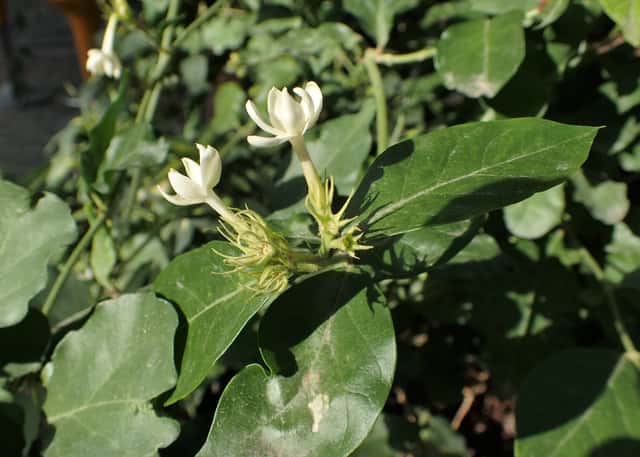
Jasminum is a genus of about 200 species of shrubs and vines in the olive family (Oleaceae), native to tropical and warm temperate regions of Asia, Africa, Australasia and Oceania. Grown for their intensely fragrant, star-shaped flowers, usually white or yellow, jasmines range from compact evergreen shrubs to vigorous climbing vines that can reach several meters with support. Popular garden and houseplant species include Jasminum officinale (common jasmine), Jasminum sambac (Arabian jasmine, used to scent jasmine tea) and Jasminum polyanthum (a fast-growing winter-flowering climber). Most jasmines bloom heaviest in spring and summer, filling gardens and homes with perfume especially in the evening. Because this entry covers the genus as a whole, care guidance below reflects typical requirements shared across common cultivated species; individual species can vary in hardiness, mature size and growth habit.
How to Propagate Jasmine?
Stem cutting
Use clean, sharp tools and take cuttings from actively growing shoots in spring or early summer for the best rooting success.
- 1 Take a 10-15 cm semi-hardwood cutting just below a leaf node from a healthy, non-flowering stem
- 2 Remove the lower leaves and dip the cut end in rooting hormone
- 3 Insert the cutting into a moist mix of perlite and peat or coir
- 4 Cover with a clear plastic bag or propagator lid to keep humidity high
- 5 Keep in bright, indirect light and mist regularly until roots form
Materials needed:
Layering
Layering is especially reliable for climbing jasmine species with long, trailing stems.
- 1 Choose a flexible, low-growing stem still attached to the parent plant
- 2 Wound the underside of the stem lightly at the point that will touch soil
- 3 Pin the wounded section into moist soil or a pot of potting mix, leaving the tip exposed
- 4 Keep the soil consistently moist until roots develop at the buried node
- 5 Once well rooted, sever the new plant from the parent and transplant
Materials needed:
How Big Does Jasmine Grow?
TLDR: Jasmine can reach up to ?cm tall with Medium growth rate.
Growth rate
Medium
Foliage
Semi-evergreen
Plant Uses
Ornamental
Great for decoration
Aromatic
Pleasant fragrance
Medicinal Uses
- Essential oil and flower extracts are used traditionally in aromatherapy for relaxation and stress relief
- Some cultures use jasmine flower infusions in traditional herbal remedies for mild anxiety and sleep support
Culinary Uses
- Flowers of some species, notably Jasminum sambac, are used to scent green and white tea (jasmine tea)
- Fresh blossoms are sometimes used to flavor desserts, syrups and rice dishes in Southeast Asian cuisine
Is your plant showing symptoms?
Click on the symptom to discover possible causes:
What Diseases Commonly Affect Jasmine?
TLDR: Jasmine is susceptible to 7 known diseases. Monitor regularly for early detection.
Powdery Mildew
Powdery mildew is a common fungal disease caused by various fungi species including Erysiphe, Podosphaera, Oïdium, and Leveillula. It affects over 10,000 plant species worldwide. The disease thrives in warm, dry climates with high humidity and appears as a distinctive white powdery coating on plant surfaces.
Root Rot
Root rot is a serious fungal disease that affects the root system of plants, causing them to decay and die. It is primarily caused by overwatering, poor drainage, or soil-borne fungi such as Pythium, Phytophthora, Rhizoctonia, and Fusarium. The disease thrives in waterlogged conditions where roots are deprived of oxygen, making them susceptible to fungal infection.
Rust
Rust is a common fungal disease caused by fungi in the order Pucciniales that affects a wide variety of plants. The disease gets its name from the characteristic orange, yellow, or reddish-brown pustules that appear on leaves, resembling metal rust. This obligate fungal parasite requires living plants to survive and can cause significant economic losses in agricultural crops.
Aphids
Aphids are small, soft-bodied, pear-shaped insects (1/16 to 1/8 inch long) that feed by sucking nutrient-rich sap from plants. They reproduce rapidly and can quickly weaken plants, causing distorted growth and transmitting plant viruses. Aphids come in various colors including green, black, red, yellow, brown, and gray. They secrete honeydew, a sticky substance that attracts ants and encourages sooty mold growth.
Meaning & Symbolism
Across many cultures jasmine is a symbol of love, purity, sensuality and beauty; garlands and loose blossoms are used in South and Southeast Asian weddings, religious offerings and as a traditional hair adornment, while in Western floriography jasmine represents amiability and grace.
Fun Facts
Some jasmine species only release their strongest fragrance after sunset, making them popular in evening gardens
Jasminum sambac flowers are hand-picked at dawn to scent traditional jasmine tea
The genus Jasminum contains roughly 200 species native to Asia, Africa and Oceania
Jasmine is the national flower of several countries, including Pakistan, the Philippines and Indonesia
Frequently asked questions
How often should I water jasmine?
Is jasmine toxic to cats and dogs?
Why is my jasmine not flowering?
How do I propagate jasmine?
Does jasmine need a trellis?
Compare with similar plants
| Attribute | Difficulty | Light | Watering | Pet Safe |
|---|---|---|---|---|
| Dark Fieldcap | Medium | Low light | 2d | ⚠️ |
| Azalea | Medium | Partial shade | 3d | ⚠️ |
| Bougainvillea | Medium | Direct sun | 7d | ⚠️ |
| Wild Lettuce | Medium | Direct sun | 7d | ⚠️ |



