Rubiaceae
Jungle Geranium (Ixora coccinea)
Ixora coccinea
Plant in full sun with well-draining, acidic soil (pH 5.0–5.5). Water when the top inch of soil is dry, roughly every 7 days. Fertilize monthly with an acid-forming fertilizer. Prune lightly after flowering to maintain compact shape. Protect from frost — hardy only in USDA zones 10–11.
Every 7 days
Direct sun
13° - 35°C
50% - 80%
Categories
What is Jungle Geranium?
Jungle Geranium (Ixora coccinea) is a medium-care plant from the Rubiaceae family. Ixora coccinea, commonly known as jungle geranium or flame of the woods, is a dense, multi-branched evergreen shrub in the family Rubiaceae. Native to Southern India, Bangladesh, and Sri Lanka, it has been widely cultivated across tropical and subtropical regions worldwide for centuries. The plant t...
Jungle Geranium grows up to 3.7m, spread of 150cm, watering every 7 days, 13°C – 35°C, 50–80% humidity. It is suitable for indoor environments and safe for pets.
Unlike many popular species, Jungle Geranium is safe to keep around pets. Without adequate drainage, root rot can develop within 14 days.
How to Care for Jungle Geranium?
TLDR: Jungle Geranium needs Direct sun, watering every 7 days, and temperatures between 13-35°C with 50-80% humidity.
How Often Should You Water Jungle Geranium?
Water thoroughly when the top inch of soil feels dry, approximately every 7 days. Never allow the pot to sit in standing water — ixora is sensitive to overwatering. Reduce watering in winter. Always water at the base of the plant to prevent fungal issues on foliage.
How Much Light Does Jungle Geranium Need?
Ixora requires full sun — at least 6 hours of direct sunlight daily — for abundant flowering. It can tolerate partial afternoon shade in very hot climates. Insufficient light results in sparse blooming and leggy growth.
What Is the Best Soil for Jungle Geranium?
Plant in fertile, well-draining, acidic soil with pH 5.0–5.5. Amend with peat moss or compost to improve drainage and acidity. Avoid alkaline soils — iron/manganese chlorosis develops rapidly, causing yellowing leaves. Ixora is notably pH-sensitive.
What Pot Should You Use for Jungle Geranium?
Terracotta or plastic pot with ample drainage holes. For indoor growing, choose a larger container to retain moisture without waterlogging. Pebble trays with water beneath the pot help maintain the humidity ixora prefers.
Care Schedule
Fertilize
Every 30 days
Misting
Every 3 days
Repot
Every 730 days
What Is Jungle Geranium and Where Does It Come From?
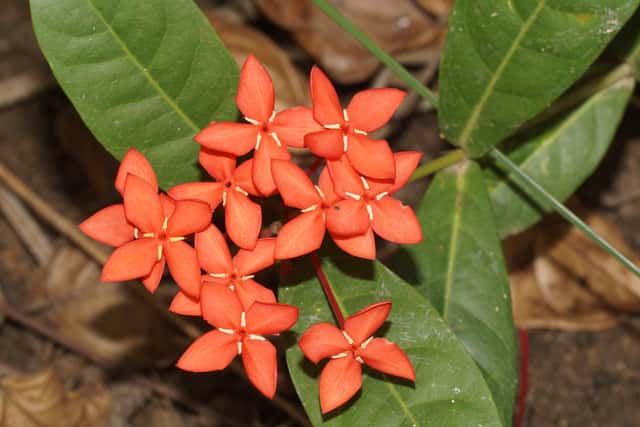
Ixora coccinea, commonly known as jungle geranium or flame of the woods, is a dense, multi-branched evergreen shrub in the family Rubiaceae. Native to Southern India, Bangladesh, and Sri Lanka, it has been widely cultivated across tropical and subtropical regions worldwide for centuries. The plant typically reaches 1.2–1.8 m (4–6 ft) in height under garden conditions, though it can grow to 3.7 m (12 ft) or more in ideal settings. Its glossy, leathery oblong leaves emerge bronzy before maturing to deep dark green, providing an attractive backdrop for its showy flowers. The plant produces spectacular rounded clusters (corymbs) of small, tubular, four-petaled flowers measuring 2–5 inches across. While the classic form bears brilliant scarlet-red blooms, cultivars exist in orange, yellow, pink, and white. In frost-free tropical climates, flowering is nearly continuous year-round, making it one of the most reliable and long-blooming tropical shrubs available. The flowers are mildly fragrant and attract butterflies, hummingbirds, and other pollinators, followed by small dark purple-black berry-like fruits. Ixora coccinea thrives in full sun with consistently moist, well-draining, acidic soil (pH 5.0–5.5) — it is notably sensitive to alkaline conditions, quickly developing iron and manganese chlorosis if soil pH rises above 6.0. It is frost-tender, suited only to USDA zones 10–11 outdoors, but can be grown as a container plant brought indoors in cooler climates. Beyond its ornamental value, Ixora holds significant cultural and medicinal importance — it is sacred in Hindu practice as an offering to Shiva, is the national flower of Suriname, and has a long history of use in Ayurvedic medicine.
How Big Does Jungle Geranium Grow?
TLDR: Jungle Geranium can reach up to 3.7m tall with Slow growth rate.
Max height
3.7m
Spread
1.5m
Growth rate
Slow
Foliage
Evergreen
Plant Uses
Ornamental
Great for decoration
Medicinal
Medicinal properties
Medicinal Uses
- Used in Ayurvedic medicine to treat dysentery and ulcers
- Bark and roots have documented antiseptic properties
- Flowers used in poultices for skin conditions
Is your plant showing symptoms?
Click on the symptom to discover possible causes:
What Diseases Commonly Affect Jungle Geranium?
TLDR: Jungle Geranium is susceptible to 11 known diseases. Monitor regularly for early detection.
Root Rot
Root rot is a serious fungal disease that affects the root system of plants, causing them to decay and die. It is primarily caused by overwatering, poor drainage, or soil-borne fungi such as Pythium, Phytophthora, Rhizoctonia, and Fusarium. The disease thrives in waterlogged conditions where roots are deprived of oxygen, making them susceptible to fungal infection.
Iron Deficiency
Iron deficiency, commonly known as iron chlorosis, is a nutrient deficiency disorder where plants cannot access sufficient iron from the soil. While iron is typically abundant in soil, various soil conditions can limit plant uptake, resulting in characteristic yellowing of leaves while veins remain green.
Leaf Spot
Leaf spot is a common fungal disease caused by various pathogens including Alternaria, Ascochyta, Colletotrichum, Septoria, and Venturia. It primarily affects leaves, causing discolored spots that can lead to premature leaf drop if left untreated.
Anthracnose
Anthracnose is a fungal disease caused by fungi in the genus Colletotrichum that affects many plants, including vegetables, fruits, and trees. The disease thrives in cool, wet conditions, causing dark, sunken lesions on leaves, stems, flowers, and fruits.
Meaning & Symbolism
Ixora coccinea is the national flower of Suriname and holds deep religious significance in Hinduism. Its genus name derives from a misinterpretation of 'Isvara,' a name for Shiva. Flowers are widely used as temple offerings across South and Southeast Asia, symbolizing devotion, purity, and auspiciousness.
Fun Facts
Ixora coccinea is the national flower of Suriname, South America, despite being native to South Asia.
Its genus name 'Ixora' is derived from a misinterpretation of 'Isvara' (Shiva) — Portuguese missionaries in India adapted the plant's local name from the Hindu deity.
In Ayurvedic medicine, ixora has been used for centuries to treat dysentery, ulcers, and skin conditions; its flowers, leaves, roots, and bark all have documented medicinal applications.
A single flower cluster (corymb) can last 6–8 weeks on the shrub, and under ideal frost-free conditions the plant blooms virtually year-round.
Ixora flowers are a favorite nectar source for butterflies and hummingbirds, making it a key plant in wildlife-friendly tropical gardens.
Compare with similar plants
| Attribute | Difficulty | Light | Watering | Pet Safe |
|---|---|---|---|---|
| Dark Fieldcap | Medium | Low light | 2d | ⚠️ |
| Azalea | Medium | Partial shade | 3d | ⚠️ |
| Bougainvillea | Medium | Direct sun | 7d | ⚠️ |
| Wild Lettuce | Medium | Direct sun | 7d | ⚠️ |
Choose & Compare
Sources & References
- NC State Extension Gardener Plant Toolbox – Ixora coccinea
- How to Grow Tropical Flowering Ixora Shrubs – Gardener's Path
- Ixora Plant Care – Gardening Know How
- Flame of the Woods (Ixora coccinea) Care Guide – Forward Plant
- Ixora coccinea – Wikipedia
- FPS 291 Ixora coccinea – UF/IFAS Extension
- Jungle Geranium – ASPCA Toxic and Non-Toxic Plants



