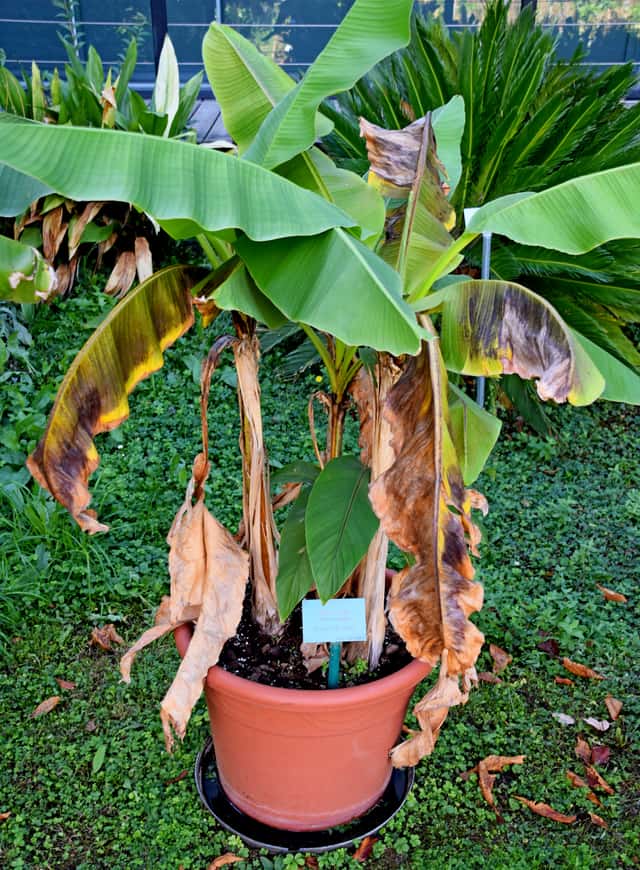
Musaceae
Japanese Banana (Musa basjoo): The Hardy Tropical Plant for Any Garden
Musa basjoo
Japanese Banana is easy to grow and rewards minimal care with spectacular tropical foliage. Plant in full sun with fertile, moist, well-drained soil. Water regularly, fertilize every two weeks during the growing season, and mulch heavily in autumn to protect rhizomes over winter. Cut back dead pseudostems in spring. It grows extremely fast — expect a new leaf every week in midsummer.
Every 4 days
Direct sun
-12° - 35°C
50% - 80%
Categories
What is Japanese Banana?
Japanese Banana (Musa basjoo) is a easy-care plant from the Musaceae family. Musa basjoo, known as the Japanese Banana or Hardy Banana, is a fast-growing herbaceous perennial in the family Musaceae. Native to the Ryukyu Islands of Japan and originally from Sichuan, China, it produces enormous paddle-shaped leaves up to 6 feet long, creating a lush tropical effect in temperat...
Japanese Banana grows up to 4.6m, spread of 460cm, watering every 4 days, -12°C – 35°C, 50–80% humidity. It is suitable for indoor environments and safe for pets.
Unlike many tropical plants, Japanese Banana tolerates watering mistakes. Best for beginners. Unlike many popular species, Japanese Banana is safe to keep around pets. Without adequate drainage, root rot can develop within 8 days.
How to Care for Japanese Banana?
TLDR: Japanese Banana needs Direct sun, watering every 4 days, and temperatures between -12-35°C with 50-80% humidity.
How Often Should You Water Japanese Banana?
Water deeply and consistently, keeping soil evenly moist but never waterlogged. During the growing season, water 2–3 times per week. Reduce watering in autumn. Good drainage is critical — soggy soils cause root and crown rot.
How Much Light Does Japanese Banana Need?
Provide at least 6 hours of direct sunlight daily for best growth. In hot climates, light afternoon shade prevents leaf scorch. Shelter the plant from strong winds to avoid leaf tearing.
What Is the Best Soil for Japanese Banana?
Use deep, fertile, moisture-retentive but well-draining soil rich in organic matter. Amend with compost before planting. Avoid heavy clay without amendment, and mound soil slightly in clay-heavy gardens to improve drainage.
What Pot Should You Use for Japanese Banana?
For container growing, use large (minimum 15-gallon) ceramic or terracotta pots with generous drainage holes. The container must be moved indoors or well-insulated in cold climates during winter.
Care Schedule
Fertilize
Every 14 days
Misting
Every 7 days
Repot
Every 730 days
What Is Japanese Banana and Where Does It Come From?
Musa basjoo, known as the Japanese Banana or Hardy Banana, is a fast-growing herbaceous perennial in the family Musaceae. Native to the Ryukyu Islands of Japan and originally from Sichuan, China, it produces enormous paddle-shaped leaves up to 6 feet long, creating a lush tropical effect in temperate gardens. Unlike most bananas, its underground rhizomes can survive temperatures as low as -10°F with mulch, making it the hardiest banana available for cold-climate gardening.
How Big Does Japanese Banana Grow?
TLDR: Japanese Banana can reach up to 4.6m tall with Fast growth rate.
Max height
4.6m
Spread
4.6m
Growth rate
Fast
Foliage
Deciduous
Plant Uses
Ornamental
Great for decoration
Medicinal
Medicinal properties
Medicinal Uses
- Stem and rhizome used in Traditional Chinese Medicine to clear heat-toxins
- Leaf poultices applied for minor burns and skin conditions
Culinary Uses
- Unripe fruits are inedible due to abundant hard seeds and sparse pulp
- Young pseudostem hearts are sometimes used in Asian cooking
Is your plant showing symptoms?
Click on the symptom to discover possible causes:
What Diseases Commonly Affect Japanese Banana?
TLDR: Japanese Banana is susceptible to 12 known diseases. Monitor regularly for early detection.
Aphids
Aphids are small, soft-bodied, pear-shaped insects (1/16 to 1/8 inch long) that feed by sucking nutrient-rich sap from plants. They reproduce rapidly and can quickly weaken plants, causing distorted growth and transmitting plant viruses. Aphids come in various colors including green, black, red, yellow, brown, and gray. They secrete honeydew, a sticky substance that attracts ants and encourages sooty mold growth.
Spider Mites
Spider mites are tiny arachnids (less than 1/20 inch long) related to spiders and ticks that feed on plant sap. They thrive in hot, dry conditions and can cause significant damage to ornamental and vegetable plants. During severe infestations, crop losses can reach 14% or higher as these pests disrupt vital plant processes including photosynthesis, carbon dioxide absorption, and transpiration.
Mealybugs
Mealybugs are small, soft-bodied insects covered with a white, waxy, cottony material. They are common pests of houseplants and outdoor plants in mild climates. These sap-sucking insects feed on plant tissue, causing damage, stunted growth, and can lead to plant death if left untreated. They produce sticky honeydew which attracts sooty mold.
Scale Insects
Scale insects are small sap-sucking pests that appear as brown, shell-like bumps on plant stems and leaves. There are over 25 species, divided into armored (hard) and unarmored (soft) scales. They feed by piercing plant tissue and extracting sap, which weakens the plant and can lead to yellowing, stunted growth, and even death if left untreated. They also excrete honeydew, which attracts ants and promotes sooty mold growth.
Meaning & Symbolism
Tropical abundance, resilience, exotic beauty, and strength through adversity
Fun Facts
Japanese Banana is the world's hardiest banana — its rhizomes survive −12°C (10°F) with heavy mulch
Despite its tree-like appearance, Musa basjoo has no woody tissue — the "trunk" is a pseudostem made of tightly rolled leaf bases
In Japan, the fibers from the pseudostem are woven into a fabric called bashōfu, used for traditional kimonos and household textiles
A single plant can grow over 4 meters tall in a single growing season from a protected rhizome
Frequently asked questions
Is Musa basjoo really hardy in cold climates?
Does Japanese Banana produce edible fruit?
How fast does Musa basjoo grow?
How do I protect Japanese Banana in winter?
Compare with similar plants
| Attribute | Difficulty | Light | Watering | Pet Safe |
|---|---|---|---|---|
| Small Scabious | Easy | Direct sun | 7d | ✓ |
| Field Maple | Easy | Bright indirect | 14d | ✓ |
| Silver Birch | Easy | Direct sun | 14d | ✓ |
| Red valerian | Easy | Direct sun | 10d | ✓ |



