Cyperaceae
Evergold Sedge: Ground Cover Plant
Carex oshimensis 'Evergold'
Evergold Sedge is a low-maintenance plant. Water moderately every 5-7 days in the summer and reduce to every 10-14 days in the winter. Keep the soil consistently moist but well-drained—never waterlogged. In pots, always check the substrate moisture before watering. This plant tolerates short periods of drought once established but prefers consistency.
Every 7 days
Partial shade
-15° - 30°C
40% - 70%
Categories
What is Evergold Sedge?
Evergold Sedge (Carex oshimensis 'Evergold') is a easy-care plant from the Cyperaceae family. Carex oshimensis 'Evergold' is a perennial ornamental grass native to Japan, appreciated worldwide for its narrow, variegated foliage featuring golden-yellow centers and dark green margins. Forming compact, arching clumps up to 12 inches (30 cm) tall, this grass-like plant is evergreen, maintaining...
Evergold Sedge grows up to 30cm, spread of 35cm, watering every 7 days, -15°C – 30°C, 40–70% humidity. It is suitable for indoor environments and safe for pets.
Unlike many tropical plants, Evergold Sedge tolerates watering mistakes. Best for beginners. Unlike many popular species, Evergold Sedge is safe to keep around pets. Without adequate drainage, root rot can develop within 14 days.
How to Care for Evergold Sedge?
TLDR: Evergold Sedge needs Partial shade, watering every 7 days, and temperatures between -15-30°C with 40-70% humidity.
How Often Should You Water Evergold Sedge?
Water every 5-7 days during warmer periods, allowing the top third of the substrate to dry slightly between waterings. In winter, reduce watering to every 10-14 days. Avoid prolonged waterlogging, which can cause root rot. In pots, ensure that excess water drains freely from the bottom.
How Much Light Does Evergold Sedge Need?
Prefers partial shade to filtered sun—ideal near north or east-facing windows, or in outdoor spaces with morning light. Avoid intense direct sun, especially in summer, as it can burn the delicate leaves. In cooler, cloudier climates, it tolerates more direct sun without damage.
What Is the Best Soil for Evergold Sedge?
Plant in a well-drained, fertile substrate rich in organic matter. The ideal pH is between 5.5 and 7.0 (slightly acidic to neutral). It can be grown in clay, loamy, or sandy soils, provided that excess water does not stagnate at the roots. Mix perlite or coarse sand into the substrate to improve drainage in pots.
What Pot Should You Use for Evergold Sedge?
Opt for terracotta or ceramic pots with a drainage hole at the bottom, which allow for good air circulation around the roots and prevent excess moisture. Plastic pots also work well if they have adequate drainage. Choose a pot 1 inch (2-3 cm) larger than the root ball to avoid accumulating excess moist substrate.
Care Schedule
Fertilize
Every 30 days
Rotate
Every 90 days
Repot
Every 730 days
What Is Evergold Sedge and Where Does It Come From?
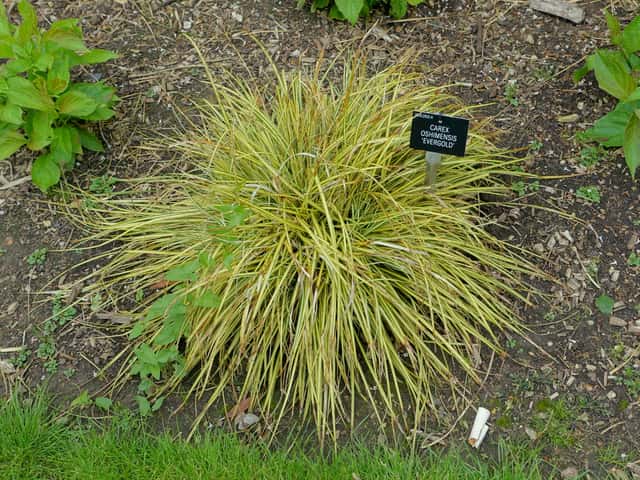
Carex oshimensis 'Evergold' is a perennial ornamental grass native to Japan, appreciated worldwide for its narrow, variegated foliage featuring golden-yellow centers and dark green margins. Forming compact, arching clumps up to 12 inches (30 cm) tall, this grass-like plant is evergreen, maintaining its visual appeal throughout the year. It is extremely versatile—ideal for borders, groundcover, containers, and Asian-style or contemporary gardens. Deer-resistant, salt-tolerant, and very low-maintenance, it is one of the most reliable ornamental plants for temperate gardens and indoor environments with indirect light.
How to Propagate Evergold Sedge?
How Big Does Evergold Sedge Grow?
TLDR: Evergold Sedge can reach up to 30cm tall with Slow growth rate.
Max height
30cm
Spread
35cm
Growth rate
Slow
Foliage
Evergreen
Plant Uses
Ornamental
Great for decoration
Ground Cover
Soil coverage
Is your plant showing symptoms?
Click on the symptom to discover possible causes:
What Diseases Commonly Affect Evergold Sedge?
TLDR: Evergold Sedge is susceptible to 9 known diseases. Monitor regularly for early detection.
Root Rot
Root rot is a serious fungal disease that affects the root system of plants, causing them to decay and die. It is primarily caused by overwatering, poor drainage, or soil-borne fungi such as Pythium, Phytophthora, Rhizoctonia, and Fusarium. The disease thrives in waterlogged conditions where roots are deprived of oxygen, making them susceptible to fungal infection.
Crown Rot
Crown rot is a serious fungal disease that attacks the crown (base) of the plant where the stem meets the soil. It is caused by various fungal pathogens including Phytophthora, Fusarium, and Rhizoctonia. The disease thrives in waterlogged conditions and can quickly spread to kill the entire plant if not addressed promptly.
Leaf Spot
Leaf spot is a common fungal disease caused by various pathogens including Alternaria, Ascochyta, Colletotrichum, Septoria, and Venturia. It primarily affects leaves, causing discolored spots that can lead to premature leaf drop if left untreated.
Rust
Rust is a common fungal disease caused by fungi in the order Pucciniales that affects a wide variety of plants. The disease gets its name from the characteristic orange, yellow, or reddish-brown pustules that appear on leaves, resembling metal rust. This obligate fungal parasite requires living plants to survive and can cause significant economic losses in agricultural crops.
Meaning & Symbolism
In Japanese culture, Carex plants symbolize understated elegance, patience, and resilience. Its golden, persistent foliage is associated with longevity and beauty that endures through the seasons, evoking the wabi-sabi philosophy of finding beauty in simple and lasting things.
Compare with similar plants
| Attribute | Difficulty | Light | Watering | Pet Safe |
|---|---|---|---|---|
| Field Maple | Easy | Bright indirect | 14d | ✓ |
| Silver Birch | Easy | Direct sun | 14d | ✓ |
| Cushion Bush | Easy | Direct sun | 14d | ✓ |
| Peruvian peppertree | Easy | Direct sun | 14d | ⚠️ |