Bignoniaceae
Cape Honeysuckle (Tecoma capensis) Care Guide
Tecoma capensis
Grows best in full sun to light shade with well-drained soil and moderate watering; drought-tolerant once established but intolerant of waterlogged roots. Annual pruning in late winter encourages denser growth and more flowers.
Every 7 days
Bright indirect
-4° - 40°C
30% - 70%
Categories
What is Cape Honeysuckle?
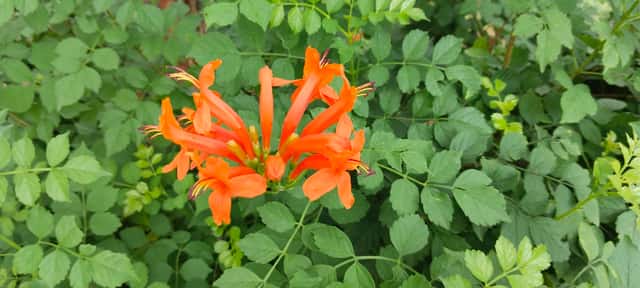
Cape Honeysuckle (Tecoma capensis) is a easy-care plant from the Bignoniaceae family. Cape Honeysuckle (Tecoma capensis) is an evergreen, scrambling shrub native to southern Africa, prized for its clusters of orange, tubular flowers. Fast-growing and adaptable, it can be trained as a hedge, espalier, or climbing vine, blooming mainly from fall through spring and attracting hummingbir...
Cape Honeysuckle grows up to 3.0m, spread of 300cm, watering every 7 days, -4°C – 40°C, 30–70% humidity. It is not suitable for indoor environments and safe for pets.
Unlike many tropical plants, Cape Honeysuckle tolerates watering mistakes. Best for beginners. Unlike many popular species, Cape Honeysuckle is safe to keep around pets.
How to Care for Cape Honeysuckle?
TLDR: Cape Honeysuckle needs Bright indirect, watering every 7 days, and temperatures between -4-40°C with 30-70% humidity.
How Often Should You Water Cape Honeysuckle?
Water when the top few inches of soil dry out; prolonged soggy soil can cause root rot within days.
How Much Light Does Cape Honeysuckle Need?
Needs at least 6 hours of direct sun for best flowering; partial shade sharply reduces bloom production.
What Is the Best Soil for Cape Honeysuckle?
Tolerates sandy or clay soils as long as drainage is good; neutral to slightly alkaline pH is ideal.
What Pot Should You Use for Cape Honeysuckle?
Use a large, sturdy container with generous drainage holes if grown potted, since the plant is fast-growing and deep-rooted; in-ground planting is preferred where climate allows.
Care Schedule
Fertilize
Every 365 days
What Is Cape Honeysuckle and Where Does It Come From?
Cape Honeysuckle (Tecoma capensis) is an evergreen, scrambling shrub native to southern Africa, prized for its clusters of orange, tubular flowers. Fast-growing and adaptable, it can be trained as a hedge, espalier, or climbing vine, blooming mainly from fall through spring and attracting hummingbirds and butterflies.
How to Propagate Cape Honeysuckle?
Semi-hardwood stem cutting
Use clean, sharp tools and keep the medium moist but not waterlogged until roots form.
- 1 Cut a 4-6 inch semi-hardwood stem without flowers
- 2 Strip leaves from the lower half
- 3 Dip the cut end in rooting hormone
- 4 Plant in light potting mix and keep evenly moist
Materials needed:
How Big Does Cape Honeysuckle Grow?
TLDR: Cape Honeysuckle can reach up to 3.0m tall with Fast growth rate.
Max height
3.0m
Spread
3.0m
Growth rate
Fast
Foliage
Evergreen
Warning: Toxic Plant
This plant can be toxic if ingested. Keep out of reach of:
Plant Uses
Ornamental
Great for decoration
Ground Cover
Soil coverage
Is your plant showing symptoms?
Click on the symptom to discover possible causes:
What Diseases Commonly Affect Cape Honeysuckle?
TLDR: Cape Honeysuckle is susceptible to 9 known diseases. Monitor regularly for early detection.
Aphids
Aphids are small, soft-bodied, pear-shaped insects (1/16 to 1/8 inch long) that feed by sucking nutrient-rich sap from plants. They reproduce rapidly and can quickly weaken plants, causing distorted growth and transmitting plant viruses. Aphids come in various colors including green, black, red, yellow, brown, and gray. They secrete honeydew, a sticky substance that attracts ants and encourages sooty mold growth.
Scale Insects
Scale insects are small sap-sucking pests that appear as brown, shell-like bumps on plant stems and leaves. There are over 25 species, divided into armored (hard) and unarmored (soft) scales. They feed by piercing plant tissue and extracting sap, which weakens the plant and can lead to yellowing, stunted growth, and even death if left untreated. They also excrete honeydew, which attracts ants and promotes sooty mold growth.
Whiteflies
Whiteflies are small, soft-bodied, winged insects closely related to aphids and mealybugs. They are moth-like in appearance, about 1/16 inch long, triangular in shape, and gray-white in color. These sap-sucking pests feed on plant tissue, causing yellowing, stunted growth, and wilting. They also excrete honeydew, which attracts ants and promotes sooty mold growth. Whiteflies can transmit serious plant viruses.
Mealybugs
Mealybugs are small, soft-bodied insects covered with a white, waxy, cottony material. They are common pests of houseplants and outdoor plants in mild climates. These sap-sucking insects feed on plant tissue, causing damage, stunted growth, and can lead to plant death if left untreated. They produce sticky honeydew which attracts sooty mold.
Meaning & Symbolism
Its warm orange-red blooms are often linked to vitality and energy, and the flowers' appeal to hummingbirds and sunbirds makes the plant a symbol of garden hospitality.
Fun Facts
Despite its common name, it isn't a true honeysuckle — it belongs to the Bignoniaceae family, not Caprifoliaceae.
In its native South Africa, its flowers are pollinated primarily by sunbirds.
It can be grown either as an upright shrub or trained as a climbing vine, depending on support and pruning.
Frequently asked questions
Is Cape Honeysuckle toxic to cats or dogs?
How often should I water Cape Honeysuckle?
Why isn't my Cape Honeysuckle blooming?
What is the easiest way to propagate Cape Honeysuckle?
Compare with similar plants
| Attribute | Difficulty | Light | Watering | Pet Safe |
|---|---|---|---|---|
| Field Maple | Easy | Bright indirect | 14d | ✓ |
| Silver Birch | Easy | Direct sun | 14d | ✓ |
| Cushion Bush | Easy | Direct sun | 14d | ✓ |
| Peruvian peppertree | Easy | Direct sun | 14d | ⚠️ |
Choose & Compare
Sources & References
- Tecomaria capensis (Cape Honeysuckle) - NC State Extension Gardener Plant Toolbox
- Cape Honeysuckle Plant Care & Growing Basics - PlantIn
- Cape Honeysuckle: How Much Water & Light Does it Need to Thrive? - Greg
- Cape Honeysuckle (Tecoma Capensis) Plant Care & How to Grow, Water - Plantiary
- Tecoma capensis - Wikipedia (PT)
- Tecomaria capensis - InfoJardin (ES)





