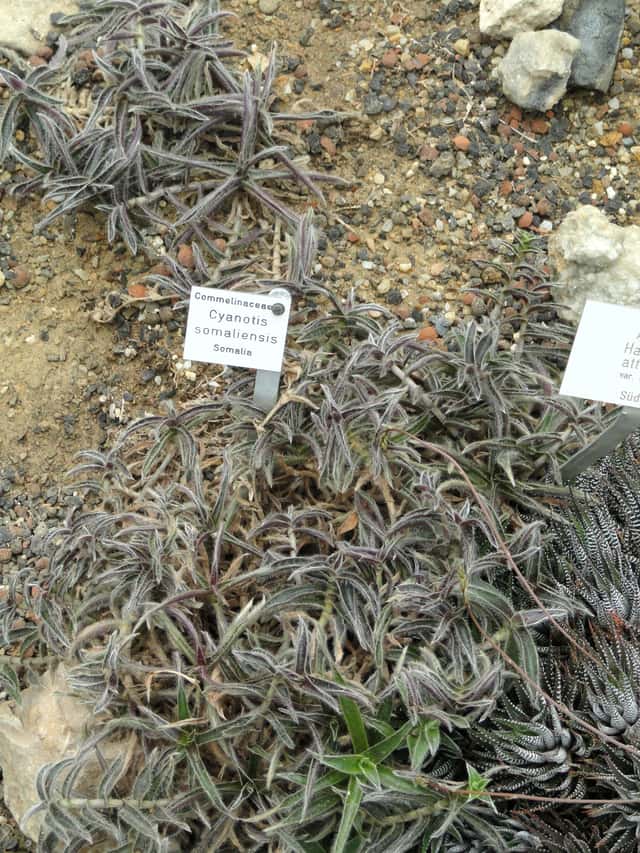
Commelinaceae
Pussy Ears: Pet-Safe Plant
Cyanotis somaliensis
A low-maintenance, slow-growing succulent. It prefers bright indirect light (or filtered morning sun) and a light, well-draining substrate. Allow the soil to dry out thoroughly between waterings and avoid getting the fuzzy leaves wet.
Every 10 days
Bright indirect
10° - 28°C
40% - 60%
Categories
What is Pussy Ears?
Pussy Ears (Cyanotis somaliensis) is a easy-care plant from the Commelinaceae family. Cyanotis somaliensis, known as Pussy Ears or Kitten Ears, is a creeping perennial succulent in the Commelinaceae family, native to northern Somalia in East Africa. Its small, fleshy, lance-shaped leaves (about 4 cm) are covered in a dense, soft white fuzz that gives it a unique velvety texture, rese...
Pussy Ears grows up to 12cm, spread of 60cm, watering every 10 days, 10°C – 28°C, 40–60% humidity. It is suitable for indoor environments and safe for pets.
Unlike many tropical plants, Pussy Ears tolerates watering mistakes. Best for beginners. Unlike many popular species, Pussy Ears is safe to keep around pets. Without adequate drainage, root rot can develop within 20 days.
How to Care for Pussy Ears?
TLDR: Pussy Ears needs Bright indirect, watering every 10 days, and temperatures between 10-28°C with 40-60% humidity.
How Often Should You Water Pussy Ears?
Water from below (bottom watering) approximately every 10 days during spring and summer, allowing the top few inches of the substrate to dry out between waterings; reduce significantly in fall/winter. Avoid wetting the fuzzy foliage, as water trapped between the hairs promotes fungus and rot.
How Much Light Does Pussy Ears Need?
Prefers bright indirect light or filtered morning sun; it tolerates some direct sun but should be protected from intense midday sun, which can burn the leaves. Low light causes the plant to become leggy with pale leaves.
What Is the Best Soil for Pussy Ears?
Use a light, porous substrate rich in organic matter, such as cactus/succulent mix blended with perlite or coarse sand, always in a pot with drainage holes.
What Pot Should You Use for Pussy Ears?
Ceramic or terracotta pots with drainage holes are ideal; hanging baskets showcase the plant's trailing stems.
Care Schedule
Fertilize
Every 28 days
Rotate
Every 90 days
Repot
Every 730 days
What Is Pussy Ears and Where Does It Come From?
Cyanotis somaliensis, known as Pussy Ears or Kitten Ears, is a creeping perennial succulent in the Commelinaceae family, native to northern Somalia in East Africa. Its small, fleshy, lance-shaped leaves (about 4 cm) are covered in a dense, soft white fuzz that gives it a unique velvety texture, resembling a kitten's ears. It is a slow-growing and compact plant, reaching about 12 cm in height, with trailing stems that can extend up to 60 cm, making it ideal for hanging baskets. In summer, it produces small three-petaled purple or blue flowers with showy yellow stamens that create a charming contrast. The species has received the Royal Horticultural Society's Award of Garden Merit.
How to Propagate Pussy Ears?
Stem Cuttings
- Avoid overwatering during rooting to prevent stem rot
- Keep in a bright spot but without intense direct sun
- 1 Cutting the Stem
Cut a healthy stem segment 7 to 10 cm long, containing at least 2 to 3 leaf nodes.
- 2 Preparation
Remove the leaves from the bottom of the cutting and let the end callus for 24 hours before planting.
- 3 Rooting
Insert the base of the stem into a light succulent substrate (or in water, changing every 5-7 days) and keep slightly moist until rooted.
Materials needed:
Division
- Ensure each division has enough roots to establish itself
- 1 Removing from Pot
Remove the plant from the pot at the beginning of the growing season and observe the natural clumps of stems and roots.
- 2 Division
Carefully separate sections with their own roots using your hands or a clean tool.
- 3 Repotting
Plant each section in a light, well-draining substrate and keep slightly moist until established.
Materials needed:
How Big Does Pussy Ears Grow?
TLDR: Pussy Ears can reach up to 12cm tall with Slow growth rate.
Max height
12cm
Spread
60cm
Growth rate
Slow
Foliage
Evergreen
Plant Uses
Ornamental
Great for decoration
Is your plant showing symptoms?
Click on the symptom to discover possible causes:
What Diseases Commonly Affect Pussy Ears?
TLDR: Pussy Ears is susceptible to 7 known diseases. Monitor regularly for early detection.
Powdery Mildew
Powdery mildew is a common fungal disease caused by various fungi species including Erysiphe, Podosphaera, Oïdium, and Leveillula. It affects over 10,000 plant species worldwide. The disease thrives in warm, dry climates with high humidity and appears as a distinctive white powdery coating on plant surfaces.
Root Rot
Root rot is a serious fungal disease that affects the root system of plants, causing them to decay and die. It is primarily caused by overwatering, poor drainage, or soil-borne fungi such as Pythium, Phytophthora, Rhizoctonia, and Fusarium. The disease thrives in waterlogged conditions where roots are deprived of oxygen, making them susceptible to fungal infection.
Leaf Spot
Leaf spot is a common fungal disease caused by various pathogens including Alternaria, Ascochyta, Colletotrichum, Septoria, and Venturia. It primarily affects leaves, causing discolored spots that can lead to premature leaf drop if left untreated.
Scale Insects
Scale insects are small sap-sucking pests that appear as brown, shell-like bumps on plant stems and leaves. There are over 25 species, divided into armored (hard) and unarmored (soft) scales. They feed by piercing plant tissue and extracting sap, which weakens the plant and can lead to yellowing, stunted growth, and even death if left untreated. They also excrete honeydew, which attracts ants and promotes sooty mold growth.
Meaning & Symbolism
Represents softness, comfort, and beauty in small things—symbolized by the velvety leaves that invite touch.
Compare with similar plants
| Attribute | Difficulty | Light | Watering | Pet Safe |
|---|---|---|---|---|
| Field Maple | Easy | Bright indirect | 14d | ✓ |
| Silver Birch | Easy | Direct sun | 14d | ✓ |
| Cushion Bush | Easy | Direct sun | 14d | ✓ |
| Peruvian peppertree | Easy | Direct sun | 14d | ⚠️ |





