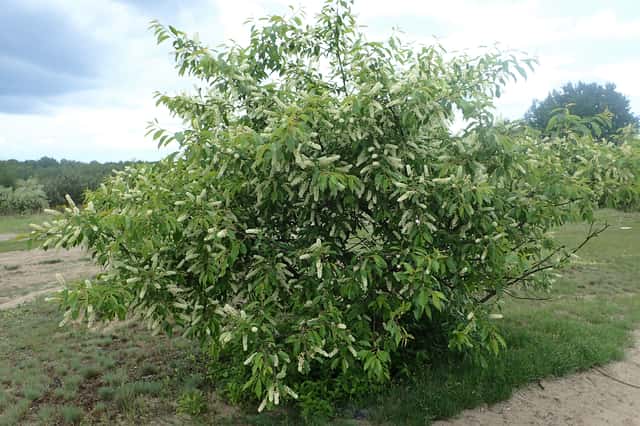
Rosaceae
Black Cherry (Prunus serotina): The Complete Care Guide
Prunus serotina
Provide full sun for best flowering and fruiting. Water deeply but infrequently once established — deep soaks every 1–2 weeks during dry spells. Plant in well-drained loamy soil. Prune during dormancy. Caution: all plant parts except ripe fruit flesh are toxic due to cyanogenic glycosides.
Every 14 days
Direct sun
-40° - 35°C
40% - 70%
Categories
What is Black Cherry?
Black Cherry (Prunus serotina) is a easy-care plant from the Rosaceae family. Black Cherry (Prunus serotina) is a large, fast-growing deciduous tree native to North America, valued for its fragrant spring blossoms, edible dark fruits, and prized hardwood timber. It thrives in full sun across a wide climate range from Canada to the southern United States.
Black Cherry grows up to 24.0m, spread of 1500cm, watering every 14 days, -40°C – 35°C, 40–70% humidity. It is not suitable for indoor environments and not safe for pets.
Unlike many tropical plants, Black Cherry tolerates watering mistakes. Best for beginners. Without precautions, ingestion can cause irritation in pets. Keep out of reach of cats and dogs.
How to Care for Black Cherry?
TLDR: Black Cherry needs Direct sun, watering every 14 days, and temperatures between -40-35°C with 40-70% humidity.
How Often Should You Water Black Cherry?
Water regularly during the first growing season to establish roots. Once mature, deep water during extended dry periods (every 1–2 weeks). Avoid waterlogged soil — good drainage is essential.
How Much Light Does Black Cherry Need?
Full sun is ideal — at least 6 hours of direct sunlight daily. Black Cherry tolerates partial shade but flowering and fruiting will be reduced. Best planted in open woodland or garden settings.
What Is the Best Soil for Black Cherry?
Prefers moist, fertile, well-drained loamy soil. Tolerates a wide pH range (5.5–7.5). Amend heavy clay soils with organic matter to improve drainage. Avoid compacted or poorly drained sites.
What Pot Should You Use for Black Cherry?
For young trees: use large containers or root-control bags initially; for mature landscape planting, plant directly in-ground. Not suitable as a houseplant.
Care Schedule
Fertilize
Every 365 days
What Is Black Cherry and Where Does It Come From?
Black Cherry (Prunus serotina) is a large, fast-growing deciduous tree native to North America, valued for its fragrant spring blossoms, edible dark fruits, and prized hardwood timber. It thrives in full sun across a wide climate range from Canada to the southern United States.
How to Propagate Black Cherry?
Seed Propagation
Cold stratification is essential for germination. Plant seeds promptly after stratification period ends.
- 1 Collect ripe dark fruit in late summer
- 2 Remove flesh and clean seeds thoroughly
- 3 Cold-stratify seeds at 4°C for 90–120 days
- 4 Sow stratified seeds in spring in well-drained mix
- 5 Keep moist until germination (2–4 weeks after stratification)
Materials needed:
Softwood Cutting
Success rate is low. Mist frequently and maintain high humidity. Use a propagation dome.
- 1 Take 10–15 cm softwood cuttings in early summer
- 2 Remove lower leaves, keep 2–3 at tip
- 3 Apply rooting hormone to the cut end
- 4 Insert in moist, well-drained propagation mix
- 5 Keep in humid environment at 20–24°C
Materials needed:
How Big Does Black Cherry Grow?
TLDR: Black Cherry can reach up to 24.0m tall with Fast growth rate.
Max height
24.0m
Spread
15.0m
Growth rate
Fast
Foliage
Deciduous
Warning: Toxic Plant
This plant can be toxic if ingested. Keep out of reach of:
Plant Uses
Ornamental
Great for decoration
Edible
Can be consumed
Medicinal Uses
- Bark extracts have historically been used in cough syrups and as a mild sedative in traditional North American herbal medicine.
Culinary Uses
- Ripe fruit flesh used in jams, jellies, pies, and wild cherry brandy. Fruit is tart-sweet and rich in antioxidants. Avoid crushing the pits.
Is your plant showing symptoms?
Click on the symptom to discover possible causes:
What Diseases Commonly Affect Black Cherry?
TLDR: Black Cherry is susceptible to 9 known diseases. Monitor regularly for early detection.
Powdery Mildew
Powdery mildew is a common fungal disease caused by various fungi species including Erysiphe, Podosphaera, Oïdium, and Leveillula. It affects over 10,000 plant species worldwide. The disease thrives in warm, dry climates with high humidity and appears as a distinctive white powdery coating on plant surfaces.
Leaf Spot
Leaf spot is a common fungal disease caused by various pathogens including Alternaria, Ascochyta, Colletotrichum, Septoria, and Venturia. It primarily affects leaves, causing discolored spots that can lead to premature leaf drop if left untreated.
Root Rot
Root rot is a serious fungal disease that affects the root system of plants, causing them to decay and die. It is primarily caused by overwatering, poor drainage, or soil-borne fungi such as Pythium, Phytophthora, Rhizoctonia, and Fusarium. The disease thrives in waterlogged conditions where roots are deprived of oxygen, making them susceptible to fungal infection.
Aphids
Aphids are small, soft-bodied, pear-shaped insects (1/16 to 1/8 inch long) that feed by sucking nutrient-rich sap from plants. They reproduce rapidly and can quickly weaken plants, causing distorted growth and transmitting plant viruses. Aphids come in various colors including green, black, red, yellow, brown, and gray. They secrete honeydew, a sticky substance that attracts ants and encourages sooty mold growth.
Meaning & Symbolism
The black cherry symbolizes renewal, the wild abundance of North American forests, and the bittersweet balance between beauty and danger.
Fun Facts
Black Cherry wood is one of the most prized furniture timbers in North America, valued for its rich reddish-brown tone.
A single mature Black Cherry tree can produce thousands of fruits that feed over 40 species of birds and mammals.
The tree's cyanogenic compounds are a defense mechanism against herbivores — wilted leaves are especially dangerous to livestock.
Prunus serotina is considered invasive in parts of Europe, particularly Poland and Belgium, where it displaces native forest species.
Frequently asked questions
Is Black Cherry toxic to pets?
How fast does a Black Cherry tree grow?
How often should I water a Black Cherry tree?
When does Black Cherry bloom?
Can I eat Black Cherry fruit?
Compare with similar plants
| Attribute | Difficulty | Light | Watering | Pet Safe |
|---|---|---|---|---|
| Field Maple | Easy | Bright indirect | 14d | ✓ |
| Silver Birch | Easy | Direct sun | 14d | ✓ |
| Cushion Bush | Easy | Direct sun | 14d | ✓ |
| Peruvian peppertree | Easy | Direct sun | 14d | ⚠️ |





