Crassulaceae
Sedum allantoides — Ghost Sedum: Complete Care Guide
Sedum allantoides
Easy-care succulent perfect for beginners. Needs full sun, fast-draining soil, and infrequent watering. Drought-tolerant and non-toxic to pets and humans.
Every 14 days
Direct sun
5° - 28°C
20% - 40%
Categories
What is Ghost Sedum?
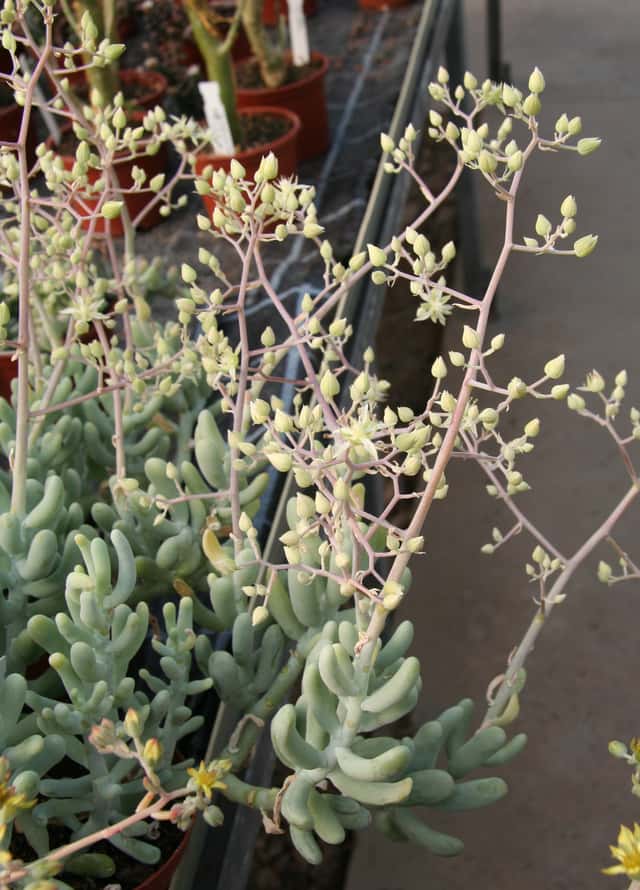
Ghost Sedum (Sedum allantoides) is a easy-care plant from the Crassulaceae family. Sedum allantoides is a compact succulent in the Crassulaceae family, native to Mexico (Oaxaca). Its fleshy, cylindrical leaves are coated in a white powdery bloom (pruina), giving it a ghostly appearance. In summer it produces small star-shaped greenish-white flowers.
Ghost Sedum grows up to 20cm, spread of 30cm, watering every 14 days, 5°C – 28°C, 20–40% humidity. It is suitable for indoor environments and safe for pets.
Unlike many tropical plants, Ghost Sedum tolerates watering mistakes. Best for beginners. Unlike many popular species, Ghost Sedum is safe to keep around pets. Without adequate drainage, root rot can develop within 28 days.
How to Care for Ghost Sedum?
TLDR: Ghost Sedum needs Direct sun, watering every 14 days, and temperatures between 5-28°C with 20-40% humidity.
How Often Should You Water Ghost Sedum?
Water every 10–14 days, only when the soil is completely dry. Avoid getting water on the leaves or stem to prevent rot.
How Much Light Does Ghost Sedum Need?
Needs at least 6 hours of direct sunlight daily. Place near a bright south-facing window or grow outdoors in full sun.
What Is the Best Soil for Ghost Sedum?
Use a cactus or succulent mix with added perlite or coarse sand for fast drainage. Ideal pH 6.0–7.0.
What Pot Should You Use for Ghost Sedum?
Terracotta or unglazed ceramic pot with drainage hole. Avoid oversized containers.
Care Schedule
Fertilize
Every 30 days
Repot
Every 730 days
What Is Ghost Sedum and Where Does It Come From?
Sedum allantoides is a compact succulent in the Crassulaceae family, native to Mexico (Oaxaca). Its fleshy, cylindrical leaves are coated in a white powdery bloom (pruina), giving it a ghostly appearance. In summer it produces small star-shaped greenish-white flowers.
How Big Does Ghost Sedum Grow?
TLDR: Ghost Sedum can reach up to 20cm tall with Slow growth rate.
Max height
20cm
Spread
30cm
Growth rate
Slow
Foliage
Evergreen
Plant Uses
Ornamental
Great for decoration
Is your plant showing symptoms?
Click on the symptom to discover possible causes:
What Diseases Commonly Affect Ghost Sedum?
TLDR: Ghost Sedum is susceptible to 7 known diseases. Monitor regularly for early detection.
Root Rot
Root rot is a serious fungal disease that affects the root system of plants, causing them to decay and die. It is primarily caused by overwatering, poor drainage, or soil-borne fungi such as Pythium, Phytophthora, Rhizoctonia, and Fusarium. The disease thrives in waterlogged conditions where roots are deprived of oxygen, making them susceptible to fungal infection.
Crown Rot
Crown rot is a serious fungal disease that attacks the crown (base) of the plant where the stem meets the soil. It is caused by various fungal pathogens including Phytophthora, Fusarium, and Rhizoctonia. The disease thrives in waterlogged conditions and can quickly spread to kill the entire plant if not addressed promptly.
Powdery Mildew
Powdery mildew is a common fungal disease caused by various fungi species including Erysiphe, Podosphaera, Oïdium, and Leveillula. It affects over 10,000 plant species worldwide. The disease thrives in warm, dry climates with high humidity and appears as a distinctive white powdery coating on plant surfaces.
Gray Mold (Botrytis Blight)
Gray mold, caused by the fungus Botrytis cinerea, is a widespread necrotrophic pathogen affecting over 1,400 plant species. It thrives in cool, humid conditions and attacks weakened or aging plant tissues, causing soft rot and characteristic gray fuzzy growth.
Fun Facts
The white coating on its leaves is called pruina and acts as natural sunscreen.
Its star-shaped green flowers bloom in summer on terminal racemes.
Native to Oaxaca, Mexico, where it grows in rocky, arid environments.
Compare with similar plants
| Attribute | Difficulty | Light | Watering | Pet Safe |
|---|---|---|---|---|
| Field Maple | Easy | Bright indirect | 14d | ✓ |
| Silver Birch | Easy | Direct sun | 14d | ✓ |
| Cushion Bush | Easy | Direct sun | 14d | ✓ |
| Peruvian peppertree | Easy | Direct sun | 14d | ⚠️ |