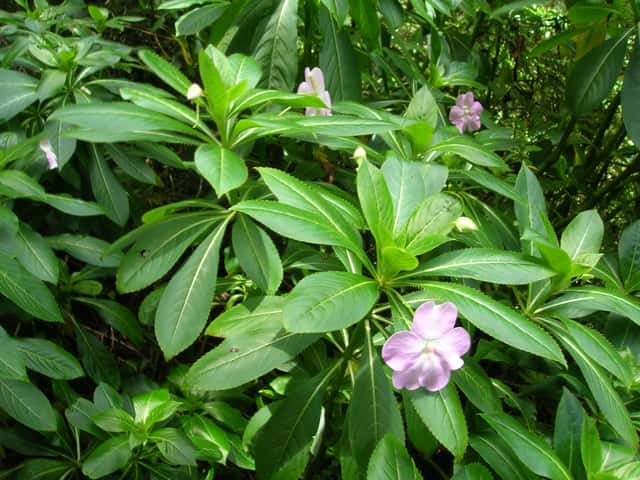
Balsaminaceae
Poor Man's Rhododendron – Impatiens sodenii
Impatiens sodenii
Keep soil consistently moist but well-drained. Prefers bright indirect light and temperatures between 10–27°C (50–80°F). Fertilize every 6 weeks during the growing season and prune regularly to encourage bushy growth.
Every 7 days
Partial shade
10° - 27°C
60% - 85%
Categories
What is Poor Man's Rhododendron?
Poor Man's Rhododendron (Impatiens sodenii) is a medium-care plant from the Balsaminaceae family. Impatiens sodenii, commonly known as Poor Man's Rhododendron, is a perennial subshrub native to Kenya and Tanzania. It grows up to 2.5 meters tall with whorled leaves and produces pink or white flowers year-round. It has received the Royal Horticultural Society's Award of Garden Merit and is widely...
Poor Man's Rhododendron grows up to 2.5m, spread of 55cm, watering every 7 days, 10°C – 27°C, 60–85% humidity. It is suitable for indoor environments and safe for pets.
Unlike many popular species, Poor Man's Rhododendron is safe to keep around pets. Without adequate drainage, root rot can develop within 14 days.
How to Care for Poor Man's Rhododendron?
TLDR: Poor Man's Rhododendron needs Partial shade, watering every 7 days, and temperatures between 10-27°C with 60-85% humidity.
How Often Should You Water Poor Man's Rhododendron?
Water every 7 days, keeping soil evenly moist but never waterlogged. Check soil moisture more frequently during hot weather.
How Much Light Does Poor Man's Rhododendron Need?
Place in bright indirect light or partial shade. Avoid intense direct sunlight which can scorch leaves.
What Is the Best Soil for Poor Man's Rhododendron?
Use a loamy, organically rich, well-draining soil mix. Ideal pH is between 4.5 and 6.5.
Care Schedule
Fertilize
Every 42 days
Repot
Every 548 days
What Is Poor Man's Rhododendron and Where Does It Come From?
Impatiens sodenii, commonly known as Poor Man's Rhododendron, is a perennial subshrub native to Kenya and Tanzania. It grows up to 2.5 meters tall with whorled leaves and produces pink or white flowers year-round. It has received the Royal Horticultural Society's Award of Garden Merit and is widely cultivated as an ornamental plant in tropical and subtropical gardens.
How Big Does Poor Man's Rhododendron Grow?
TLDR: Poor Man's Rhododendron can reach up to 2.5m tall with Medium growth rate.
Max height
2.5m
Spread
55cm
Growth rate
Medium
Foliage
Evergreen
Plant Uses
Ornamental
Great for decoration
Is your plant showing symptoms?
Click on the symptom to discover possible causes:
What Diseases Commonly Affect Poor Man's Rhododendron?
TLDR: Poor Man's Rhododendron is susceptible to 10 known diseases. Monitor regularly for early detection.
Downy Mildew
Downy mildew is a fungal-like disease caused by oomycetes (water molds) that thrives in cool, wet conditions. It affects a wide range of plants, causing yellowing leaves with fuzzy white-gray growth underneath, leading to defoliation and reduced yields if left untreated.
Thrips
Thrips are tiny cigar-shaped insects (1/25-inch long) that damage plants by sucking plant juices and scraping at fruits, flowers, and leaves. With over 6,000 species and rapid reproduction (lifecycle as short as 14 days), they can quickly infest plants and transmit viruses like tomato spotted wilt virus.
Root Rot
Root rot is a serious fungal disease that affects the root system of plants, causing them to decay and die. It is primarily caused by overwatering, poor drainage, or soil-borne fungi such as Pythium, Phytophthora, Rhizoctonia, and Fusarium. The disease thrives in waterlogged conditions where roots are deprived of oxygen, making them susceptible to fungal infection.
Gray Mold (Botrytis Blight)
Gray mold, caused by the fungus Botrytis cinerea, is one of the most common fungal diseases in plants. It affects over 200 plant species, including ornamentals, vegetables, fruits, and houseplants. The disease thrives in cool, humid conditions with poor air circulation, causing grayish spots and soft rot on infected tissues.
Fun Facts
Blooms year-round, making it one of the few shrubs with continuous flowering.
Native to Kenya and Tanzania, it has earned the Royal Horticultural Society Award of Garden Merit.
Its seed pods explode on touch when ripe, dispersing seeds — hence the name Touch-Me-Not.
Frequently asked questions
How often should I water Poor Man's Rhododendron?
Is Impatiens sodenii toxic to pets?
Can I grow it indoors?
Compare with similar plants
| Attribute | Difficulty | Light | Watering | Pet Safe |
|---|---|---|---|---|
| Dark Fieldcap | Medium | Low light | 2d | ⚠️ |
| Azalea | Medium | Partial shade | 3d | ⚠️ |
| Bougainvillea | Medium | Direct sun | 7d | ⚠️ |
| Wild Lettuce | Medium | Direct sun | 7d | ⚠️ |



