Brassicaceae
Garlic Mustard: Ground Cover Plant
Alliaria petiolata
Garlic mustard is a low-maintenance, undemanding wild plant that prefers semi-shaded to shaded locations with nutrient-rich, moist soil. It is very frost-hardy (down to -23 °C), requires regular watering during dry spells, and spreads quickly through self-seeding. Once established, it requires very little additional care.
Every 7 days
Low light
-23° - 30°C
50% - 80%
Categories
What is Garlic Mustard?
Garlic Mustard (Alliaria petiolata) is a easy-care plant from the Brassicaceae family. Garlic mustard (Alliaria petiolata) is a biennial herbaceous plant in the mustard family (Brassicaceae), widely distributed across Central and Northern Europe as well as parts of Asia. In its first year, it forms a basal rosette of heart-shaped, deeply toothed leaves, while in its second year, it se...
Garlic Mustard grows up to 1.0m, spread of 50cm, watering every 7 days, -23°C – 30°C, 50–80% humidity. It is not suitable for indoor environments and safe for pets.
Unlike many tropical plants, Garlic Mustard tolerates watering mistakes. Best for beginners. Unlike many popular species, Garlic Mustard is safe to keep around pets.
How to Care for Garlic Mustard?
TLDR: Garlic Mustard needs Low light, watering every 7 days, and temperatures between -23-30°C with 50-80% humidity.
How Often Should You Water Garlic Mustard?
Keep the soil evenly moist, but strictly avoid waterlogging. During hot summer weeks, daily watering may be necessary. In the garden, natural rainfall is usually sufficient, except during prolonged dry periods.
How Much Light Does Garlic Mustard Need?
Semi-shaded to shaded locations are ideal—garlic mustard thrives best under light tree canopies or on north-facing slopes. It does not tolerate direct midday sun well and should be avoided.
What Is the Best Soil for Garlic Mustard?
Nutrient-rich, humus-rich, and slightly loamy soil with good moisture retention is optimal. The plant tolerates pH values from 6.0 to 8.0. Container cultivation works well with standard potting soil, as specialized herb soils are often too dry.
What Pot Should You Use for Garlic Mustard?
Medium-sized clay pots or containers with good drainage are suitable for pot culture. North- and east-facing locations on balconies or terraces are ideal. The soil should be kept regularly moist.
What Is Garlic Mustard and Where Does It Come From?
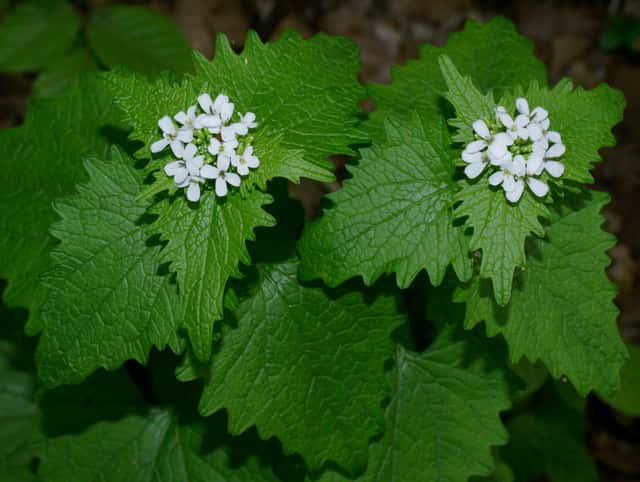
Garlic mustard (Alliaria petiolata) is a biennial herbaceous plant in the mustard family (Brassicaceae), widely distributed across Central and Northern Europe as well as parts of Asia. In its first year, it forms a basal rosette of heart-shaped, deeply toothed leaves, while in its second year, it sends up a 60–100 cm tall stem with white, four-petaled flowers. Its distinctive feature is the intense garlic scent released when the leaves are crushed, which is due to the presence of glucosinolates. The plant inhabits open deciduous forests, road and forest edges, and slopes, and is known as an invasive species in North America. It is an important host plant for the Orange-tip butterfly (Anthocharis cardamines) and its caterpillars.
How to Propagate Garlic Mustard?
How Big Does Garlic Mustard Grow?
TLDR: Garlic Mustard can reach up to 1.0m tall with Fast growth rate.
Max height
1.0m
Spread
50cm
Growth rate
Fast
Foliage
Deciduous
Plant Uses
Edible
Can be consumed
Medicinal
Medicinal properties
Aromatic
Pleasant fragrance
Ground Cover
Soil coverage
Medicinal Uses
- Antibacterial: The glucosinolates it contains have antimicrobial properties
- Expectorant and mucolytic for respiratory congestion
- Diuretic: Supports kidney function
- External: Crushed leaves soothe insect bites and promote wound healing
- Historically used for rheumatism, gout, and gingivitis
- Mouth and throat inflammation: Freshly pressed juice or tea used as a gargle
Culinary Uses
- Young leaves raw in salads, herb butter, quark, or as a pesto base
- Flowers as an edible garnish for salads and cold dishes
- Seeds for making wild herb mustard or as a spice
- First-year roots can be used similarly to horseradish
- Important: Flavors are not optimal when heated—best added raw or after cooking
Is your plant showing symptoms?
Click on the symptom to discover possible causes:
What Diseases Commonly Affect Garlic Mustard?
TLDR: Garlic Mustard is susceptible to 5 known diseases. Monitor regularly for early detection.
Downy Mildew
Downy mildew is a fungal-like disease caused by oomycetes (water molds) that thrives in cool, wet conditions. It affects a wide range of plants, causing yellowing leaves with fuzzy white-gray growth underneath, leading to defoliation and reduced yields if left untreated.
Aphids
Aphids are small, soft-bodied, pear-shaped insects (1/16 to 1/8 inch long) that feed by sucking nutrient-rich sap from plants. They reproduce rapidly and can quickly weaken plants, causing distorted growth and transmitting plant viruses. Aphids come in various colors including green, black, red, yellow, brown, and gray. They secrete honeydew, a sticky substance that attracts ants and encourages sooty mold growth.
Slugs and Snails
Slugs and snails are mollusks that feed on plant tissue, causing irregular holes in leaves and damage to young seedlings. They are most active at night and in moist conditions, leaving characteristic silvery slime trails. These pests can quickly devastate gardens, especially during wet seasons.
Fusarium Wilt
Fusarium wilt is a serious fungal disease caused by the soil-borne fungus Fusarium oxysporum. The fungus invades roots and blocks the water-conducting vessels (xylem) of the plant, causing progressive wilting and eventual death. Host-specific forms of the pathogen exist that attack different plant species.
Meaning & Symbolism
In European folklore, garlic mustard represented purification and protection; its antibacterial properties have been considered healing since the Middle Ages.
Compare with similar plants
| Attribute | Difficulty | Light | Watering | Pet Safe |
|---|---|---|---|---|
| Field Maple | Easy | Bright indirect | 14d | ✓ |
| Silver Birch | Easy | Direct sun | 14d | ✓ |
| Cushion Bush | Easy | Direct sun | 14d | ✓ |
| Peruvian peppertree | Easy | Direct sun | 14d | ⚠️ |