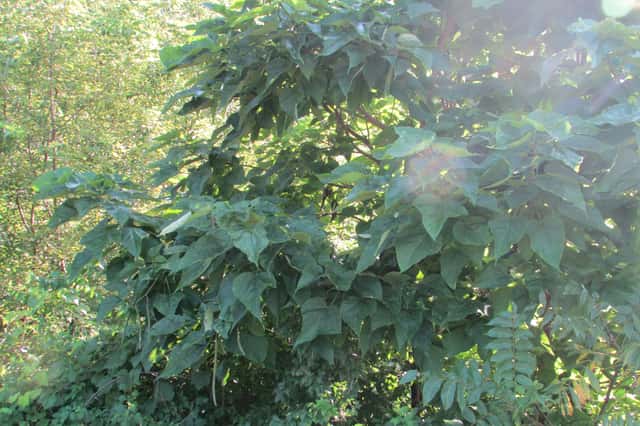
Bignoniaceae
Northern Catalpa (Catalpa speciosa)
Catalpa speciosa
Low-maintenance outdoor tree best suited for large open spaces. Thrives in full sun and tolerates a wide range of soils including clay, wet, and dry conditions. Young trees need regular watering; established trees are drought tolerant. Prune annually in late winter to maintain desired shape. Fertilize in early spring with a balanced slow-release fertilizer.
Every 7 days
Direct sun
-29° - 38°C
30% - 70%
Categories
What is Northern Catalpa?
Northern Catalpa (Catalpa speciosa) is a easy-care plant from the Bignoniaceae family. Northern Catalpa (Catalpa speciosa) is a large, fast-growing deciduous tree native to the central eastern United States. It is renowned for its showy white bell-shaped flowers with purple and yellow markings in late spring, and its distinctive long cigar-shaped seedpods that persist through winter....
Northern Catalpa grows up to 21.0m, spread of 1500cm, watering every 7 days, -29°C – 38°C, 30–70% humidity. It is not suitable for indoor environments and safe for pets.
Unlike many tropical plants, Northern Catalpa tolerates watering mistakes. Best for beginners. Unlike many popular species, Northern Catalpa is safe to keep around pets.
How to Care for Northern Catalpa?
TLDR: Northern Catalpa needs Direct sun, watering every 7 days, and temperatures between -29-38°C with 30-70% humidity.
How Often Should You Water Northern Catalpa?
Water young trees every 7 days, keeping the soil consistently moist to encourage deep root development. Once established (after 2-3 years), Northern Catalpa is drought tolerant and requires watering only during extended dry spells or extreme heat.
How Much Light Does Northern Catalpa Need?
Requires full sun for best growth and flowering. Tolerates partial shade but flowering may be reduced. Plant in open, spacious locations away from shade from buildings or other large trees.
What Is the Best Soil for Northern Catalpa?
Adapts to a wide variety of soils including clay, sandy, alkaline, and occasionally wet soils. Prefers deep, moist, well-drained loamy soil with a pH of 6.0 to 8.0. Tolerates urban soil compaction well.
What Pot Should You Use for Northern Catalpa?
For container cultivation of young trees: use large terracotta or durable plastic pots with excellent drainage, minimum 50 cm diameter. Northern Catalpa is ultimately a landscape tree best planted in the ground in a large open space.
Care Schedule
Fertilize
Every 90 days
What Is Northern Catalpa and Where Does It Come From?
Northern Catalpa (Catalpa speciosa) is a large, fast-growing deciduous tree native to the central eastern United States. It is renowned for its showy white bell-shaped flowers with purple and yellow markings in late spring, and its distinctive long cigar-shaped seedpods that persist through winter. Widely planted as a shade and ornamental tree in parks, large gardens, and urban streetscapes, it is valued for its adaptability to a wide range of soil and climate conditions.
How to Propagate Northern Catalpa?
Seed Propagation
Fresh seeds germinate most readily. Cold stratification mimics natural winter conditions and significantly improves germination rates.
- 1 Collect mature seedpods in fall and extract seeds
- 2 Cold-stratify seeds for 4-6 weeks in the refrigerator
- 3 Sow in light, moist seed-starting mix at 2 cm depth
- 4 Keep at 20-25°C until germination occurs
- 5 Transplant to larger containers when 4-5 true leaves appear
Materials needed:
Softwood Cutting
Use firm but young stems. Maintain high humidity by covering with a plastic bag for the first two weeks.
- 1 Take 15-20 cm semi-hardwood cuttings with 2-3 buds in spring
- 2 Remove lower leaves and dip the base in rooting hormone powder
- 3 Plant in a mix of coarse sand and perlite
- 4 Keep moist in bright indirect light until rooted
- 5 Transplant to permanent location after rooting is established
Materials needed:
How Big Does Northern Catalpa Grow?
TLDR: Northern Catalpa can reach up to 21.0m tall with Fast growth rate.
Max height
21.0m
Spread
15.0m
Growth rate
Fast
Foliage
Deciduous
Plant Uses
Ornamental
Great for decoration
Medicinal
Medicinal properties
Medicinal Uses
- The bark and leaves contain catalpol, an iridoid glycoside studied for potential anti-inflammatory properties in traditional North American folk medicine
Is your plant showing symptoms?
Click on the symptom to discover possible causes:
What Diseases Commonly Affect Northern Catalpa?
TLDR: Northern Catalpa is susceptible to 8 known diseases. Monitor regularly for early detection.
Leaf Spot
Leaf spot is a common fungal disease caused by various pathogens including Alternaria, Ascochyta, Colletotrichum, Septoria, and Venturia. It primarily affects leaves, causing discolored spots that can lead to premature leaf drop if left untreated.
Powdery Mildew
Powdery mildew is a common fungal disease caused by various fungi species including Erysiphe, Podosphaera, Oïdium, and Leveillula. It affects over 10,000 plant species worldwide. The disease thrives in warm, dry climates with high humidity and appears as a distinctive white powdery coating on plant surfaces.
Anthracnose
Anthracnose is a fungal disease caused by fungi in the genus Colletotrichum that affects many plants, including vegetables, fruits, and trees. The disease thrives in cool, wet conditions, causing dark, sunken lesions on leaves, stems, flowers, and fruits.
Verticillium Wilt
Verticillium wilt is a soil-borne fungal disease caused primarily by the fungi Verticillium dahliae and V. albo-atrum. These pathogens infect plant roots and grow within the vascular tissues, blocking water and nutrient transport, resulting in wilting and eventual plant death. The disease affects over 350 plant species including vegetables, fruits, ornamental flowers, and trees. The fungi can survive in soil for more than 10 years as resistant structures called microsclerotia.
Meaning & Symbolism
Associated with strength, endurance, and generosity. Its broad canopy symbolizes shelter and protection. In Native American and early American settler traditions, the tree was prized for its durable wood used in fence posts and railroad ties.
Fun Facts
The long cigar-shaped seedpods can reach 60 cm in length and cling to the bare branches all winter, providing shelter for birds
Catalpol in the leaves attracts and feeds Catalpa Sphinx Moth caterpillars, which are a prized live fishing bait in the US South
One of few ornamental trees that thrives in both droughty soils and temporarily flooded sites
Its wood is exceptionally rot-resistant and was extensively used for railroad ties and fence posts in 19th-century America
Frequently asked questions
How often should I water Northern Catalpa?
Is Northern Catalpa toxic to pets?
When does Northern Catalpa bloom?
How much space does a Northern Catalpa need?
What are the seedpods used for?
Compare with similar plants
| Attribute | Difficulty | Light | Watering | Pet Safe |
|---|---|---|---|---|
| Field Maple | Easy | Bright indirect | 14d | ✓ |
| Silver Birch | Easy | Direct sun | 14d | ✓ |
| Cushion Bush | Easy | Direct sun | 14d | ✓ |
| Peruvian peppertree | Easy | Direct sun | 14d | ⚠️ |
Choose & Compare
Sources & References
- Northern Catalpa (Catalpa speciosa): A Complete Guide - Gardenia
- Northern Catalpa (Catalpa speciosa) - How to Grow & Care Guide
- Northern Catalpa - UFOR Nursery & Lab, University of Minnesota
- Identify & Treat Hardy Catalpa Tree Diseases - Cultivating Flora
- Catalpa speciosa - Missouri Botanical Garden Plant Finder





