Lamiaceae
How to Grow and Care for Lamb's Ear (Stachys byzantina)
Stachys
Lamb's Ear is an easy-to-grow perennial that thrives on neglect once established. Plant in full sun with well-draining soil and water sparingly — it is highly drought-tolerant. Avoid overhead watering and humid, stagnant conditions to prevent the woolly foliage from rotting. Divide clumps every 2-4 years to maintain vigour and remove flower spikes for a neater display.
Every 14 days
Bright indirect
-20° - 38°C
30% - 55%
Categories
What is Lamb's Ear?
Lamb's Ear (Stachys) is a easy-care plant from the Lamiaceae family. Lamb's Ear (Stachys byzantina) is a low-growing, mat-forming perennial in the mint family (Lamiaceae), celebrated for its striking silvery-white, densely woolly leaves that feel as soft as velvet. Native to Turkey, Armenia, and Iran, this hardy plant thrives in sunny, dry garden borders and is belov...
Lamb's Ear grows up to 45cm, spread of 90cm, watering every 14 days, -20°C – 38°C, 30–55% humidity. It is not suitable for indoor environments and safe for pets.
Unlike many tropical plants, Lamb's Ear tolerates watering mistakes. Best for beginners. Unlike many popular species, Lamb's Ear is safe to keep around pets.
How to Care for Lamb's Ear?
TLDR: Lamb's Ear needs Bright indirect, watering every 14 days, and temperatures between -20-38°C with 30-55% humidity.
How Often Should You Water Lamb's Ear?
Water deeply but infrequently — roughly every 14 days during the growing season, less in winter. Always water at the base to keep the fuzzy leaves dry. Overwatering and soggy soil cause crown rot and foliage collapse. Allow the soil to dry out completely between waterings.
How Much Light Does Lamb's Ear Need?
Lamb's Ear performs best in full sun (at least 6 hours per day). It tolerates light afternoon shade in hot climates, but too much shade reduces foliage density and increases fungal disease risk.
What Is the Best Soil for Lamb's Ear?
Plant in well-draining, lean to moderately fertile soil. Sandy or gravelly soils are ideal. Tolerates pH 6.0–8.0. Amend heavy clay with grit or perlite. Avoid mulching directly over the crown to prevent moisture retention and rot.
What Pot Should You Use for Lamb's Ear?
Terracotta or unglazed ceramic pots are ideal — they allow excellent air circulation and wick away excess moisture. Ensure large drainage holes. Raised stone or gravel troughs also suit Lamb's Ear well.
Care Schedule
Fertilize
Every 60 days
What Is Lamb's Ear and Where Does It Come From?
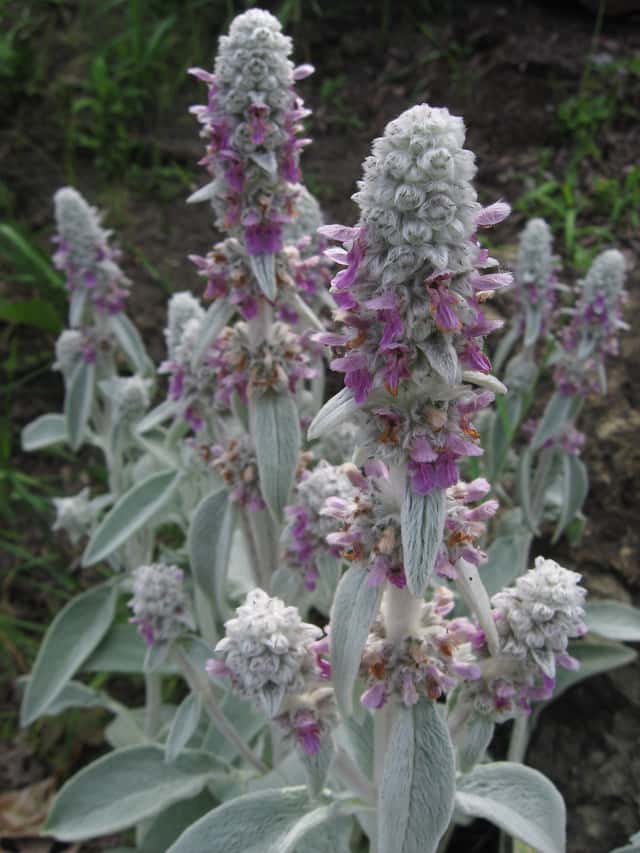
Lamb's Ear (Stachys byzantina) is a low-growing, mat-forming perennial in the mint family (Lamiaceae), celebrated for its striking silvery-white, densely woolly leaves that feel as soft as velvet. Native to Turkey, Armenia, and Iran, this hardy plant thrives in sunny, dry garden borders and is beloved in cottage gardens, sensory gardens, and water-wise landscapes. It produces upright spikes of small pink-purple flowers in late spring and summer, though it is primarily grown for its distinctive textured foliage.
How to Propagate Lamb's Ear?
Crown Division
Divide every 2-4 years to prevent the centre from dying out. Spring division gives best establishment before summer heat.
- 1 Dig up an established clump in early spring before new growth begins.
- 2 Use a sharp spade to divide the clump into sections, each with healthy roots and foliage.
- 3 Replant divisions at the same depth in well-draining soil, spacing 30-45 cm apart.
- 4 Water in thoroughly and keep moist for 2 weeks until established.
Materials needed:
How Big Does Lamb's Ear Grow?
TLDR: Lamb's Ear can reach up to 45cm tall with Medium growth rate.
Max height
45cm
Spread
90cm
Growth rate
Medium
Foliage
Semi-evergreen
Plant Uses
Ornamental
Great for decoration
Ground Cover
Soil coverage
Medicinal
Medicinal properties
Medicinal Uses
- Historically used as a natural wound dressing due to soft absorbent leaves with mild antiseptic properties
- Traditional herbalists applied crushed leaves to minor cuts, insect bites, and skin irritations
Is your plant showing symptoms?
Click on the symptom to discover possible causes:
What Diseases Commonly Affect Lamb's Ear?
TLDR: Lamb's Ear is susceptible to 5 known diseases. Monitor regularly for early detection.
Root Rot
Root rot is a serious fungal disease that affects the root system of plants, causing them to decay and die. It is primarily caused by overwatering, poor drainage, or soil-borne fungi such as Pythium, Phytophthora, Rhizoctonia, and Fusarium. The disease thrives in waterlogged conditions where roots are deprived of oxygen, making them susceptible to fungal infection.
Leaf Spot
Leaf spot is a common fungal disease caused by various pathogens including Alternaria, Ascochyta, Colletotrichum, Septoria, and Venturia. It primarily affects leaves, causing discolored spots that can lead to premature leaf drop if left untreated.
Powdery Mildew
Powdery mildew is a common fungal disease caused by various fungi species including Erysiphe, Podosphaera, Oïdium, and Leveillula. It affects over 10,000 plant species worldwide. The disease thrives in warm, dry climates with high humidity and appears as a distinctive white powdery coating on plant surfaces.
Slugs and Snails
Slugs and snails are mollusks that feed on plant tissue, causing irregular holes in leaves and damage to young seedlings. They are most active at night and in moist conditions, leaving characteristic silvery slime trails. These pests can quickly devastate gardens, especially during wet seasons.
Meaning & Symbolism
In garden traditions, Lamb's Ear symbolises gentleness, softness, and maternal care. Its touchably soft leaves have made it a favourite in sensory gardens, representing nurturing touch and comfort.
Fun Facts
The soft woolly leaves were historically used as natural bandages on the battlefield due to their absorbent and mildly antiseptic properties.
Despite the name, Lamb's Ear is native to the Middle East and Caucasus region, not Europe.
It belongs to the mint family (Lamiaceae) alongside lavender, rosemary, and salvia.
It spreads by creeping stems that root as they travel along the ground, forming an effective low-maintenance ground cover.
Frequently asked questions
How often should I water Lamb's Ear?
Why are my Lamb's Ear leaves rotting?
Is Lamb's Ear toxic to cats and dogs?
When does Lamb's Ear flower?
How do I propagate Lamb's Ear?
Compare with similar plants
| Attribute | Difficulty | Light | Watering | Pet Safe |
|---|---|---|---|---|
| Field Maple | Easy | Bright indirect | 14d | ✓ |
| Silver Birch | Easy | Direct sun | 14d | ✓ |
| Cushion Bush | Easy | Direct sun | 14d | ✓ |
| Peruvian peppertree | Easy | Direct sun | 14d | ⚠️ |