Bignoniaceae
Handroanthus (Trumpet Tree): How to Care for Brazil's Symbol Tree
Handroanthus
A full-sun tree that needs well-draining soil. Water regularly during the first years without waterlogging; once established it tolerates drought well. Avoid heavy pruning and intensive fertilization.
Every 10 days
Direct sun
5° - 35°C
40% - 70%
Categories
What is Trumpet Tree?
Trumpet Tree (Handroanthus) is a medium-care plant from the Bignoniaceae family. Handroanthus is a genus of Neotropical flowering trees in the family Bignoniaceae, native to Brazil and other tropical and subtropical regions of the Americas. This genus-level profile covers the group as a whole, including iconic species such as the yellow-flowered Golden Trumpet Tree (Handroanthus...
Trumpet Tree grows up to 30.0m, spread of 1000cm, watering every 10 days, 5°C – 35°C, 40–70% humidity. It is not suitable for indoor environments and safe for pets.
Unlike many popular species, Trumpet Tree is safe to keep around pets.
How to Care for Trumpet Tree?
TLDR: Trumpet Tree needs Direct sun, watering every 10 days, and temperatures between 5-35°C with 40-70% humidity.
How Often Should You Water Trumpet Tree?
Keep soil lightly moist for the first 30 days after planting, watering every 7-10 days. Once established, reduce frequency — Trumpet Trees are drought-tolerant and sensitive to waterlogging, which favors root rot.
How Much Light Does Trumpet Tree Need?
Requires full sun, at least 6 hours of direct sunlight daily, for healthy growth and abundant flowering.
What Is the Best Soil for Trumpet Tree?
Prefers sandy-loam soil, rich in organic matter and well-draining, with pH between 6.0 and 7.0. Avoid compacted or waterlogged soils.
What Pot Should You Use for Trumpet Tree?
Use large containers (20-30L+) with generous drainage holes for young saplings before permanent planting in the ground; not suited for long-term container cultivation due to its tree-sized mature form.
Care Schedule
Fertilize
Every 180 days
What Is Trumpet Tree and Where Does It Come From?
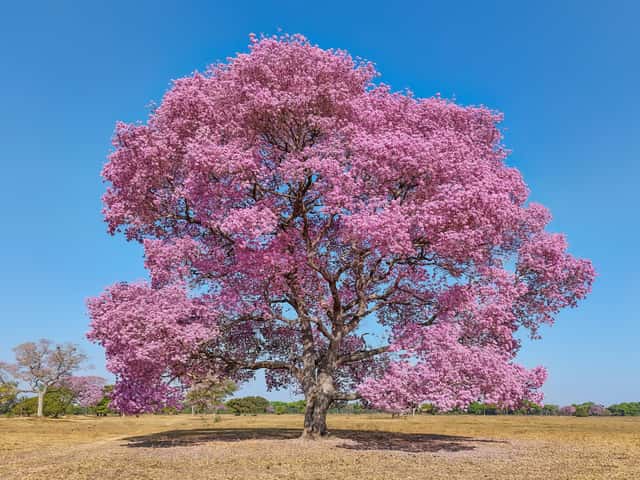
Handroanthus is a genus of Neotropical flowering trees in the family Bignoniaceae, native to Brazil and other tropical and subtropical regions of the Americas. This genus-level profile covers the group as a whole, including iconic species such as the yellow-flowered Golden Trumpet Tree (Handroanthus albus and H. chrysotrichus) and the purple-flowered Pink/Purple Trumpet Tree (H. impetiginosus). Known in Brazil as "Ipê," these deciduous trees produce one of the most spectacular displays in the plant world: a canopy of flowers covering completely leafless branches, typically between late winter and spring.
How to Propagate Trumpet Tree?
Seed propagation
Seeds lose viability quickly; sow as soon as possible after collection. Germination typically occurs within 15-30 days.
- 1 Collect winged seeds soon after dry seed pods open
- 2 Sow in light, well-draining substrate, covering lightly
- 3 Keep consistently moist without waterlogging until germination
- 4 Transplant seedlings to larger pots after 2-3 months
Materials needed:
Semi-hardwood cuttings
Success rate is low compared to seed propagation; rarely used commercially.
- 1 Select healthy semi-hardwood branches
- 2 Apply rooting hormone to the cut base
- 3 Plant in well-draining sandy substrate
- 4 Keep in a shaded, humid environment until rooted
Materials needed:
How Big Does Trumpet Tree Grow?
TLDR: Trumpet Tree can reach up to 30.0m tall with Medium growth rate.
Max height
30.0m
Spread
10.0m
Growth rate
Medium
Foliage
Deciduous
Plant Uses
Ornamental
Great for decoration
Medicinal
Medicinal properties
Medicinal Uses
- Bark (pau d'arco) traditionally used in teas and tinctures by Indigenous peoples and in folk medicine as an anti-inflammatory and immune stimulant
- Popular use as a blood purifier and tonic — scientific efficacy unproven; consult a healthcare professional before medicinal use
Is your plant showing symptoms?
Click on the symptom to discover possible causes:
What Diseases Commonly Affect Trumpet Tree?
TLDR: Trumpet Tree is susceptible to 9 known diseases. Monitor regularly for early detection.
Root Rot
Root rot is a serious fungal disease that affects the root system of plants, causing them to decay and die. It is primarily caused by overwatering, poor drainage, or soil-borne fungi such as Pythium, Phytophthora, Rhizoctonia, and Fusarium. The disease thrives in waterlogged conditions where roots are deprived of oxygen, making them susceptible to fungal infection.
Phytophthora Root Rot
Disease caused by fungus-like organisms (oomycetes) that live in soil and can survive for years. It affects roots, stem, and crown of plants, being especially severe in waterlogged or poorly drained soils. It is the second most common cause of root rot in trees and shrubs.
Powdery Mildew
Powdery mildew is a common fungal disease caused by various fungi species including Erysiphe, Podosphaera, Oïdium, and Leveillula. It affects over 10,000 plant species worldwide. The disease thrives in warm, dry climates with high humidity and appears as a distinctive white powdery coating on plant surfaces.
Anthracnose
Anthracnose is a fungal disease caused by fungi in the genus Colletotrichum that affects many plants, including vegetables, fruits, and trees. The disease thrives in cool, wet conditions, causing dark, sunken lesions on leaves, stems, flowers, and fruits.
Meaning & Symbolism
The Trumpet Tree (Ipê) is one of Brazil's most powerful botanical symbols. The Golden Trumpet Tree was elected Brazil's national tree, and its bloom is associated with the arrival of spring, renewal, and hope — the tree sheds all its leaves before bursting into flower, a display often read as a reminder that beauty can emerge from apparent vulnerability. The Purple Trumpet Tree is linked to spirituality, transformation and protection in popular tradition, and its bark (pau d'arco) has been used for centuries by Indigenous peoples as a restorative remedy. Because each bloom lasts only a few intense days, the Trumpet Tree is also a folk metaphor for impermanence and for seizing life's fleeting moments of beauty.
Fun Facts
The Golden Trumpet Tree is considered Brazil's national tree
Trumpet Tree blooms typically last only a few days but are extremely showy
Handroanthus wood is among the hardest and most durable in the world, used for decking and flooring
The genus was split from Tabebuia in 2007 following botanical reclassification studies
Frequently asked questions
Can Trumpet Trees be grown in pots?
How long does it take for a Trumpet Tree to first flower?
Is the Trumpet Tree toxic to pets?
Why does the Trumpet Tree flower without leaves?
Compare with similar plants
| Attribute | Difficulty | Light | Watering | Pet Safe |
|---|---|---|---|---|
| Dark Fieldcap | Medium | Low light | 2d | ⚠️ |
| Azalea | Medium | Partial shade | 3d | ⚠️ |
| Bougainvillea | Medium | Direct sun | 7d | ⚠️ |
| Wild Lettuce | Medium | Direct sun | 7d | ⚠️ |
Choose & Compare
Sources & References
- Ipe-amarelo - Handroanthus albus - Jardineiro.net
- Como cultivar ipes? - Blog Plantei
- Como Plantar e Cuidar de Pe de Ipe Roxo (Handroanthus impetiginosus)
- Tabebuia Tree: Growing The Flowering Pink Yellow Tree
- Araguaney Plant Care - Greg App
- Ipe (Handroanthus spp.) - Brasil Florestal
- Ipe amarelo cascudo (Handroanthus chrysotrichus)



