Rhamnaceae
Black Ironwood: Medicinal Uses & Care Tips
Krugiodendron ferreum
A robust and low-maintenance tree, ideal for tropical and subtropical gardens. It prefers full sun to partial shade and tolerates prolonged drought once established. It requires well-drained soil, preferably limestone, and does not need frequent watering once established. Suitable only for outdoor cultivation in USDA zones 10a to 11.
Every 14 days
Bright indirect
10° - 38°C
40% - 80%
Categories
What is Black Ironwood?
Black Ironwood (Krugiodendron ferreum) is a medium-care plant from the Rhamnaceae family. Black Ironwood (Krugiodendron ferreum) is a tree native to South Florida, the Caribbean, and Central America, belonging to the Rhamnaceae family. Famous for having the densest wood in the Americas—with a density of up to 1.42 g/cm³, so heavy that it sinks in water—it is a slow-growing and extremely...
Black Ironwood grows up to 10.0m, spread of 800cm, watering every 14 days, 10°C – 38°C, 40–80% humidity. It is not suitable for indoor environments and safe for pets.
Unlike many popular species, Black Ironwood is safe to keep around pets.
How to Care for Black Ironwood?
TLDR: Black Ironwood needs Bright indirect, watering every 14 days, and temperatures between 10-38°C with 40-80% humidity.
How Often Should You Water Black Ironwood?
Water every 14 days during initial establishment. Once well-rooted, the plant is highly drought-tolerant and rarely needs supplemental irrigation. Avoid waterlogging—roots in permanently wet soil rot easily.
How Much Light Does Black Ironwood Need?
Prefers full sun (more than 6 hours of direct light per day) for optimal development. Tolerates partial shade, but growth is even slower and the canopy less dense. It is not suitable for indoor cultivation.
What Is the Best Soil for Black Ironwood?
Thrives in well-drained soils, including sand, limestone, and rocky substrate. It adapts to slightly acidic to alkaline pH (6.0–8.0). Avoid heavy clay soils or those with poor drainage. The preference for limestone substrate reflects its natural habitat in the rocky forests of the Caribbean and Florida.
Care Schedule
Fertilize
Every 42 days
What Is Black Ironwood and Where Does It Come From?
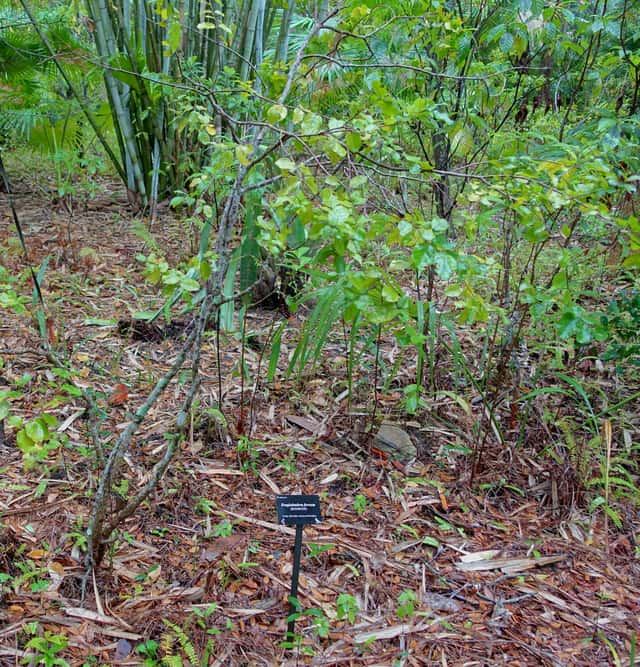
Black Ironwood (Krugiodendron ferreum) is a tree native to South Florida, the Caribbean, and Central America, belonging to the Rhamnaceae family. Famous for having the densest wood in the Americas—with a density of up to 1.42 g/cm³, so heavy that it sinks in water—it is a slow-growing and extremely long-lived species. It features opposite, leathery, oval leaves with an emarginate apex, persisting on the branches for two to three years. The flowers are small, greenish, and inconspicuous; the fruits are dark purple drupes, favored by birds and wild mammals. It grows in rocky limestone environments, dry forests, and coastal hammocks, tolerating intense drought, salt spray, and hurricane-force winds.
How to Propagate Black Ironwood?
How Big Does Black Ironwood Grow?
TLDR: Black Ironwood can reach up to 10.0m tall with Slow growth rate.
Max height
10.0m
Spread
8.0m
Growth rate
Slow
Foliage
Evergreen
Plant Uses
Ornamental
Great for decoration
Medicinal
Medicinal properties
Medicinal Uses
- Teas prepared with the bark are used in Caribbean folk medicine as a general strengthening tonic
- Ethnobotanical use reported for back pain relief
- Used in mouthwashes for oral cavity infections
Culinary Uses
- The ripe fruits (dark purple drupes) are edible and consumed fresh
- Favored by wildlife, especially birds
Is your plant showing symptoms?
Click on the symptom to discover possible causes:
What Diseases Commonly Affect Black Ironwood?
TLDR: Black Ironwood is susceptible to 8 known diseases. Monitor regularly for early detection.
Scale Insects
Scale insects are small sap-sucking pests that appear as brown, shell-like bumps on plant stems and leaves. There are over 25 species, divided into armored (hard) and unarmored (soft) scales. They feed by piercing plant tissue and extracting sap, which weakens the plant and can lead to yellowing, stunted growth, and even death if left untreated. They also excrete honeydew, which attracts ants and promotes sooty mold growth.
Caterpillars
Caterpillars are the larval stage of moths and butterflies that feed voraciously on plant foliage, stems, flowers, and fruits. Common species include cabbage loopers, tomato hornworms, armyworms, and cutworms. These pests can cause extensive damage by consuming large amounts of plant tissue in a short time. They vary in size from small (1/4 inch) to large (5 inches), with colors ranging from green to brown, often featuring stripes or spots. Caterpillars are highly mobile and can quickly spread throughout gardens, making them one of the most destructive common pests.
Root Rot
Root rot is a serious fungal disease that affects the root system of plants, causing them to decay and die. It is primarily caused by overwatering, poor drainage, or soil-borne fungi such as Pythium, Phytophthora, Rhizoctonia, and Fusarium. The disease thrives in waterlogged conditions where roots are deprived of oxygen, making them susceptible to fungal infection.
Anthracnose
Anthracnose is a fungal disease caused by fungi in the genus Colletotrichum that affects many plants, including vegetables, fruits, and trees. The disease thrives in cool, wet conditions, causing dark, sunken lesions on leaves, stems, flowers, and fruits.
Meaning & Symbolism
The extraordinary density of its wood—the heaviest in the Americas—makes the Black Ironwood a symbol of strength, resilience, and permanence. In Caribbean cultures, it is associated with durability and the ability to withstand the forces of nature.
Compare with similar plants
| Attribute | Difficulty | Light | Watering | Pet Safe |
|---|---|---|---|---|
| Azalea | Medium | Partial shade | 3d | ⚠️ |
| Wild Lettuce | Medium | Direct sun | 7d | ⚠️ |
| Cape Primrose | Medium | Partial shade | 7d | ✓ |
| Honey Locust | Medium | Direct sun | 14d | ✓ |