Apocynaceae
Purple Allamanda: Complete Care Guide
Allamanda blanchetii
Grow in full sun, water when the topsoil dries out (about once a week), use fertile, well-draining soil, and fertilize monthly during spring and summer. Protect from frost and cold drafts.
Every 7 days
Bright indirect
15° - 32°C
50% - 70%
Categories
What is Purple Allamanda?
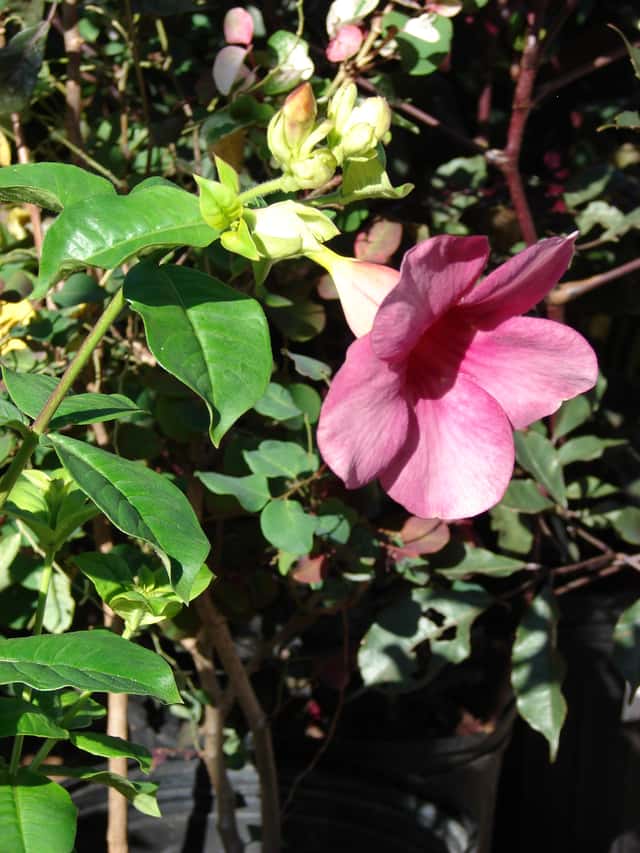
Purple Allamanda (Allamanda blanchetii) is a medium-care plant from the Apocynaceae family. Purple Allamanda (Allamanda blanchetii) is a woody, semi-climbing tropical shrub in the Apocynaceae family, native to Bahia, Brazil. It produces large, trumpet-shaped flowers in shades of reddish-purple to lavender-pink with a contrasting yellow throat, blooming profusely from spring through fall. T...
Purple Allamanda grows up to 4.0m, spread of 250cm, watering every 7 days, 15°C – 32°C, 50–70% humidity. It is not suitable for indoor environments and not safe for pets.
Without precautions, ingestion can cause irritation in pets. Keep out of reach of cats and dogs.
How to Care for Purple Allamanda?
TLDR: Purple Allamanda needs Bright indirect, watering every 7 days, and temperatures between 15-32°C with 50-70% humidity.
How Often Should You Water Purple Allamanda?
Water deeply and allow the topsoil to dry between waterings; avoid soggy soil to prevent root rot.
How Much Light Does Purple Allamanda Need?
Prefers full sun (6+ hours daily); tolerates light partial shade but flowers less.
What Is the Best Soil for Purple Allamanda?
Fertile, light, well-draining soil rich in organic matter; slightly acidic to neutral pH (6.0-7.5).
What Pot Should You Use for Purple Allamanda?
Large terracotta or ceramic pot with drainage holes, ideal for training on a trellis
Care Schedule
Fertilize
Every 30 days
Repot
Every 730 days
What Is Purple Allamanda and Where Does It Come From?
Purple Allamanda (Allamanda blanchetii) is a woody, semi-climbing tropical shrub in the Apocynaceae family, native to Bahia, Brazil. It produces large, trumpet-shaped flowers in shades of reddish-purple to lavender-pink with a contrasting yellow throat, blooming profusely from spring through fall. The velvety, elliptical leaves are arranged in whorls along flexible stems that can be trained on a trellis or pruned into a compact shrub. It is a moderately fast-growing tropical plant that demands full sun and warmth, and is sensitive to frost. The entire plant, especially its milky sap, is toxic and a skin irritant, so gloves should be worn when handling or pruning.
How to Propagate Purple Allamanda?
Stem cutting
Use rooting hormone to speed up the process. Keep the substrate moist but not waterlogged and cover with a plastic bag to retain humidity.
- 1 Cut a 15-20 cm semi-hardwood stem with at least 2 nodes
- 2 Remove leaves from the lower half of the cutting
- 3 Wear gloves, as the sap is irritating
- 4 Plant in a moist sand and peat mix
- 5 Keep warm, humid, and in indirect light until roots form
Materials needed:
Seed propagation
Germination is slow and irregular; less reliable than stem cuttings.
- 1 Collect seeds from mature seed pods
- 2 Sow in light, moist substrate
- 3 Keep in a warm environment (25-30°C) with indirect light
Materials needed:
How Big Does Purple Allamanda Grow?
TLDR: Purple Allamanda can reach up to 4.0m tall with Medium growth rate.
Max height
4.0m
Spread
2.5m
Growth rate
Medium
Foliage
Evergreen
Warning: Toxic Plant
This plant can be toxic if ingested. Keep out of reach of:
Plant Uses
Ornamental
Great for decoration
Is your plant showing symptoms?
Click on the symptom to discover possible causes:
What Diseases Commonly Affect Purple Allamanda?
TLDR: Purple Allamanda is susceptible to 13 known diseases. Monitor regularly for early detection.
Anthracnose
Anthracnose is a fungal disease caused by fungi in the genus Colletotrichum that affects many plants, including vegetables, fruits, and trees. The disease thrives in cool, wet conditions, causing dark, sunken lesions on leaves, stems, flowers, and fruits.
Bacterial Leaf Spot
Bacterial leaf spot is a plant disease caused by bacteria in the Xanthomonas and Pseudomonas genera that affects various ornamental and edible plants. The bacteria infect leaves through wounds or natural openings, causing characteristic lesions that can lead to premature leaf drop and plant weakening.
Root Rot
Root rot is a serious fungal disease that affects the root system of plants, causing them to decay and die. It is primarily caused by overwatering, poor drainage, or soil-borne fungi such as Pythium, Phytophthora, Rhizoctonia, and Fusarium. The disease thrives in waterlogged conditions where roots are deprived of oxygen, making them susceptible to fungal infection.
Powdery Mildew
Powdery mildew is a common fungal disease caused by various fungi species including Erysiphe, Podosphaera, Oïdium, and Leveillula. It affects over 10,000 plant species worldwide. The disease thrives in warm, dry climates with high humidity and appears as a distinctive white powdery coating on plant surfaces.
Meaning & Symbolism
Symbolizes tropical vitality and exotic beauty; a striking accent in warm-climate gardens.
Fun Facts
The milky sap has traditionally been used as a purgative, but this use is discouraged due to its toxicity.
Flowers can reach up to 10 cm across, with a striking yellow throat.
It is native to Bahia, Brazil, and belongs to the same family as periwinkle and oleander.
Frequently asked questions
Is Purple Allamanda toxic?
How often should I water Purple Allamanda?
What is the best way to propagate Purple Allamanda?
Is Purple Allamanda cold hardy?
Compare with similar plants
| Attribute | Difficulty | Light | Watering | Pet Safe |
|---|---|---|---|---|
| Dark Fieldcap | Medium | Low light | 2d | ⚠️ |
| Azalea | Medium | Partial shade | 3d | ⚠️ |
| Bougainvillea | Medium | Direct sun | 7d | ⚠️ |
| Wild Lettuce | Medium | Direct sun | 7d | ⚠️ |
Choose & Compare
Sources & References
- FPS 32/FP032: Allamanda blanchetii: Purple Allamanda - Ask IFAS
- Purple allamanda (Allamanda blanchetii) Care Guide - ForwardPlant
- Alamanda-roxa (Allamanda blanchetti) - Terracota Jardinagem
- Como Cultivar e Cuidar de Alamanda-roxa - PictureThis
- Allamanda blanchetii (Purple Allamanda) - Gardenia.net
- Allamanda blanchetii (purple allamanda) - CABI Compendium




