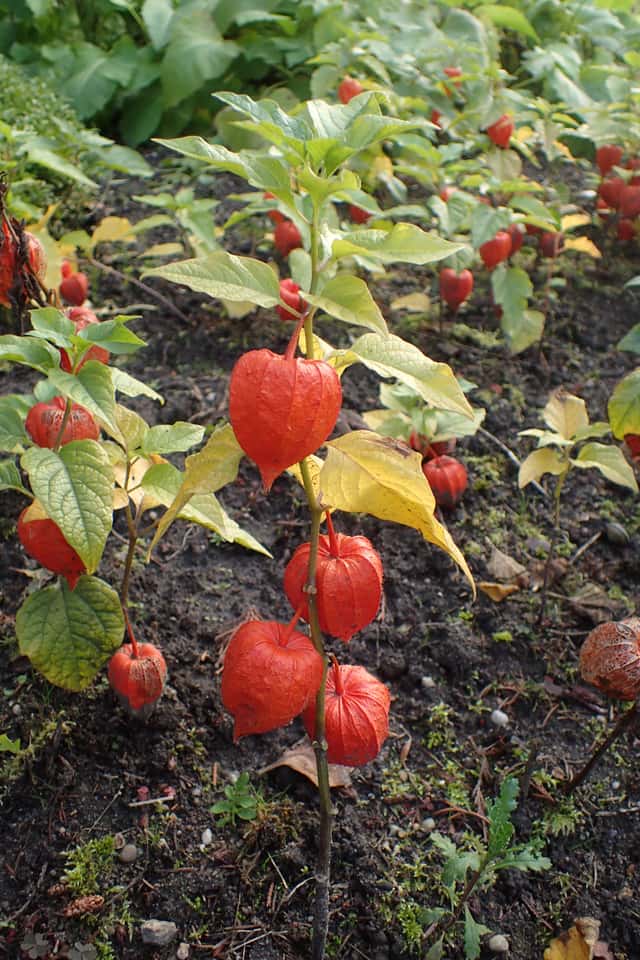
Solanaceae
Chinese lantern: Medicinal Uses & Care Tips
Alkekengi officinarum
Easy, cold-hardy perennial that thrives in full sun to light shade and average, well-drained soil; water regularly while establishing, then let the soil dry between waterings.
Every 7 days
Partial shade
-23° - 30°C
40% - 60%
Categories
What is Chinese lantern?
Chinese lantern (Alkekengi officinarum) is a easy-care plant from the Solanaceae family. Chinese lantern is a spreading, rhizomatous herbaceous perennial in the nightshade family, grown for its papery calyces that inflate into bright orange "lanterns" around an edible berry in late summer and autumn. Native to Asia and southeastern Europe, it naturalizes readily and is a favorite for dr...
Chinese lantern grows up to 1.0m, spread of 100cm, watering every 7 days, -23°C – 30°C, 40–60% humidity. It is not suitable for indoor environments and not safe for pets.
Unlike many tropical plants, Chinese lantern tolerates watering mistakes. Best for beginners. Without precautions, ingestion can cause irritation in pets. Keep out of reach of cats and dogs.
How to Care for Chinese lantern?
TLDR: Chinese lantern needs Partial shade, watering every 7 days, and temperatures between -23-30°C with 40-60% humidity.
How Often Should You Water Chinese lantern?
Keep soil evenly moist the first season; established plants are quite drought-tolerant and only need supplemental water during prolonged dry spells.
How Much Light Does Chinese lantern Need?
Best lantern color and fruit set come with at least half a day of direct sun; it also tolerates light or dappled shade.
What Is the Best Soil for Chinese lantern?
Grows in almost any well-drained soil - sandy, loamy or chalky - with a near-neutral pH; avoid soggy, waterlogged ground.
What Pot Should You Use for Chinese lantern?
If containerized, use a wide pot with drainage holes, since the rhizomes spread aggressively and benefit from root restriction.
Care Schedule
Fertilize
Every 60 days
What Is Chinese lantern and Where Does It Come From?
Chinese lantern is a spreading, rhizomatous herbaceous perennial in the nightshade family, grown for its papery calyces that inflate into bright orange "lanterns" around an edible berry in late summer and autumn. Native to Asia and southeastern Europe, it naturalizes readily and is a favorite for dried-flower arrangements.
How to Propagate Chinese lantern?
Division
- Divide clumps in early spring before new growth appears
- Each division should include healthy rhizome and at least one growth bud
- 1 Dig up the clump
Lift the dormant clump in early spring, keeping as much root and rhizome intact as possible.
- 2 Separate rhizomes
Cut or pull apart sections of rhizome, each with at least one bud or shoot.
- 3 Replant immediately
Plant divisions at the same depth in well-drained soil and water well.
Materials needed:
Seed sowing
- Sow indoors 6-8 weeks before the last frost for earlier flowering
- Seeds germinate best at 18-21C
- 1 Sow seeds
Sow seeds shallowly in seed trays with moist seed compost.
- 2 Germinate
Keep warm and lightly moist until seedlings emerge, usually within 2-3 weeks.
- 3 Transplant
Move seedlings outdoors after the last frost once hardened off.
Materials needed:
How Big Does Chinese lantern Grow?
TLDR: Chinese lantern can reach up to 1.0m tall with Fast growth rate.
Max height
1.0m
Spread
1.0m
Growth rate
Fast
Foliage
Deciduous
Warning: Toxic Plant
This plant can be toxic if ingested. Keep out of reach of:
Plant Uses
Ornamental
Great for decoration
Medicinal
Medicinal properties
Medicinal Uses
- Traditional Chinese medicine remedy for sore throat and fever
- Used historically as a diuretic and cough remedy
- Source of antioxidant withanolide compounds studied for anti-inflammatory effects
Culinary Uses
- Only the fully ripe, husk-removed berry is eaten, raw or in preserves
- Used in jams, sauces and as a garnish once ripe
Is your plant showing symptoms?
Click on the symptom to discover possible causes:
What Diseases Commonly Affect Chinese lantern?
TLDR: Chinese lantern is susceptible to 1 known diseases. Monitor regularly for early detection.
Meaning & Symbolism
Symbol of prosperity and protection; the glowing lanterns are used in Japan's Obon festival to guide ancestral spirits home.
Compare with similar plants
| Attribute | Difficulty | Light | Watering | Pet Safe |
|---|---|---|---|---|
| Field Maple | Easy | Bright indirect | 14d | ✓ |
| Silver Birch | Easy | Direct sun | 14d | ✓ |
| Cushion Bush | Easy | Direct sun | 14d | ✓ |
| Peruvian peppertree | Easy | Direct sun | 14d | ⚠️ |





