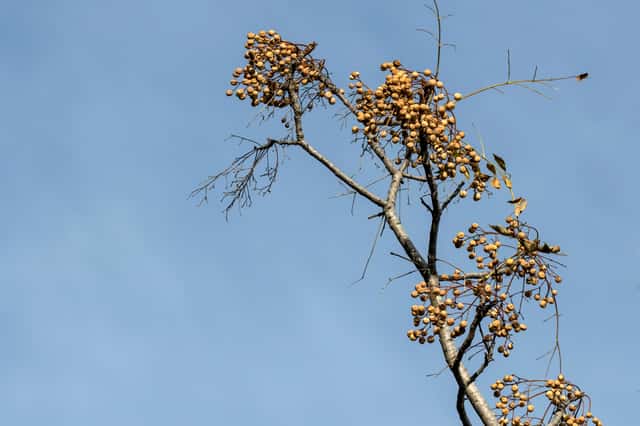
Meliaceae
Chinaberry Tree: Full Sun Plant
Melia azedarach
Plant in full sun with well-drained soil; established trees need very little supplemental water and shrug off heat and neglect. Prune lightly in the dormant season to maintain shape and remove deadwood. Keep berries away from children and animals due to toxicity.
Every 14 days
Direct sun
-5° - 40°C
40% - 60%
Categories
What is Chinaberry Tree?
Chinaberry Tree (Melia azedarach) is a easy-care plant from the Meliaceae family. The Chinaberry tree is a fast-growing deciduous tree prized for its rounded canopy of fern-like leaves and fragrant lavender flower clusters that appear in spring. Native to Asia and Australia but now widely naturalized in warm climates worldwide, it tolerates heat, drought, and poor soils with ease...
Chinaberry Tree grows up to 15.0m, spread of 900cm, watering every 14 days, -5°C – 40°C, 40–60% humidity. It is not suitable for indoor environments and not safe for pets.
Unlike many tropical plants, Chinaberry Tree tolerates watering mistakes. Best for beginners. Without precautions, ingestion can cause irritation in pets. Keep out of reach of cats and dogs.
How to Care for Chinaberry Tree?
TLDR: Chinaberry Tree needs Direct sun, watering every 14 days, and temperatures between -5-40°C with 40-60% humidity.
How Often Should You Water Chinaberry Tree?
Water deeply but infrequently, letting the soil dry out almost completely between waterings; mature trees are drought tolerant and rarely need irrigation once established.
How Much Light Does Chinaberry Tree Need?
Needs full, direct sun for at least 6 hours a day; it will not thrive or flower well in shade.
What Is the Best Soil for Chinaberry Tree?
Tolerates sandy, loamy, or clay soil as long as drainage is good; avoid waterlogged spots since wet roots invite rot.
What Pot Should You Use for Chinaberry Tree?
Not typically grown in pots; best planted directly in open ground with space for its full canopy spread.
Care Schedule
Fertilize
Every 14 days
Misting
Every 3 days
Rotate
Every 7 days
Repot
Every 365 days
What Is Chinaberry Tree and Where Does It Come From?
The Chinaberry tree is a fast-growing deciduous tree prized for its rounded canopy of fern-like leaves and fragrant lavender flower clusters that appear in spring. Native to Asia and Australia but now widely naturalized in warm climates worldwide, it tolerates heat, drought, and poor soils with ease, making it a tough, low-maintenance shade tree. All parts of the tree, especially the yellow berries, are toxic if ingested, so it is best planted away from children and pets.
How to Propagate Chinaberry Tree?
Seed
- Collect ripe berries and clean pulp from seeds before sowing
- Sow in autumn or late winter
- Germination is generally reliable
- 1 Clean seeds
Remove pulp from ripe berries and rinse seeds.
- 2 Sow
Sow in a seed tray or pot with well-drained potting mix, covering lightly.
- 3 Grow on
Keep in a bright, sheltered spot until seedlings are large enough to transplant outdoors.
Materials needed:
Root cutting
- Take root cuttings from a dormant, healthy tree
- Plant cuttings in sandy, well-drained mix
- 1 Take cutting
Cut a section of root from a dormant tree in winter.
- 2 Plant
Insert cutting into sandy potting mix, leaving a small portion exposed.
- 3 Wait
Keep in a warm, sheltered spot until shoots emerge.
Materials needed:
How Big Does Chinaberry Tree Grow?
TLDR: Chinaberry Tree can reach up to 15.0m tall with Fast growth rate.
Max height
15.0m
Spread
9.0m
Growth rate
Fast
Foliage
Deciduous
Warning: Toxic Plant
This plant can be toxic if ingested. Keep out of reach of:
Plant Uses
Ornamental
Great for decoration
Medicinal
Medicinal properties
Medicinal Uses
- Traditionally used as an anthelmintic, antiseptic, and febrifuge in folk medicine
Is your plant showing symptoms?
Click on the symptom to discover possible causes:
What Diseases Commonly Affect Chinaberry Tree?
TLDR: Chinaberry Tree is susceptible to 6 known diseases. Monitor regularly for early detection.
Scale Insects
Scale insects are small sap-sucking pests that appear as brown, shell-like bumps on plant stems and leaves. There are over 25 species, divided into armored (hard) and unarmored (soft) scales. They feed by piercing plant tissue and extracting sap, which weakens the plant and can lead to yellowing, stunted growth, and even death if left untreated. They also excrete honeydew, which attracts ants and promotes sooty mold growth.
Aphids
Aphids are small, soft-bodied, pear-shaped insects (1/16 to 1/8 inch long) that feed by sucking nutrient-rich sap from plants. They reproduce rapidly and can quickly weaken plants, causing distorted growth and transmitting plant viruses. Aphids come in various colors including green, black, red, yellow, brown, and gray. They secrete honeydew, a sticky substance that attracts ants and encourages sooty mold growth.
Caterpillars
Caterpillars are the larval stage of moths and butterflies that feed voraciously on plant foliage, stems, flowers, and fruits. Common species include cabbage loopers, tomato hornworms, armyworms, and cutworms. These pests can cause extensive damage by consuming large amounts of plant tissue in a short time. They vary in size from small (1/4 inch) to large (5 inches), with colors ranging from green to brown, often featuring stripes or spots. Caterpillars are highly mobile and can quickly spread throughout gardens, making them one of the most destructive common pests.
Pseudocercospora
Meaning & Symbolism
Long associated with resilience and humble rural life across Asia, the Chinaberry is also called Pride of India for its showy spring bloom, and its hard seeds have traditionally been strung as rosary beads.
Compare with similar plants
| Attribute | Difficulty | Light | Watering | Pet Safe |
|---|---|---|---|---|
| Field Maple | Easy | Bright indirect | 14d | ✓ |
| Silver Birch | Easy | Direct sun | 14d | ✓ |
| Cushion Bush | Easy | Direct sun | 14d | ✓ |
| Peruvian peppertree | Easy | Direct sun | 14d | ⚠️ |





