Sapindaceae
Golden Rain Tree (Koelreuteria paniculata)
Koelreuteria paniculata
A low-maintenance, drought-tolerant tree once established. Requires full sun and well-drained soil. Regular watering during the first 1-2 years is crucial for root establishment. After that, it needs minimal supplemental watering. Fertilize annually in spring. Prune in late winter to maintain shape and remove dead wood.
Every 14 days
Direct sun
-20° - 38°C
30% - 70%
Categories
What is Golden Rain Tree?
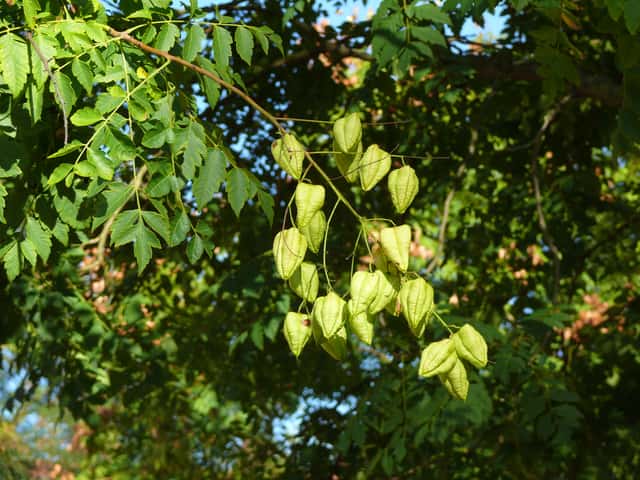
Golden Rain Tree (Koelreuteria paniculata) is a medium-care plant from the Sapindaceae family. Koelreuteria paniculata, commonly known as the Golden Rain Tree, is a deciduous ornamental tree native to China, Korea, and Japan. It is celebrated for its spectacular cascading panicles of bright yellow flowers in midsummer and its distinctive papery, lantern-like seed pods that turn from green to...
Golden Rain Tree grows up to 12.0m, spread of 1200cm, watering every 14 days, -20°C – 38°C, 30–70% humidity. It is not suitable for indoor environments and safe for pets.
Unlike many popular species, Golden Rain Tree is safe to keep around pets.
How to Care for Golden Rain Tree?
TLDR: Golden Rain Tree needs Direct sun, watering every 14 days, and temperatures between -20-38°C with 30-70% humidity.
How Often Should You Water Golden Rain Tree?
Water deeply and regularly during the first two years after planting to encourage deep root development. Once established, the Golden Rain Tree is quite drought-tolerant and only needs supplemental watering during prolonged dry spells in summer. Avoid overwatering, which can lead to root rot.
How Much Light Does Golden Rain Tree Need?
Plant in full sun with at least 6 hours of direct sunlight per day. Full sun is essential for abundant flowering and healthy growth. The tree will tolerate partial shade but flowering will be reduced.
What Is the Best Soil for Golden Rain Tree?
Adaptable to a wide range of soil types including clay, loam, sandy, and even compacted or alkaline soils. Prefers well-drained soil with a pH of 6.0-7.5. Avoid waterlogged conditions to prevent root rot.
What Pot Should You Use for Golden Rain Tree?
Terracotta or large containers suitable for young nursery plants. Not suitable for permanent container growing due to its large size.
Care Schedule
Fertilize
Every 90 days
What Is Golden Rain Tree and Where Does It Come From?
Koelreuteria paniculata, commonly known as the Golden Rain Tree, is a deciduous ornamental tree native to China, Korea, and Japan. It is celebrated for its spectacular cascading panicles of bright yellow flowers in midsummer and its distinctive papery, lantern-like seed pods that turn from green to pinkish-bronze in late summer and persist through winter, providing multi-season interest.
How to Propagate Golden Rain Tree?
Seed Propagation
Scarification is essential as the seed coat is very hard. Cold stratification significantly improves germination rates. Freshly collected seeds may germinate without stratification.
- 1 Collect ripe seeds in autumn and remove the outer capsule
- 2 Scarify seeds by nicking or soaking in hot water for 24 hours to break dormancy
- 3 Cold stratify for 30-60 days in the refrigerator in moist medium
- 4 Sow in spring in well-drained seed-starting mix, covering lightly
- 5 Keep moist and in a bright location until germination occurs
Materials needed:
How Big Does Golden Rain Tree Grow?
TLDR: Golden Rain Tree can reach up to 12.0m tall with Medium growth rate.
Max height
12.0m
Spread
12.0m
Growth rate
Medium
Foliage
Deciduous
Plant Uses
Ornamental
Great for decoration
Is your plant showing symptoms?
Click on the symptom to discover possible causes:
What Diseases Commonly Affect Golden Rain Tree?
TLDR: Golden Rain Tree is susceptible to 6 known diseases. Monitor regularly for early detection.
Root Rot
Root rot is a serious fungal disease that affects the root system of plants, causing them to decay and die. It is primarily caused by overwatering, poor drainage, or soil-borne fungi such as Pythium, Phytophthora, Rhizoctonia, and Fusarium. The disease thrives in waterlogged conditions where roots are deprived of oxygen, making them susceptible to fungal infection.
Aphids
Aphids are small, soft-bodied, pear-shaped insects (1/16 to 1/8 inch long) that feed by sucking nutrient-rich sap from plants. They reproduce rapidly and can quickly weaken plants, causing distorted growth and transmitting plant viruses. Aphids come in various colors including green, black, red, yellow, brown, and gray. They secrete honeydew, a sticky substance that attracts ants and encourages sooty mold growth.
Scale Insects
Scale insects are small sap-sucking pests that appear as brown, shell-like bumps on plant stems and leaves. There are over 25 species, divided into armored (hard) and unarmored (soft) scales. They feed by piercing plant tissue and extracting sap, which weakens the plant and can lead to yellowing, stunted growth, and even death if left untreated. They also excrete honeydew, which attracts ants and promotes sooty mold growth.
Verticillium Wilt
Verticillium wilt is a soil-borne fungal disease caused primarily by the fungi Verticillium dahliae and V. albo-atrum. These pathogens infect plant roots and grow within the vascular tissues, blocking water and nutrient transport, resulting in wilting and eventual plant death. The disease affects over 350 plant species including vegetables, fruits, ornamental flowers, and trees. The fungi can survive in soil for more than 10 years as resistant structures called microsclerotia.
Meaning & Symbolism
In its native China, the Golden Rain Tree is associated with beauty, abundance, and good fortune. Its cascading golden flowers are seen as a symbol of prosperity.
Fun Facts
It produces blooms in midsummer when few other trees flower, making it uniquely valuable for pollinators
The papery lantern-shaped seed pods are ornamentally valuable and persist through winter
It is one of the few trees tolerant of drought, heat, wind, and alkaline soil simultaneously
Considered invasive in parts of the eastern United States and New Zealand due to abundant seed production
Frequently asked questions
How often should I water a Golden Rain Tree?
Is the Golden Rain Tree toxic to pets?
When does the Golden Rain Tree bloom?
How big does a Golden Rain Tree get?
Is the Golden Rain Tree invasive?
Compare with similar plants
| Attribute | Difficulty | Light | Watering | Pet Safe |
|---|---|---|---|---|
| Dark Fieldcap | Medium | Low light | 2d | ⚠️ |
| Azalea | Medium | Partial shade | 3d | ⚠️ |
| Field Maple | Easy | Bright indirect | 14d | ✓ |
| Bougainvillea | Medium | Direct sun | 7d | ⚠️ |




