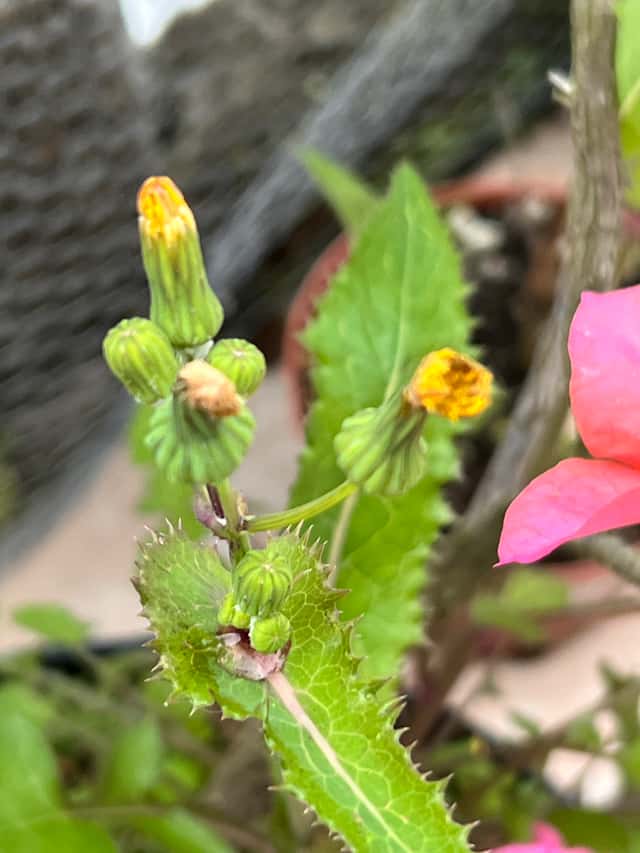
Asteraceae
Sow Thistle: Edible Plant
Sonchus
Grow in full sun with consistently moist, fertile soil. Sow thistles need little intervention -- they self-seed readily and grow fastest in cool, damp conditions. Deadhead before seed-set to stop them spreading uncontrollably in beds or containers.
Every 4 days
Bright indirect
5° - 30°C
40% - 70%
Categories
What is Sow Thistle?
Sow Thistle (Sonchus) is a easy-care plant from the Asteraceae family. Sonchus is a genus of fast-growing annual, biennial and occasionally perennial herbs in the daisy family (Asteraceae), commonly called sow thistles. They form a basal rosette of soft, deeply lobed, spiny-edged leaves and send up hollow, milky-sapped stems topped with small, dandelion-like yellow flo...
Sow Thistle grows up to 1.5m, spread of 45cm, watering every 4 days, 5°C – 30°C, 40–70% humidity. It is not suitable for indoor environments and safe for pets.
Unlike many tropical plants, Sow Thistle tolerates watering mistakes. Best for beginners. Unlike many popular species, Sow Thistle is safe to keep around pets.
How to Care for Sow Thistle?
TLDR: Sow Thistle needs Bright indirect, watering every 4 days, and temperatures between 5-30°C with 40-70% humidity.
How Often Should You Water Sow Thistle?
Keep soil evenly moist; sow thistle wilts quickly in dry soil but recovers fast once watered. Avoid waterlogging in containers.
How Much Light Does Sow Thistle Need?
Needs full sun to grow well -- it will not thrive in shade and becomes leggy with weak flowering in low light.
What Is the Best Soil for Sow Thistle?
Tolerates sandy, loamy or clay soil as long as it is reasonably fertile and retains some moisture; prefers mildly acid to mildly alkaline pH.
What Pot Should You Use for Sow Thistle?
Not typically potted; if containerized, use a wide pot with good drainage and rich, moisture-retentive potting mix.
Care Schedule
Fertilize
Every 14 days
Misting
Every 3 days
Rotate
Every 7 days
Repot
Every 365 days
What Is Sow Thistle and Where Does It Come From?
Sonchus is a genus of fast-growing annual, biennial and occasionally perennial herbs in the daisy family (Asteraceae), commonly called sow thistles. They form a basal rosette of soft, deeply lobed, spiny-edged leaves and send up hollow, milky-sapped stems topped with small, dandelion-like yellow flowerheads. Widespread as a garden and field weed on every continent, sow thistles are edible, fast to establish, and remarkably tolerant of poor soil and disturbance.
How to Propagate Sow Thistle?
Seed Sowing
- Self-seeds freely -- sow directly where plants are wanted
- No pre-treatment needed, germinates readily in cool soil
- 1 Prepare soil
Loosen soil and rake to a fine tilth in a sunny spot.
- 2 Sow seed
Scatter seed thinly on the surface and press in lightly; do not bury deep.
- 3 Keep moist
Water gently until seedlings emerge, usually within 1-2 weeks.
Materials needed:
How Big Does Sow Thistle Grow?
TLDR: Sow Thistle can reach up to 1.5m tall with Fast growth rate.
Max height
1.5m
Spread
45cm
Growth rate
Fast
Foliage
Deciduous
Plant Uses
Edible
Can be consumed
Medicinal
Medicinal properties
Medicinal Uses
- Traditional folk remedy for inflammation and as a mild diuretic; latex sap applied topically to warts
Culinary Uses
- Young leaves eaten raw in salads or cooked as a potherb; peeled stems can be cooked like a mild vegetable
Is your plant showing symptoms?
Click on the symptom to discover possible causes:
What Diseases Commonly Affect Sow Thistle?
TLDR: Sow Thistle is susceptible to 6 known diseases. Monitor regularly for early detection.
Aphids
Aphids are small, soft-bodied, pear-shaped insects (1/16 to 1/8 inch long) that feed by sucking nutrient-rich sap from plants. They reproduce rapidly and can quickly weaken plants, causing distorted growth and transmitting plant viruses. Aphids come in various colors including green, black, red, yellow, brown, and gray. They secrete honeydew, a sticky substance that attracts ants and encourages sooty mold growth.
Whiteflies
Whiteflies are small, soft-bodied, winged insects closely related to aphids and mealybugs. They are moth-like in appearance, about 1/16 inch long, triangular in shape, and gray-white in color. These sap-sucking pests feed on plant tissue, causing yellowing, stunted growth, and wilting. They also excrete honeydew, which attracts ants and promotes sooty mold growth. Whiteflies can transmit serious plant viruses.
Rust
Rust is a common fungal disease caused by fungi in the order Pucciniales that affects a wide variety of plants. The disease gets its name from the characteristic orange, yellow, or reddish-brown pustules that appear on leaves, resembling metal rust. This obligate fungal parasite requires living plants to survive and can cause significant economic losses in agricultural crops.
Powdery Mildew
Powdery mildew is a common fungal disease caused by various fungi species including Erysiphe, Podosphaera, Oïdium, and Leveillula. It affects over 10,000 plant species worldwide. The disease thrives in warm, dry climates with high humidity and appears as a distinctive white powdery coating on plant surfaces.
Meaning & Symbolism
As a plant that colonizes bare, disturbed ground almost anywhere, Sonchus has come to symbolize resilience, abundance and nourishment in folk tradition -- a humble survivor that feeds people, livestock and pollinators alike.
Compare with similar plants
| Attribute | Difficulty | Light | Watering | Pet Safe |
|---|---|---|---|---|
| Field Maple | Easy | Bright indirect | 14d | ✓ |
| Silver Birch | Easy | Direct sun | 14d | ✓ |
| Cushion Bush | Easy | Direct sun | 14d | ✓ |
| Wild Lettuce | Medium | Direct sun | 7d | ⚠️ |





