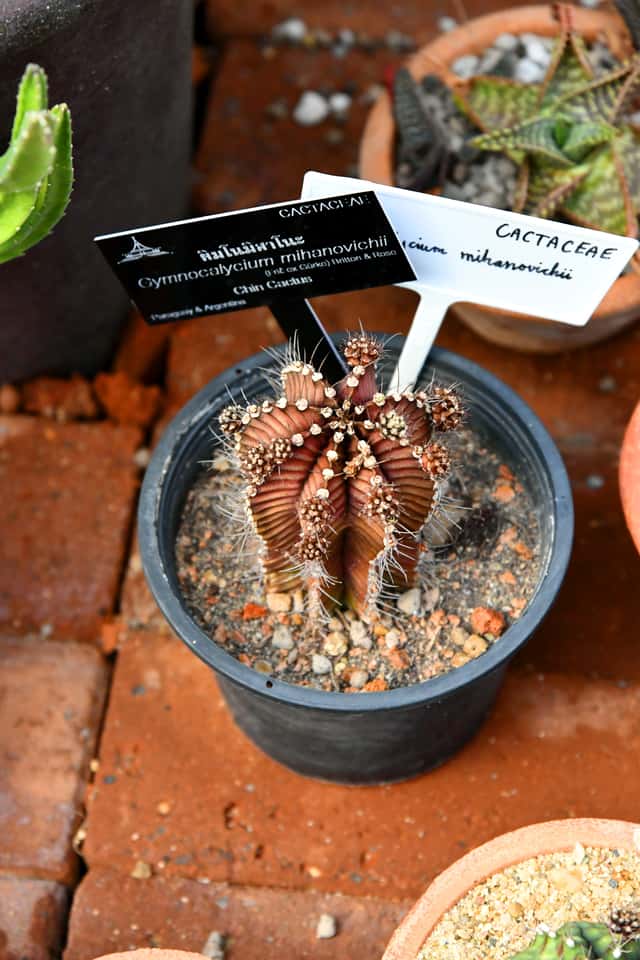
Cactaceae
Moon Cactus: Low Water Needs
Gymnocalycium mihanovichii
Low-maintenance cactus. Bright indirect light, infrequent watering allowing soil to dry completely between waterings. Protect from frost and temperatures below 10°C (50°F). Does not require frequent pruning or rotation.
Every 15 days
Partial shade
10° - 28°C
20% - 40%
Categories
What is Moon Cactus?
Moon Cactus (Gymnocalycium mihanovichii) is a easy-care plant from the Cactaceae family. Gymnocalycium mihanovichii is a small globular cactus native to Paraguay and Argentina. It is famous for its brightly colored varieties (red, orange, yellow, pink) that lack chlorophyll and must be grafted onto another cactus to survive. Natural green forms can grow on their own and produce beautifu...
Moon Cactus grows up to 6cm, spread of 8cm, watering every 15 days, 10°C – 28°C, 20–40% humidity. It is suitable for indoor environments and safe for pets.
Unlike many tropical plants, Moon Cactus tolerates watering mistakes. Best for beginners. Unlike many popular species, Moon Cactus is safe to keep around pets. Without adequate drainage, root rot can develop within 30 days.
How to Care for Moon Cactus?
TLDR: Moon Cactus needs Partial shade, watering every 15 days, and temperatures between 10-28°C with 20-40% humidity.
How Often Should You Water Moon Cactus?
Water every 10-20 days in spring/summer, allowing the substrate to dry completely. Drastically reduce watering in winter. Use soft water, preferably rainwater. Avoid wetting the cactus body.
How Much Light Does Moon Cactus Need?
Needs 6-8 hours of bright indirect light daily. Cannot tolerate intense direct sun which can cause burns. Ideal for bright interiors or balconies with filtered light.
What Is the Best Soil for Moon Cactus?
Use well-draining cactus mix with coarse sand, perlite or gravel. Prefers slightly acidic soil (pH 6-6.5). Avoid moisture-retaining substrates.
What Pot Should You Use for Moon Cactus?
Small terracotta or ceramic pot with good drainage. Size should be barely larger than the cactus. Terracotta allows the substrate to dry faster.
Care Schedule
Fertilize
Every 14 days
Misting
Every 3 days
Rotate
Every 7 days
Repot
Every 365 days
What Is Moon Cactus and Where Does It Come From?
Gymnocalycium mihanovichii is a small globular cactus native to Paraguay and Argentina. It is famous for its brightly colored varieties (red, orange, yellow, pink) that lack chlorophyll and must be grafted onto another cactus to survive. Natural green forms can grow on their own and produce beautiful flowers in spring and summer.
How to Propagate Moon Cactus?
Seeds
Seeds lose viability quickly, use fresh ones
- 1 Obtain fresh seeds from ripe fruits
- 2 Sow in moist sandy substrate
- 3 Maintain temperature of 20-25°C (68-77°F)
- 4 Cover with plastic to maintain humidity
- 5 Seeds will germinate in 1-3 weeks
Materials needed:
Grafting
Technique necessary for chlorophyll-free varieties
- 1 Select healthy rootstock (Hylocereus or Selenicereus)
- 2 Cut both cacti horizontally with sterile blade
- 3 Join vascular tissues by aligning them
- 4 Press gently and secure with rubber bands
- 5 Keep in partial shade for 2-3 weeks
Materials needed:
How Big Does Moon Cactus Grow?
TLDR: Moon Cactus can reach up to 6cm tall with Slow growth rate.
Max height
6cm
Spread
8cm
Growth rate
Slow
Foliage
Evergreen
Plant Uses
Ornamental
Great for decoration
Is your plant showing symptoms?
Click on the symptom to discover possible causes:
What Diseases Commonly Affect Moon Cactus?
TLDR: Moon Cactus is susceptible to 22 known diseases. Monitor regularly for early detection.
Root Rot
Root rot is a serious fungal disease that affects the root system of plants, causing them to decay and die. It is primarily caused by overwatering, poor drainage, or soil-borne fungi such as Pythium, Phytophthora, Rhizoctonia, and Fusarium. The disease thrives in waterlogged conditions where roots are deprived of oxygen, making them susceptible to fungal infection.
Crown Rot
Crown rot is a serious fungal disease that attacks the crown (base) of the plant where the stem meets the soil. It is caused by various fungal pathogens including Phytophthora, Fusarium, and Rhizoctonia. The disease thrives in waterlogged conditions and can quickly spread to kill the entire plant if not addressed promptly.
Overwatering
Overwatering occurs when plants receive too much water, depriving roots of oxygen and causing root rot. This environmental stress is one of the most common causes of houseplant death, as waterlogged soil prevents roots from breathing and functioning properly.
Bacterial Soft Rot
Bacterial soft rot is a destructive plant disease caused primarily by bacteria from the genera Pectobacterium (formerly Erwinia) and Dickeya. These bacteria produce enzymes that break down plant cell walls, causing rapid and foul-smelling tissue decomposition. It mainly affects succulent tissues such as tubers, fruits, stems, and bulbs, being especially problematic in warm and humid conditions.
Meaning & Symbolism
Symbolizes resilience, adaptation, and unique beauty in adverse conditions
Compare with similar plants
| Attribute | Difficulty | Light | Watering | Pet Safe |
|---|---|---|---|---|
| Field Maple | Easy | Bright indirect | 14d | ✓ |
| Silver Birch | Easy | Direct sun | 14d | ✓ |
| Common Blanketflower | Easy | Direct sun | 10d | ✓ |
| Cushion Bush | Easy | Direct sun | 14d | ✓ |





