Convolvulaceae
Moonflower (Ipomoea alba) Care Guide
Ipomoea alba
Grow in full sun with well-draining, organically rich soil. Water deeply twice a week during hot weather, avoiding waterlogging. Provide a trellis or support structure and fertilize monthly until flower buds form.
Every 3 days
Direct sun
15° - 32°C
40% - 70%
Categories
What is Moonflower?
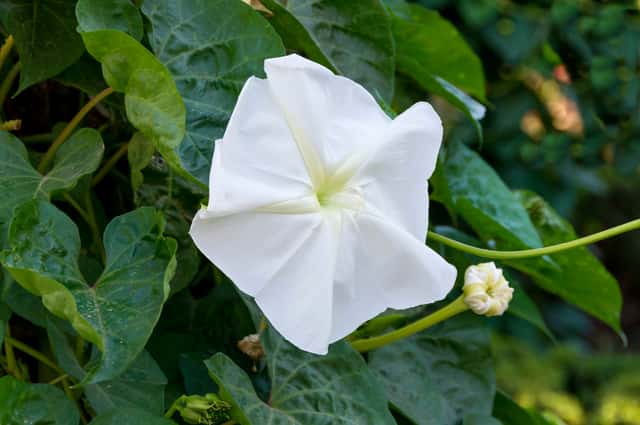
Moonflower (Ipomoea alba) is a easy-care plant from the Convolvulaceae family. Moonflower (Ipomoea alba) is a vigorous tropical vine in the Convolvulaceae family, prized for its large, fragrant white flowers that open at dusk and close by morning. Native to tropical regions of the Americas, it climbs rapidly over trellises and fences, reaching several meters in a single growin...
Moonflower grows up to 9.0m, spread of 180cm, watering every 3 days, 15°C – 32°C, 40–70% humidity. It is not suitable for indoor environments and not safe for pets.
Unlike many tropical plants, Moonflower tolerates watering mistakes. Best for beginners. Without precautions, ingestion can cause irritation in pets. Keep out of reach of cats and dogs.
How to Care for Moonflower?
TLDR: Moonflower needs Direct sun, watering every 3 days, and temperatures between 15-32°C with 40-70% humidity.
How Often Should You Water Moonflower?
Water when the top few centimeters of soil are dry, roughly twice a week in heat; never let the roots sit in soggy soil to avoid root rot.
How Much Light Does Moonflower Need?
Needs full sun, at least 6-8 hours of direct light daily; tolerates partial shade in very hot climates.
What Is the Best Soil for Moonflower?
Use well-draining soil enriched with organic matter; adaptable to clay, sandy, or loamy soil as long as drainage is good.
What Pot Should You Use for Moonflower?
Large, deep container with drainage holes, or plant directly in the ground near a trellis or fence for support.
Care Schedule
Fertilize
Every 30 days
What Is Moonflower and Where Does It Come From?
Moonflower (Ipomoea alba) is a vigorous tropical vine in the Convolvulaceae family, prized for its large, fragrant white flowers that open at dusk and close by morning. Native to tropical regions of the Americas, it climbs rapidly over trellises and fences, reaching several meters in a single growing season.
How to Propagate Moonflower?
Seed propagation
Nicked or soaked seeds germinate much faster; sow after the last frost date.
- 1 Lightly sand or nick the hard seed coat
- 2 Soak in warm water for 24 hours
- 3 Sow in light, moist potting mix at 1 cm depth
- 4 Keep warm (above 21C/70F) until germination
Materials needed:
Stem cutting
Use clean, sharp tools; change the water every 2-3 days if rooting in water.
- 1 Cut a healthy stem with 2-3 nodes
- 2 Remove the lower leaves
- 3 Place in water or moist potting mix
- 4 Keep in bright indirect light until rooted
Materials needed:
How Big Does Moonflower Grow?
TLDR: Moonflower can reach up to 9.0m tall with Fast growth rate.
Max height
9.0m
Spread
1.8m
Growth rate
Fast
Foliage
Deciduous
Warning: Toxic Plant
This plant can be toxic if ingested. Keep out of reach of:
Plant Uses
Ornamental
Great for decoration
Aromatic
Pleasant fragrance
Is your plant showing symptoms?
Click on the symptom to discover possible causes:
What Diseases Commonly Affect Moonflower?
TLDR: Moonflower is susceptible to 6 known diseases. Monitor regularly for early detection.
Aphids
Aphids are small, soft-bodied, pear-shaped insects (1/16 to 1/8 inch long) that feed by sucking nutrient-rich sap from plants. They reproduce rapidly and can quickly weaken plants, causing distorted growth and transmitting plant viruses. Aphids come in various colors including green, black, red, yellow, brown, and gray. They secrete honeydew, a sticky substance that attracts ants and encourages sooty mold growth.
Spider Mites
Spider mites are tiny arachnids (less than 1/20 inch long) related to spiders and ticks that feed on plant sap. They thrive in hot, dry conditions and can cause significant damage to ornamental and vegetable plants. During severe infestations, crop losses can reach 14% or higher as these pests disrupt vital plant processes including photosynthesis, carbon dioxide absorption, and transpiration.
Whiteflies
Whiteflies are small, soft-bodied, winged insects closely related to aphids and mealybugs. They are moth-like in appearance, about 1/16 inch long, triangular in shape, and gray-white in color. These sap-sucking pests feed on plant tissue, causing yellowing, stunted growth, and wilting. They also excrete honeydew, which attracts ants and promotes sooty mold growth. Whiteflies can transmit serious plant viruses.
Powdery Mildew
Powdery mildew is a common fungal disease caused by various fungi species including Erysiphe, Podosphaera, Oïdium, and Leveillula. It affects over 10,000 plant species worldwide. The disease thrives in warm, dry climates with high humidity and appears as a distinctive white powdery coating on plant surfaces.
Meaning & Symbolism
Represents mystery, nocturnal transformation, and fleeting beauty revealed only after dark.
Fun Facts
Its flowers unfurl in just minutes at dusk and may last only one night
It is pollinated mainly by night-flying moths drawn to its strong perfume
Its seeds contain hallucinogenic compounds and are toxic if ingested
It can grow more than 9 meters (30 feet) in a single growing season
Frequently asked questions
When does moonflower bloom?
Is moonflower toxic to pets?
How fast does moonflower grow?
Does moonflower need a trellis?
Compare with similar plants
| Attribute | Difficulty | Light | Watering | Pet Safe |
|---|---|---|---|---|
| Field Maple | Easy | Bright indirect | 14d | ✓ |
| Silver Birch | Easy | Direct sun | 14d | ✓ |
| Common Blanketflower | Easy | Direct sun | 10d | ✓ |
| Cushion Bush | Easy | Direct sun | 14d | ✓ |





