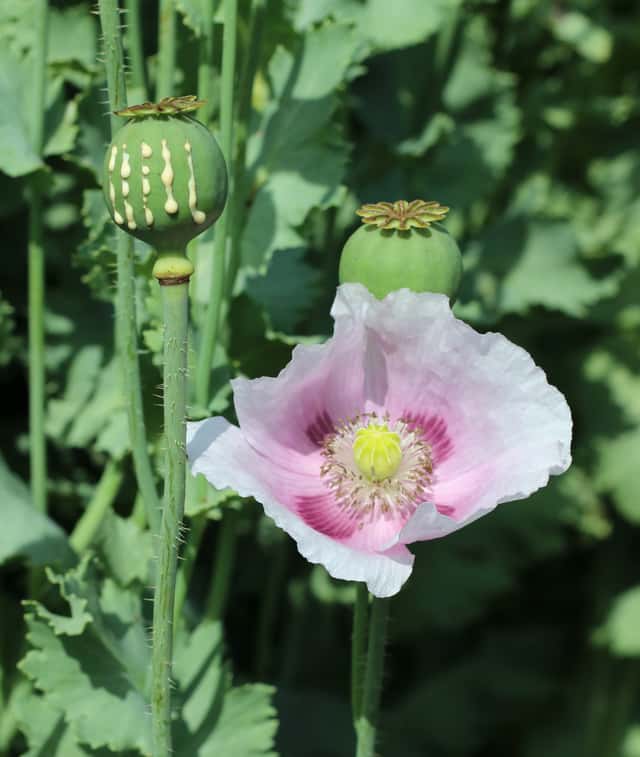
Papaveraceae
Opium poppy: Edible Plant
Papaver somniferum
Best grown as a cool-weather annual. Sow seeds directly into well-drained soil in a location receiving full sun, as the plant's taproot makes it difficult to transplant.
Every 4 days
Direct sun
5° - 21°C
30% - 50%
Categories
What is Opium poppy?
Opium poppy (Papaver somniferum) is a easy-care plant from the Papaveraceae family. Papaver somniferum, known as the opium poppy or breadseed poppy, is an annual herb characterized by its glaucous, lobed foliage and large, striking flowers. It is historically significant for its production of latex containing alkaloids such as morphine and codeine, as well as for its edible seeds u...
Opium poppy grows up to 1.0m, spread of 20cm, watering every 4 days, 5°C – 21°C, 30–50% humidity. It is not suitable for indoor environments and not safe for pets.
Unlike many tropical plants, Opium poppy tolerates watering mistakes. Best for beginners. Without precautions, ingestion can cause irritation in pets. Keep out of reach of cats and dogs.
How to Care for Opium poppy?
TLDR: Opium poppy needs Direct sun, watering every 4 days, and temperatures between 5-21°C with 30-50% humidity.
How Often Should You Water Opium poppy?
Keep the soil consistently moist during germination. Once established, the plant is somewhat drought-tolerant but benefits from weekly watering during dry spells.
How Much Light Does Opium poppy Need?
Requires full, direct sunlight for at least 6 to 8 hours a day to develop strong stems and large blooms.
What Is the Best Soil for Opium poppy?
Prefers a loamy, well-drained soil. Avoid heavy clay or areas where water sits, as the roots are prone to rot.
What Pot Should You Use for Opium poppy?
Deep terracotta pots are necessary if container-grown to accommodate the long taproot, though ground planting is highly recommended.
Care Schedule
Fertilize
Every 30 days
What Is Opium poppy and Where Does It Come From?
Papaver somniferum, known as the opium poppy or breadseed poppy, is an annual herb characterized by its glaucous, lobed foliage and large, striking flowers. It is historically significant for its production of latex containing alkaloids such as morphine and codeine, as well as for its edible seeds used globally in culinary applications. The plant typically features a single upright stem topped by a nodding bud that opens into a delicate, four-petaled flower.
How to Propagate Opium poppy?
Direct Sowing
- Mix seeds with sand before scattering to ensure even distribution.
- Avoid transplanting once the taproot has started to grow.
- 1 Soil Preparation
Clear the area of weeds and rake the soil to a fine tilth in early spring or late autumn.
- 2 Sowing
Scatter seeds thinly over the surface. Do not cover them with soil as they require light to germinate.
- 3 Thinning
Once seedlings are 5cm tall, thin them to be approximately 20-30cm apart to allow for air circulation.
Materials needed:
How Big Does Opium poppy Grow?
TLDR: Opium poppy can reach up to 1.0m tall with Medium growth rate.
Max height
1.0m
Spread
20cm
Growth rate
Medium
Foliage
Deciduous
Warning: Toxic Plant
This plant can be toxic if ingested. Keep out of reach of:
Plant Uses
Ornamental
Great for decoration
Medicinal
Medicinal properties
Edible
Can be consumed
Medicinal Uses
- Pharmaceutical source of analgesic alkaloids
- Traditional use for sleep induction
- Cough suppression
Culinary Uses
- Seeds for bagels and breads
- Poppy seed filling for pastries
- Cold-pressed poppy seed oil
Is your plant showing symptoms?
Click on the symptom to discover possible causes:
What Diseases Commonly Affect Opium poppy?
TLDR: Opium poppy is susceptible to 11 known diseases. Monitor regularly for early detection.
Downy Mildew
Downy mildew is a fungal-like disease caused by oomycetes (water molds) that thrives in cool, wet conditions. It affects a wide range of plants, causing yellowing leaves with fuzzy white-gray growth underneath, leading to defoliation and reduced yields if left untreated.
Powdery Mildew
Powdery mildew is a common fungal disease caused by various fungi species including Erysiphe, Podosphaera, Oïdium, and Leveillula. It affects over 10,000 plant species worldwide. The disease thrives in warm, dry climates with high humidity and appears as a distinctive white powdery coating on plant surfaces.
Aphids
Aphids are small, soft-bodied, pear-shaped insects (1/16 to 1/8 inch long) that feed by sucking nutrient-rich sap from plants. They reproduce rapidly and can quickly weaken plants, causing distorted growth and transmitting plant viruses. Aphids come in various colors including green, black, red, yellow, brown, and gray. They secrete honeydew, a sticky substance that attracts ants and encourages sooty mold growth.
Root Rot
Root rot is a serious fungal disease that affects the root system of plants, causing them to decay and die. It is primarily caused by overwatering, poor drainage, or soil-borne fungi such as Pythium, Phytophthora, Rhizoctonia, and Fusarium. The disease thrives in waterlogged conditions where roots are deprived of oxygen, making them susceptible to fungal infection.
Meaning & Symbolism
Symbolizes sleep, peace, and eternal remembrance.
Compare with similar plants
| Attribute | Difficulty | Light | Watering | Pet Safe |
|---|---|---|---|---|
| Field Maple | Easy | Bright indirect | 14d | ✓ |
| Silver Birch | Easy | Direct sun | 14d | ✓ |
| Cushion Bush | Easy | Direct sun | 14d | ✓ |
| Peruvian peppertree | Easy | Direct sun | 14d | ⚠️ |





