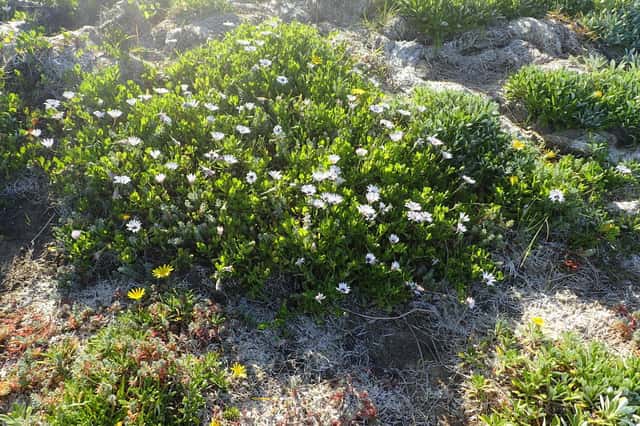
Asteraceae
Trailing African Daisy: Ground Cover Plant
Dimorphotheca fruticosa
Give this daisy full sun and well-draining soil and it will reward you with months of bloom on very little care. It is drought tolerant once established, resistant to most pests and diseases, and needs only occasional deadheading and an annual hard prune to stay tidy.
Every 5 days
Direct sun
° - °C
% - %
Categories
What is Trailing African Daisy?
Trailing African Daisy (Dimorphotheca fruticosa) is a easy-care plant from the Asteraceae family. Trailing African Daisy (Dimorphotheca fruticosa, syn. Osteospermum fruticosum) is a fast-growing, evergreen perennial native to South Africa. It forms a dense, spreading mat of semi-succulent, mid-green leaves and produces abundant daisy-like flowers with white or pale lilac petals surrounding a dee...
Trailing African Daisy grows up to 60cm, spread of 60cm, watering every 5 days. It is suitable for indoor environments and safe for pets.
Unlike many tropical plants, Trailing African Daisy tolerates watering mistakes. Best for beginners. Unlike many popular species, Trailing African Daisy is safe to keep around pets. Without adequate drainage, root rot can develop within 10 days.
How to Care for Trailing African Daisy?
TLDR: Trailing African Daisy needs Direct sun, watering every 5 days, and temperatures between 15-30°C with 40-70% humidity.
How Often Should You Water Trailing African Daisy?
Water regularly to help the plant establish, then let the top inch of soil dry out between waterings. It is drought tolerant and dislikes soggy soil, so avoid overwatering, especially in humid or cool weather.
How Much Light Does Trailing African Daisy Need?
Needs full sun — at least 6 hours of direct light a day. Flowers are phototropic and close up in shade or on overcast days, so a bright, open spot gives the longest and showiest bloom.
What Is the Best Soil for Trailing African Daisy?
Prefers light, sandy to loamy, well-draining soil. A mix of garden soil, compost and coarse sand or perlite prevents waterlogging and root rot while keeping enough moisture for steady growth.
What Pot Should You Use for Trailing African Daisy?
Wide, shallow pot or hanging basket with generous drainage holes — its trailing habit suits containers where stems can spill over the edge.
Care Schedule
Fertilize
Every 14 days
Misting
Every 3 days
Rotate
Every 7 days
Repot
Every 365 days
What Is Trailing African Daisy and Where Does It Come From?
Trailing African Daisy (Dimorphotheca fruticosa, syn. Osteospermum fruticosum) is a fast-growing, evergreen perennial native to South Africa. It forms a dense, spreading mat of semi-succulent, mid-green leaves and produces abundant daisy-like flowers with white or pale lilac petals surrounding a deep purple center. Widely planted as a groundcover on slopes, embankments and along roadsides, it is prized for its drought tolerance, salt tolerance and long bloom period from spring through fall.
How to Propagate Trailing African Daisy?
Stem cuttings
Keep cuttings out of direct sun until roots form; avoid overwatering to prevent rot.
- 1 Take a 7-10cm (3-4in) leafy stem cutting
- 2 Remove the lower leaves
- 3 Dip the cut end in rooting hormone (optional)
- 4 Plant in moist, well-draining mix
- 5 Keep in bright, indirect light until rooted
Materials needed:
Seed
Sow on the soil surface — seeds need light to germinate, so avoid burying them.
- 1 Sow seeds on the soil surface and press lightly
- 2 Keep the mix consistently moist
- 3 Place in a bright, warm spot
- 4 Transplant seedlings once they have 2 true leaves
Materials needed:
Division
Keep divided sections shaded and well-watered for the first week to reduce transplant shock.
- 1 Dig up a mature, spreading clump
- 2 Separate into sections, each with roots attached
- 3 Replant sections immediately
- 4 Water well to settle the soil
Materials needed:
How Big Does Trailing African Daisy Grow?
TLDR: Trailing African Daisy can reach up to 60cm tall with Fast growth rate.
Max height
60cm
Spread
60cm
Growth rate
Fast
Foliage
Evergreen
Plant Uses
Ornamental
Great for decoration
Ground Cover
Soil coverage
Is your plant showing symptoms?
Click on the symptom to discover possible causes:
What Diseases Commonly Affect Trailing African Daisy?
TLDR: Trailing African Daisy is susceptible to 10 known diseases. Monitor regularly for early detection.
Root Rot
Root rot is a serious fungal disease that affects the root system of plants, causing them to decay and die. It is primarily caused by overwatering, poor drainage, or soil-borne fungi such as Pythium, Phytophthora, Rhizoctonia, and Fusarium. The disease thrives in waterlogged conditions where roots are deprived of oxygen, making them susceptible to fungal infection.
Downy Mildew
Downy mildew is a fungal-like disease caused by oomycetes (water molds) that thrives in cool, wet conditions. It affects a wide range of plants, causing yellowing leaves with fuzzy white-gray growth underneath, leading to defoliation and reduced yields if left untreated.
Powdery Mildew
Powdery mildew is a common fungal disease caused by various fungi species including Erysiphe, Podosphaera, Oïdium, and Leveillula. It affects over 10,000 plant species worldwide. The disease thrives in warm, dry climates with high humidity and appears as a distinctive white powdery coating on plant surfaces.
Verticillium Wilt
Verticillium wilt is a soil-borne fungal disease caused primarily by the fungi Verticillium dahliae and V. albo-atrum. These pathogens infect plant roots and grow within the vascular tissues, blocking water and nutrient transport, resulting in wilting and eventual plant death. The disease affects over 350 plant species including vegetables, fruits, ornamental flowers, and trees. The fungi can survive in soil for more than 10 years as resistant structures called microsclerotia.
Meaning & Symbolism
Symbolizes joy, new beginnings and purity; the daisy-like flowers opening at dawn and closing at dusk evoke optimism and renewal.
Compare with similar plants
| Attribute | Difficulty | Light | Watering | Pet Safe |
|---|---|---|---|---|
| Field Maple | Easy | Bright indirect | 14d | ✓ |
| Silver Birch | Easy | Direct sun | 14d | ✓ |
| Common Blanketflower | Easy | Direct sun | 10d | ✓ |
| Cushion Bush | Easy | Direct sun | 14d | ✓ |





