Solanaceae
Garden Petunia: How to Care for Petunia x hybrida
Petunia x hybrida
Grow garden petunia in full sun, water when the top inch of soil dries out, and use a light, well-draining, organically rich soil. Feed every two weeks during the growing season and deadhead spent blooms regularly to encourage continuous flowering.
Every 3 days
Direct sun
10° - 35°C
40% - 70%
Categories
What is Garden Petunia?
Garden Petunia (Petunia x hybrida) is a easy-care plant from the Solanaceae family. The garden petunia (Petunia x hybrida) is a herbaceous hybrid in the nightshade family (Solanaceae), bred from Petunia axillaris and Petunia integrifolia, both native to South America. Grown as an annual bedding plant nearly worldwide, it is one of the most popular flowers for beds, borders, hanging...
Garden Petunia grows up to 45cm, spread of 90cm, watering every 3 days, 10°C – 35°C, 40–70% humidity. It is suitable for indoor environments and safe for pets.
Unlike many tropical plants, Garden Petunia tolerates watering mistakes. Best for beginners. Unlike many popular species, Garden Petunia is safe to keep around pets. Without adequate drainage, root rot can develop within 7 days.
How to Care for Garden Petunia?
TLDR: Garden Petunia needs Direct sun, watering every 3 days, and temperatures between 10-35°C with 40-70% humidity.
How Often Should You Water Garden Petunia?
Water when the top 2-3 cm of soil feels dry to the touch; avoid soggy soil, since overwatering is the leading cause of root rot.
How Much Light Does Garden Petunia Need?
Needs at least 6 hours of direct sunlight a day; it survives in partial shade but blooms far less.
What Is the Best Soil for Garden Petunia?
Use a light, loose, well-draining soil rich in organic matter; waterlogged soil encourages root diseases.
What Pot Should You Use for Garden Petunia?
Well-draining pots and window boxes at least 15-20 cm (6-8 in) deep work well, especially for trailing varieties such as Wave and Surfinia.
Care Schedule
Fertilize
Every 14 days
What Is Garden Petunia and Where Does It Come From?
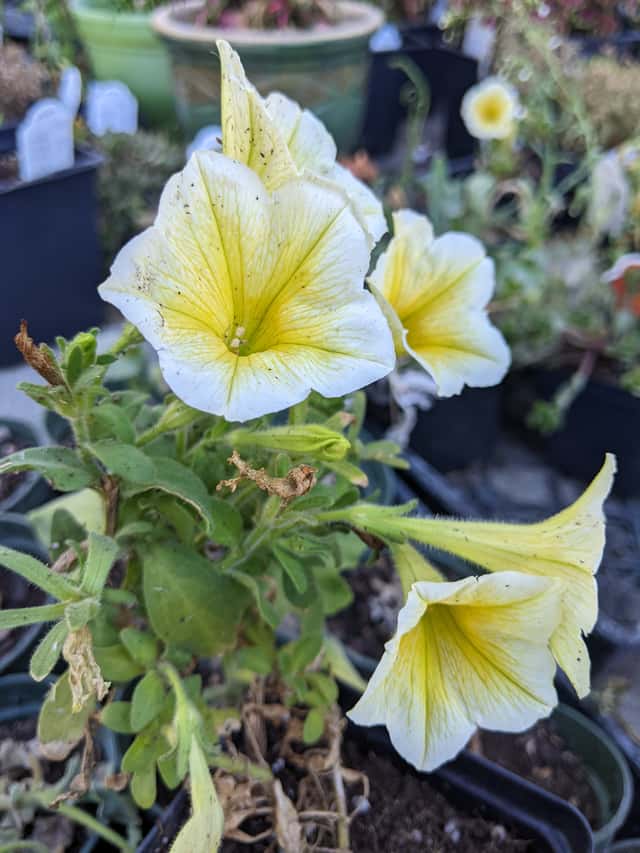
The garden petunia (Petunia x hybrida) is a herbaceous hybrid in the nightshade family (Solanaceae), bred from Petunia axillaris and Petunia integrifolia, both native to South America. Grown as an annual bedding plant nearly worldwide, it is one of the most popular flowers for beds, borders, hanging baskets, and containers thanks to its abundant, near-continuous bloom from spring until the first frost. Its trumpet-shaped flowers come in an enormous range of colors, from pure white to deep purple, plus pink, red, yellow, and bicolor combinations. Leaves are oval, green, slightly sticky, and softly fragrant due to fine glandular hairs. It is a fast-growing plant, ideal for gardeners who want quick, reliable color, but it demands full sun and regular watering to keep up its vigor and flower output.
How to Propagate Garden Petunia?
Seed sowing
Seeds are tiny; mix with fine sand for even distribution. Do not bury deeply, as they need light to germinate.
- 1 Sow onto moist, light seed-starting mix, pressing lightly without covering deeply
- 2 Keep at 22-24°C (72-75°F) in bright light
- 3 Transplant seedlings once they have 2-3 true leaves
Materials needed:
Stem cutting
Keep in bright, indirect light until rooted to prevent wilting.
- 1 Take an 8-10 cm (3-4 in) cutting from non-flowering growth
- 2 Remove lower leaves and dip the cut end in rooting hormone
- 3 Plant in light substrate and keep consistently moist until rooted
Materials needed:
How Big Does Garden Petunia Grow?
TLDR: Garden Petunia can reach up to 45cm tall with Fast growth rate.
Max height
45cm
Spread
90cm
Growth rate
Fast
Foliage
Evergreen
Plant Uses
Ornamental
Great for decoration
Is your plant showing symptoms?
Click on the symptom to discover possible causes:
What Diseases Commonly Affect Garden Petunia?
TLDR: Garden Petunia is susceptible to 17 known diseases. Monitor regularly for early detection.
Root Rot
Root rot is a serious fungal disease that affects the root system of plants, causing them to decay and die. It is primarily caused by overwatering, poor drainage, or soil-borne fungi such as Pythium, Phytophthora, Rhizoctonia, and Fusarium. The disease thrives in waterlogged conditions where roots are deprived of oxygen, making them susceptible to fungal infection.
Gray Mold (Botrytis Blight)
Gray mold, caused by the fungus Botrytis cinerea, is a widespread necrotrophic pathogen affecting over 1,400 plant species. It thrives in cool, humid conditions and attacks weakened or aging plant tissues, causing soft rot and characteristic gray fuzzy growth.
Mosaic Virus
Mosaic virus is a group of plant viruses that cause mottled, patchy patterns on leaves and can affect a wide variety of plants. The virus creates characteristic yellow, white, and green mosaic patterns, often accompanied by stunted growth and deformed plant parts. This highly contagious disease spreads rapidly through insect vectors and contaminated tools.
Phytophthora Blight
Devastating fungal disease caused by Phytophthora species (primarily P. capsici and P. infestans), famously responsible for the Irish Potato Famine in the 1840s. Affects all plant parts including roots, stems, leaves, and fruits in warm, wet conditions. The pathogen is technically an oomycete (water mold) that thrives in saturated soils and can survive in soil for 5+ years.
Meaning & Symbolism
In Victorian flower language, the petunia symbolizes a soothing, comforting presence, though it can also signify resentment or anger — a contrast between its delicate beauty and bold, assertive growth.
Fun Facts
Garden petunia is a hybrid created from Petunia axillaris and Petunia integrifolia, two species native to South America.
The name "petunia" comes from the Tupi-Guarani word "petyn," meaning tobacco, since the plant shares the nightshade family (Solanaceae) with tobacco and tomatoes.
Modern series like Wave and Surfinia revolutionized landscaping in the 1990s by forming dense, weather-resistant flowering carpets.
A single petunia plant can produce dozens of flowers at once, blooming continuously from spring until the first frost.
Frequently asked questions
How often should I water garden petunia?
Does petunia need full sun?
Is petunia toxic to dogs and cats?
Why did my petunia stop blooming?
Compare with similar plants
| Attribute | Difficulty | Light | Watering | Pet Safe |
|---|---|---|---|---|
| Field Maple | Easy | Bright indirect | 14d | ✓ |
| Silver Birch | Easy | Direct sun | 14d | ✓ |
| Common Blanketflower | Easy | Direct sun | 10d | ✓ |
| Cushion Bush | Easy | Direct sun | 14d | ✓ |





