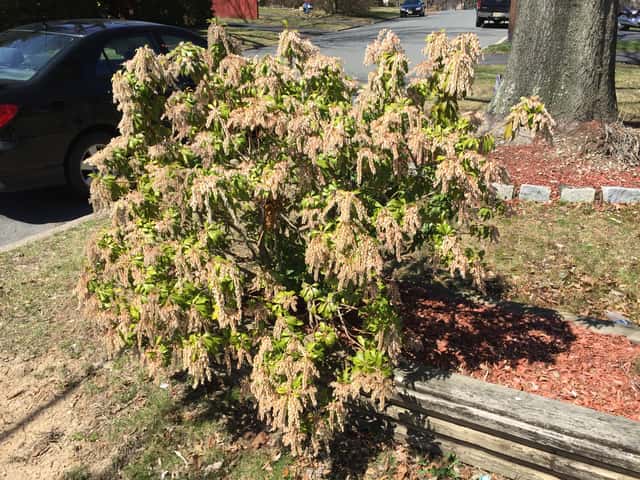
Ericaceae
Pieris japonica (Japanese Andromeda) Care Guide
Pieris japonica
Grow in partial shade with acidic, well-drained soil kept evenly moist. Prune lightly after flowering and apply an acid-forming fertilizer once a year for best results.
Every 7 days
Partial shade
-31° - 29°C
% - %
Categories
What is Japanese Andromeda?
Japanese Andromeda (Pieris japonica) is a medium-care plant from the Ericaceae family. Pieris japonica, commonly known as Japanese andromeda or lily-of-the-valley shrub, is an evergreen shrub in the heath family (Ericaceae), native to Japan, southern China, and Taiwan. It is prized for its coppery-red new growth that matures to glossy dark green, and for its drooping clusters of small...
Japanese Andromeda grows up to 3.0m, spread of 210cm, watering every 7 days, -31°C – 29°C. It is not suitable for indoor environments and not safe for pets.
Without precautions, ingestion can cause irritation in pets. Keep out of reach of cats and dogs.
How to Care for Japanese Andromeda?
TLDR: Japanese Andromeda needs Partial shade, watering every 7 days, and temperatures between -31-29°C with 40-70% humidity.
How Often Should You Water Japanese Andromeda?
Water weekly during spring and summer to keep soil evenly moist but never waterlogged; use rainwater or lime-free water when possible.
How Much Light Does Japanese Andromeda Need?
Best in dappled or partial shade; in hot climates, protect from intense midday sun to prevent leaf scorch.
What Is the Best Soil for Japanese Andromeda?
Requires acidic soil (pH 4.5-6.0), rich in organic matter and well-drained; avoid alkaline or soggy soils.
What Pot Should You Use for Japanese Andromeda?
Best grown in the ground or in large, well-draining containers for compact cultivars; avoid small pots that restrict root growth.
Care Schedule
Fertilize
Every 365 days
What Is Japanese Andromeda and Where Does It Come From?
Pieris japonica, commonly known as Japanese andromeda or lily-of-the-valley shrub, is an evergreen shrub in the heath family (Ericaceae), native to Japan, southern China, and Taiwan. It is prized for its coppery-red new growth that matures to glossy dark green, and for its drooping clusters of small, urn-shaped white flowers that bloom in early spring. A slow grower, it thrives in partial shade with consistently moist, acidic soil.
How to Propagate Japanese Andromeda?
Semi-hardwood stem cutting
Use a humidity dome or plastic bag to maintain high humidity until roots form.
- 1 Take 10-15 cm (4-6 in) cuttings from semi-hardwood stems in summer
- 2 Remove leaves from the lower half of the cutting
- 3 Dip the cut end in rooting hormone
- 4 Plant in acidic, well-draining potting mix and keep consistently moist
Materials needed:
How Big Does Japanese Andromeda Grow?
TLDR: Japanese Andromeda can reach up to 3.0m tall with Slow growth rate.
Max height
3.0m
Spread
2.1m
Growth rate
Slow
Foliage
Evergreen
Warning: Toxic Plant
This plant can be toxic if ingested. Keep out of reach of:
Plant Uses
Ornamental
Great for decoration
Is your plant showing symptoms?
Click on the symptom to discover possible causes:
What Diseases Commonly Affect Japanese Andromeda?
TLDR: Japanese Andromeda is susceptible to 5 known diseases. Monitor regularly for early detection.
Phytophthora Root Rot
Disease caused by fungus-like organisms (oomycetes) that live in soil and can survive for years. It affects roots, stem, and crown of plants, being especially severe in waterlogged or poorly drained soils. It is the second most common cause of root rot in trees and shrubs.
Leaf Spot
Leaf spot is a common fungal disease caused by various pathogens including Alternaria, Ascochyta, Colletotrichum, Septoria, and Venturia. It primarily affects leaves, causing discolored spots that can lead to premature leaf drop if left untreated.
Spider Mites
Spider mites are tiny arachnids (less than 1/20 inch long) related to spiders and ticks that feed on plant sap. They thrive in hot, dry conditions and can cause significant damage to ornamental and vegetable plants. During severe infestations, crop losses can reach 14% or higher as these pests disrupt vital plant processes including photosynthesis, carbon dioxide absorption, and transpiration.
Scale Insects
Scale insects are small sap-sucking pests that appear as brown, shell-like bumps on plant stems and leaves. There are over 25 species, divided into armored (hard) and unarmored (soft) scales. They feed by piercing plant tissue and extracting sap, which weakens the plant and can lead to yellowing, stunted growth, and even death if left untreated. They also excrete honeydew, which attracts ants and promotes sooty mold growth.
Meaning & Symbolism
Often associated with renewal and quiet beauty, thanks to its striking copper-red new growth and delicate, bell-like flowers.
Fun Facts
New leaves emerge in a coppery-red hue before maturing to glossy dark green.
Its drooping clusters of white flowers resemble lily-of-the-valley, giving rise to its common nickname.
It is a slow grower that can take decades to reach its mature height of about 3 meters (10 feet).
Frequently asked questions
Is Pieris japonica toxic to pets?
How often should I water Pieris japonica?
What soil does Pieris japonica need?
Why are my Pieris leaves wilting?
Compare with similar plants
| Attribute | Difficulty | Light | Watering | Pet Safe |
|---|---|---|---|---|
| Dark Fieldcap | Medium | Low light | 2d | ⚠️ |
| Azalea | Medium | Partial shade | 3d | ⚠️ |
| Bougainvillea | Medium | Direct sun | 7d | ⚠️ |
| Wild Lettuce | Medium | Direct sun | 7d | ⚠️ |



