Rubiaceae
White Indigoberry: Edible Plant
Randia aculeata
A hardy, low-maintenance plant: full sun to partial shade, moderate watering with soil drying out between waterings, well-drained sandy or rocky soil, and light fertilization in spring and summer. It is highly tolerant of drought, strong winds, and coastal salinity, with few requirements regarding pests and diseases.
Every 10 days
Bright indirect
10° - 35°C
50% - 80%
Categories
What is White Indigoberry?
White Indigoberry (Randia aculeata) is a easy-care plant from the Rubiaceae family. A spiny, evergreen shrub or small tree in the Rubiaceae family, native to dry coastal forests, pine rocklands, and rocky outcrops of the Caribbean, Central America, and southern Florida, also occurring in Colombia and Venezuela. It features nearly horizontal, thorny branches, dense glossy foliage, a...
White Indigoberry grows up to 3.0m, spread of 180cm, watering every 10 days, 10°C – 35°C, 50–80% humidity. It is suitable for indoor environments and safe for pets.
Unlike many tropical plants, White Indigoberry tolerates watering mistakes. Best for beginners. Unlike many popular species, White Indigoberry is safe to keep around pets. Without adequate drainage, root rot can develop within 20 days.
How to Care for White Indigoberry?
TLDR: White Indigoberry needs Bright indirect, watering every 10 days, and temperatures between 10-35°C with 50-80% humidity.
How Often Should You Water White Indigoberry?
Water moderately, allowing the soil to dry out between waterings; it is a drought-tolerant plant once established. Significantly reduce watering in winter and avoid waterlogging, which can cause root rot.
How Much Light Does White Indigoberry Need?
Prefers full sun, a condition that encourages more abundant flowering; it also tolerates partial shade but will flower less under those conditions.
What Is the Best Soil for White Indigoberry?
Prefers well-drained sandy or rocky soil, ranging from slightly acidic to neutral (pH 6.0-7.5). It tolerates saline and poor soils well, which are typical of coastal regions.
What Pot Should You Use for White Indigoberry?
Prefer clay or terracotta pots with good drainage and large holes, as the plant is sensitive to waterlogging. Since it can become root-bound, choose a generously sized pot and plan for repotting approximately every 2 years.
Care Schedule
Fertilize
Every 30 days
Rotate
Every 15 days
Repot
Every 730 days
What Is White Indigoberry and Where Does It Come From?
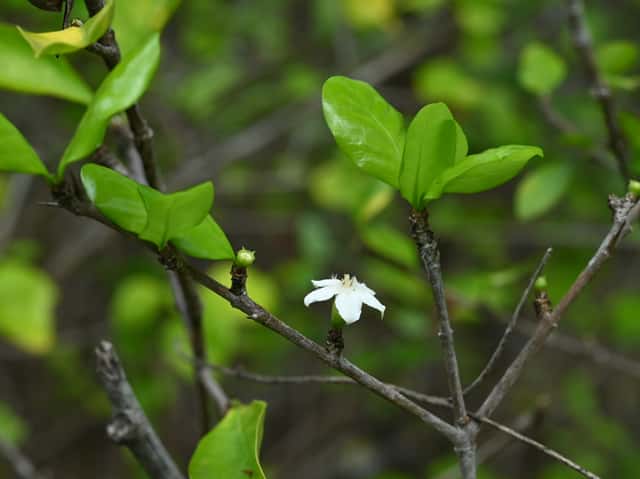
A spiny, evergreen shrub or small tree in the Rubiaceae family, native to dry coastal forests, pine rocklands, and rocky outcrops of the Caribbean, Central America, and southern Florida, also occurring in Colombia and Venezuela. It features nearly horizontal, thorny branches, dense glossy foliage, and fragrant white flowers that bloom primarily in spring and summer. Its globose white fruits contain a bluish pulp traditionally used as a dye. It is extremely tolerant of drought, wind, and salt spray, making it popular for coastal landscaping.
How to Propagate White Indigoberry?
Seeds
- Slow germination and low rates are normal for this species; be patient.
- 1 Extraction
Remove the pulp from ripe seeds (white fruits with bluish pulp).
- 2 Sowing
Lightly scatter seeds over well-drained substrate, covering them only slightly.
- 3 Location
Keep in partial shade and slightly moist substrate until germination, which is slow and irregular.
- 4 Transplanting
Seedlings usually take about 12 months before they are ready for final transplanting.
Materials needed:
Cuttings
- Visible new growth indicates the cutting has successfully rooted.
- 1 Collection
Take 8-15 cm cuttings in late winter or early spring, with at least 2-3 leaves.
- 2 Preparation
Remove lower leaves and cut the base at a 45-degree angle; apply rooting hormone.
- 3 Planting
Plant in well-drained substrate, kept moist but not waterlogged.
- 4 Environment
Cover with a plastic bag to maintain humidity and keep in a bright, warm spot without direct sun until rooted.
Materials needed:
How Big Does White Indigoberry Grow?
TLDR: White Indigoberry can reach up to 3.0m tall with Medium growth rate.
Max height
3.0m
Spread
1.8m
Growth rate
Medium
Foliage
Evergreen
Warning: Toxic Plant
This plant can be toxic if ingested. Keep out of reach of:
Plant Uses
Ornamental
Great for decoration
Medicinal
Medicinal properties
Edible
Can be consumed
Medicinal Uses
- Traditional use of fruits in treating dysentery
- Latex used topically to stop bleeding (hemostatic)
- Traditional use for fever relief
- Fruit extract studied for its protective effect against snake venom (Crotalus simus and Bothrops asper) in Mexican ethnobotany
Culinary Uses
- Fruit is edible raw, though it has an unappealing flavor
Is your plant showing symptoms?
Click on the symptom to discover possible causes:
What Diseases Commonly Affect White Indigoberry?
TLDR: White Indigoberry is susceptible to 2 known diseases. Monitor regularly for early detection.
Whiteflies
Whiteflies are small, soft-bodied, winged insects closely related to aphids and mealybugs. They are moth-like in appearance, about 1/16 inch long, triangular in shape, and gray-white in color. These sap-sucking pests feed on plant tissue, causing yellowing, stunted growth, and wilting. They also excrete honeydew, which attracts ants and promotes sooty mold growth. Whiteflies can transmit serious plant viruses.
Caterpillars
Caterpillars are the larval stage of moths and butterflies that feed voraciously on plant foliage, stems, flowers, and fruits. Common species include cabbage loopers, tomato hornworms, armyworms, and cutworms. These pests can cause extensive damage by consuming large amounts of plant tissue in a short time. They vary in size from small (1/4 inch) to large (5 inches), with colors ranging from green to brown, often featuring stripes or spots. Caterpillars are highly mobile and can quickly spread throughout gardens, making them one of the most destructive common pests.
Meaning & Symbolism
Associated with protection and resilience: its thorny branches evoke natural defense, while its remarkable tolerance to drought, wind, and coastal salt spray makes it a symbol of endurance in harsh environments. In traditional Caribbean and Central American medicine, its hemostatic latex reinforces this association with healing and protection.
Compare with similar plants
| Attribute | Difficulty | Light | Watering | Pet Safe |
|---|---|---|---|---|
| Field Maple | Easy | Bright indirect | 14d | ✓ |
| Silver Birch | Easy | Direct sun | 14d | ✓ |
| Common Blanketflower | Easy | Direct sun | 10d | ✓ |
| Cushion Bush | Easy | Direct sun | 14d | ✓ |
Choose & Compare
Sources & References
- Randia aculeata - Florida Native Plant Society
- Randia aculeata (RAAAC) Pests - EPPO Global Database
- Randia aculeata - Useful Tropical Plants
- Randia aculeata (White Indigoberry) - Top Tropicals Plant Encyclopedia
- FPS497/FP497: Randia aculeata White Indigoberry - UF/IFAS Extension
- Anti-inflammatory, antibacterial and antioxidant activity of leaf and cell cultures extracts of Randia aculeata L.
- Toxicological Evaluation of the Hydroethanolic Seed Extract of Randia aculeata





