Arecaceae
Foxtail palm: complete care guide
Wodyetia
Plant in full sun with well-draining soil. Water every 7–10 days during warm months and reduce to every 14 days in winter. Fertilize every 2 months with a palm-specific fertilizer rich in potassium and micronutrients. Remove spent fronds for a tidy appearance. Highly heat-tolerant but frost-sensitive.
Every 7 days
Direct sun
10° - 35°C
40% - 80%
Categories
What is foxtail palm?
foxtail palm (Wodyetia) is a medium-care plant from the Arecaceae family. The foxtail palm (Wodyetia bifurcata) is a monotypic palm species native to the Cape Melville Peninsula in far north Queensland, Australia. Its common name derives from the distinctive plumose fronds, where leaflets radiate in all directions around the rachis, creating a full, bushy appearance remin...
foxtail palm grows up to 10.0m, spread of 400cm, watering every 7 days, 10°C – 35°C, 40–80% humidity. It is not suitable for indoor environments and safe for pets.
Unlike many popular species, foxtail palm is safe to keep around pets.
How to Care for foxtail palm?
TLDR: foxtail palm needs Direct sun, watering every 7 days, and temperatures between 10-35°C with 40-80% humidity.
How Often Should You Water foxtail palm?
Water every 7–10 days in summer and every 14 days in winter. Allow the top 5 cm of soil to dry between waterings. Avoid waterlogging to prevent root rot.
How Much Light Does foxtail palm Need?
Requires full sun (at least 6 hours of direct sunlight daily) for healthy growth and lush fronds. Tolerates partial shade but growth will be slower.
What Is the Best Soil for foxtail palm?
Thrives in sandy or loamy, well-draining soils with a slightly acidic to neutral pH of 6.0–7.5. Amend heavy soils with coarse sand or perlite to ensure adequate drainage.
What Pot Should You Use for foxtail palm?
Large ceramic or concrete pot with generous drainage holes. For container growing, use a pot at least 60 cm in diameter to accommodate root development.
Care Schedule
Fertilize
Every 60 days
Rotate
Every 7 days
What Is foxtail palm and Where Does It Come From?
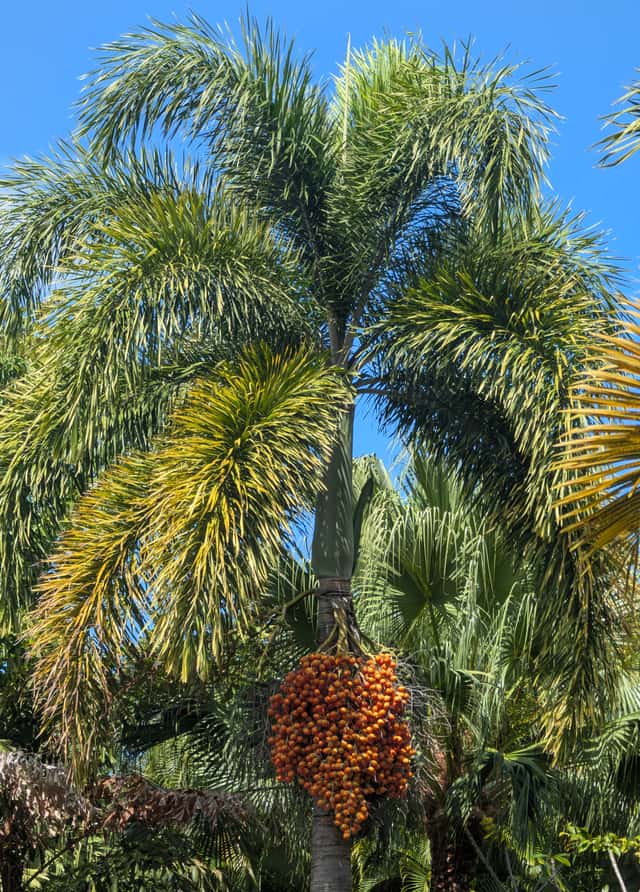
The foxtail palm (Wodyetia bifurcata) is a monotypic palm species native to the Cape Melville Peninsula in far north Queensland, Australia. Its common name derives from the distinctive plumose fronds, where leaflets radiate in all directions around the rachis, creating a full, bushy appearance reminiscent of a fox's tail. The solitary, self-cleaning trunk is grey and prominently ringed, reaching up to 10 metres in height. Widely cultivated across tropical and subtropical regions worldwide, the foxtail palm is prized as a landscape ornamental in gardens, parks, and streetscapes.
How Big Does foxtail palm Grow?
TLDR: foxtail palm can reach up to 10.0m tall with Fast growth rate.
Max height
10.0m
Spread
4.0m
Growth rate
Fast
Foliage
Evergreen
Plant Uses
Ornamental
Great for decoration
Is your plant showing symptoms?
Click on the symptom to discover possible causes:
What Diseases Commonly Affect foxtail palm?
TLDR: foxtail palm is susceptible to 11 known diseases. Monitor regularly for early detection.
Root Rot
Root rot is a serious fungal disease that affects the root system of plants, causing them to decay and die. It is primarily caused by overwatering, poor drainage, or soil-borne fungi such as Pythium, Phytophthora, Rhizoctonia, and Fusarium. The disease thrives in waterlogged conditions where roots are deprived of oxygen, making them susceptible to fungal infection.
Leaf Spot
Leaf spot is a common fungal disease caused by various pathogens including Alternaria, Ascochyta, Colletotrichum, Septoria, and Venturia. It primarily affects leaves, causing discolored spots that can lead to premature leaf drop if left untreated.
Spider Mites
Spider mites are tiny arachnids (less than 1/20 inch long) related to spiders and ticks that feed on plant sap. They thrive in hot, dry conditions and can cause significant damage to ornamental and vegetable plants. During severe infestations, crop losses can reach 14% or higher as these pests disrupt vital plant processes including photosynthesis, carbon dioxide absorption, and transpiration.
Scale Insects
Scale insects are small sap-sucking pests that appear as brown, shell-like bumps on plant stems and leaves. There are over 25 species, divided into armored (hard) and unarmored (soft) scales. They feed by piercing plant tissue and extracting sap, which weakens the plant and can lead to yellowing, stunted growth, and even death if left untreated. They also excrete honeydew, which attracts ants and promotes sooty mold growth.
Meaning & Symbolism
In its native Australia, the foxtail palm symbolises tropical abundance and the resilience of life in remote wilderness.
Fun Facts
Wodyetia bifurcata was unknown to science until 1978, when an Aboriginal Australian man named Wodyetia revealed its location to researchers.
It is one of the fastest-growing palms in the tropics, capable of adding up to 1 metre of height per year under ideal conditions.
The unique foxtail fronds, with leaflets radiating all around the rachis, are rare among palms and give the tree its unmistakably ornamental look.
Frequently asked questions
Is the foxtail palm frost-hardy?
Can I grow a foxtail palm in a pot?
How often should I fertilize?
Compare with similar plants
| Attribute | Difficulty | Light | Watering | Pet Safe |
|---|---|---|---|---|
| Dark Fieldcap | Medium | Low light | 2d | ⚠️ |
| Azalea | Medium | Partial shade | 3d | ⚠️ |
| Bougainvillea | Medium | Direct sun | 7d | ⚠️ |
| Wild Lettuce | Medium | Direct sun | 7d | ⚠️ |



