Orchidaceae
Fringed Star Orchid (Epidendrum ciliare)
Epidendrum ciliare
Provide bright indirect light (avoid harsh midday sun), water every 5–7 days allowing the bark mix to almost dry between waterings, maintain 50–80% humidity, and keep temperatures between 10°C and 32°C. Feed with balanced fertilizer at half-strength every watering during active growth. Mount on bark or pot in a well-draining orchid mix. Repot every 2 years when the medium breaks down.
Every 7 days
Bright indirect
10° - 32°C
50% - 80%
Categories
What is Fringed Star Orchid?
Fringed Star Orchid (Epidendrum ciliare) is a medium-care plant from the Orchidaceae family. Epidendrum ciliare, commonly known as the Fringed Star Orchid, is a stunning epiphytic orchid native to Mexico, Central America, the Caribbean, and northern South America. It grows on trees and rocky outcrops in humid forests at elevations of 500–1000 metres. The plant produces elongated cylindrical...
Fringed Star Orchid grows up to 90cm, spread of 45cm, watering every 7 days, 10°C – 32°C, 50–80% humidity. It is suitable for indoor environments and safe for pets.
Unlike many popular species, Fringed Star Orchid is safe to keep around pets. Without adequate drainage, root rot can develop within 14 days.
How to Care for Fringed Star Orchid?
TLDR: Fringed Star Orchid needs Bright indirect, watering every 7 days, and temperatures between 10-32°C with 50-80% humidity.
How Often Should You Water Fringed Star Orchid?
Water thoroughly every 5–7 days during the growing season, allowing the bark mix to nearly dry out between waterings. Reduce watering frequency in winter. Avoid letting the roots sit in standing water, as this promotes root rot. Once a month, flush the pot with plain water to remove salt buildup.
How Much Light Does Fringed Star Orchid Need?
Provide bright, indirect light — the equivalent of a few hours of morning sun or placement near a bright east- or south-facing window. In summer, protect from harsh midday sun. In winter, additional artificial light (LEDs placed close to the plant) will encourage blooming. Healthy foliage should be a bright, grassy green; yellowish leaves signal too much sun.
What Is the Best Soil for Fringed Star Orchid?
Plant in a coarse, fast-draining orchid bark mix (medium or fine bark blended with perlite or coconut chips). Alternatively, mount on a slab of cork bark or tree fern fibre. Never use regular potting soil — it stays too wet and will suffocate the roots. A breathable clay or wooden slatted basket is ideal for mounted or basket culture.
What Pot Should You Use for Fringed Star Orchid?
Use a clay or wooden slatted orchid basket, or a terracotta pot with large drainage holes. Mounted culture on cork bark or tree fern slabs is excellent for maximum root aeration. Avoid glazed or plastic pots without drainage, as stagnant moisture around the roots will cause rot.
Care Schedule
Fertilize
Every 14 days
Misting
Every 3 days
Repot
Every 730 days
What Is Fringed Star Orchid and Where Does It Come From?
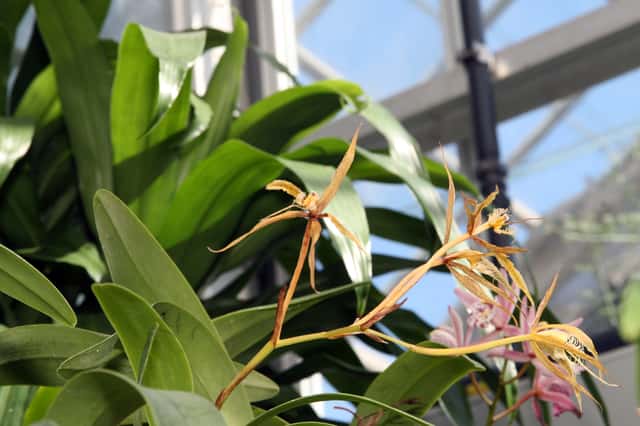
Epidendrum ciliare, commonly known as the Fringed Star Orchid, is a stunning epiphytic orchid native to Mexico, Central America, the Caribbean, and northern South America. It grows on trees and rocky outcrops in humid forests at elevations of 500–1000 metres. The plant produces elongated cylindrical pseudobulbs 10–20 cm long, topped with 1–2 glossy, oblong leaves. Its star-shaped flowers are renowned for their finely fringed white labellum and elegant greenish-yellow sepals and petals, blooming typically in winter. This long-cultivated species is a favourite among orchid enthusiasts for its dramatic, fragrant blooms and relative ease of care.
How to Propagate Fringed Star Orchid?
Division
Sterilise all cutting tools with rubbing alcohol before use. Keep divisions warm and humid during establishment — 70–80% humidity is ideal. Expect new growth within 6–10 weeks.
- 1 Wait until the plant has at least 6 pseudobulbs before dividing
- 2 Unpot the plant and gently separate rhizome sections, each with at least 3 pseudobulbs
- 3 Allow cut surfaces to dry for a few hours to prevent infection
- 4 Pot each division individually in fresh bark mix and place in a warm, humid spot
- 5 Avoid fertilising for the first 4–6 weeks to allow roots to establish
Materials needed:
Seed Propagation
Seed propagation requires laboratory-grade sterile technique and is not practical for home growers. Division is strongly preferred.
- 1 Collect ripe seed pods before they split open
- 2 Sow seeds on agar nutrient medium in sterile flasks (asymbiotic germination)
- 3 Maintain sterile conditions and consistent warmth (22–26°C)
- 4 Transfer protocorms to fresh medium as they develop
- 5 Flask seedlings after 12–18 months and acclimatise gradually to ambient conditions
Materials needed:
How Big Does Fringed Star Orchid Grow?
TLDR: Fringed Star Orchid can reach up to 90cm tall with Medium growth rate.
Max height
90cm
Spread
45cm
Growth rate
Medium
Foliage
Evergreen
Plant Uses
Ornamental
Great for decoration
Is your plant showing symptoms?
Click on the symptom to discover possible causes:
What Diseases Commonly Affect Fringed Star Orchid?
TLDR: Fringed Star Orchid is susceptible to 11 known diseases. Monitor regularly for early detection.
Root Rot
Root rot is a serious fungal disease that affects the root system of plants, causing them to decay and die. It is primarily caused by overwatering, poor drainage, or soil-borne fungi such as Pythium, Phytophthora, Rhizoctonia, and Fusarium. The disease thrives in waterlogged conditions where roots are deprived of oxygen, making them susceptible to fungal infection.
Spider Mites
Spider mites are tiny arachnids (less than 1/20 inch long) related to spiders and ticks that feed on plant sap. They thrive in hot, dry conditions and can cause significant damage to ornamental and vegetable plants. During severe infestations, crop losses can reach 14% or higher as these pests disrupt vital plant processes including photosynthesis, carbon dioxide absorption, and transpiration.
Scale Insects
Scale insects are small sap-sucking pests that appear as brown, shell-like bumps on plant stems and leaves. There are over 25 species, divided into armored (hard) and unarmored (soft) scales. They feed by piercing plant tissue and extracting sap, which weakens the plant and can lead to yellowing, stunted growth, and even death if left untreated. They also excrete honeydew, which attracts ants and promotes sooty mold growth.
Mealybugs
Mealybugs are small, soft-bodied insects covered with a white, waxy, cottony material. They are common pests of houseplants and outdoor plants in mild climates. These sap-sucking insects feed on plant tissue, causing damage, stunted growth, and can lead to plant death if left untreated. They produce sticky honeydew which attracts sooty mold.
Meaning & Symbolism
The Fringed Star Orchid symbolises elegance, delicacy, and exotic beauty. Its intricate fringed flowers are associated with refinement and the wonders of the tropical world. In the language of flowers, orchids broadly represent love, luxury, strength, and rare beauty.
Fun Facts
Epidendrum ciliare was first described by Carl Linnaeus in 1759, making it one of the earliest documented orchid species.
The fringed, hair-like edges of its white labellum inspired both its scientific name (ciliare = eyelash/fringe) and common names like Eyelash Orchid.
In Puerto Rico, this orchid is pollinated by the Giant Sphinx Moth (Pseudosphinx tetrio), one of the largest moths in the Caribbean.
It can grow as an epiphyte on tree branches or as a lithophyte directly on rocky surfaces — demonstrating remarkable adaptability.
Frequently asked questions
How often should I water Epidendrum ciliare?
What light does the Fringed Star Orchid need?
What humidity does Epidendrum ciliare need?
When does Epidendrum ciliare flower?
How do I propagate the Fringed Star Orchid?
Compare with similar plants
| Attribute | Difficulty | Light | Watering | Pet Safe |
|---|---|---|---|---|
| Azalea | Medium | Partial shade | 3d | ⚠️ |
| Wild Lettuce | Medium | Direct sun | 7d | ⚠️ |
| Cape Primrose | Medium | Partial shade | 7d | ✓ |
| Honey Locust | Medium | Direct sun | 14d | ✓ |