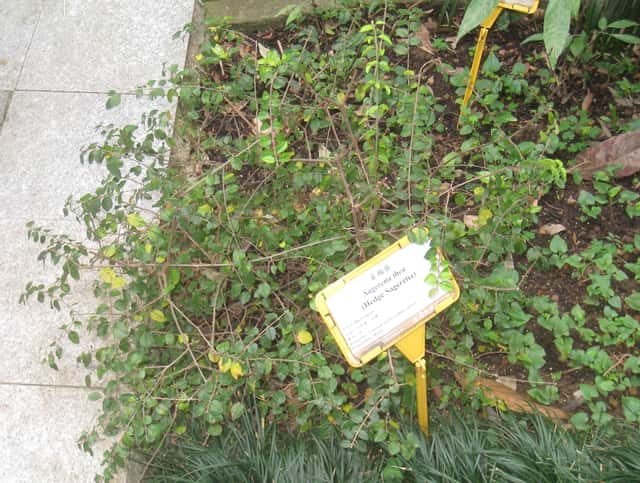
Rhamnaceae
Sweet Plum: Edible Plant
Sageretia theezans
The Sageretia prefers bright light without direct midday sun, consistently moist substrate, and high humidity. Temperatures between 50 and 77 °F (10-25 °C) are best tolerated; frost and dry air from heating systems should be avoided. Regular fertilization during the growing season and a well-draining, slightly acidic substrate complete its care.
Every 3 days
Bright indirect
10° - 25°C
50% - 70%
Categories
What is Sweet Plum?
Sweet Plum (Sageretia theezans) is a medium-care plant from the Rhamnaceae family. The Chinese Sweet Plum (Sageretia theezans) is an evergreen shrub from the buckthorn family (Rhamnaceae), native to southern China. It is one of the most popular indoor bonsai species, combining fine, glossy foliage, attractive scaly, multicolored bark, and reddish new growth at the shoot tips. In l...
Sweet Plum grows up to 3.0m, spread of 200cm, watering every 3 days, 10°C – 25°C, 50–70% humidity. It is suitable for indoor environments and safe for pets.
Unlike many popular species, Sweet Plum is safe to keep around pets. Without adequate drainage, root rot can develop within 7 days.
How to Care for Sweet Plum?
TLDR: Sweet Plum needs Bright indirect, watering every 3 days, and temperatures between 10-25°C with 50-70% humidity.
How Often Should You Water Sweet Plum?
The substrate should always be kept slightly moist—water as soon as the top layer has dried out. The Sweet Plum is very sensitive to drought; even a single missed watering can cause leaves and branches to dry up. However, avoid waterlogging in the pot and use soft, lime-free water if possible.
How Much Light Does Sweet Plum Need?
Choose a bright location with plenty of indirect light, protecting it from harsh midday sun in summer. Indoors, a spot near a south- or west-facing window is ideal; if light is insufficient, a grow light can be used.
What Is the Best Soil for Sweet Plum?
Use a well-draining, slightly acidic to neutral bonsai substrate, such as a mix of Akadama, lava granulate, and some peat moss or gravel. Good drainage is essential to ensure the roots never sit in water.
What Pot Should You Use for Sweet Plum?
A shallow, unglazed or subtly glazed bonsai pot with generous drainage holes is ideal—it allows excess water to drain quickly and complements the reddish-brown bark and dark green leaves.
Care Schedule
Fertilize
Every 14 days
Misting
Every 2 days
Repot
Every 730 days
What Is Sweet Plum and Where Does It Come From?
The Chinese Sweet Plum (Sageretia theezans) is an evergreen shrub from the buckthorn family (Rhamnaceae), native to southern China. It is one of the most popular indoor bonsai species, combining fine, glossy foliage, attractive scaly, multicolored bark, and reddish new growth at the shoot tips. In late summer, inconspicuous creamy-white flower panicles appear, followed by small, edible blue-black drupes. In its native habitat, it grows 1 to 3 meters tall, but as a bonsai, it remains significantly smaller through regular pruning.
How to Propagate Sweet Plum?
Stem Cuttings
Use clean, sharp tools and protect the cutting from direct sun. High humidity significantly accelerates rooting.
- 1 Cut a 3-4 inch (8-10 cm) semi-hardwood shoot without flowers
- 2 Remove lower leaves and dip the cut end into rooting hormone
- 3 Insert into a well-draining, moist substrate (e.g., an Akadama-gravel mix)
- 4 Keep warm under a plastic dome or in a mini-greenhouse with high humidity
- 5 Keep the substrate evenly moist until new growth appears after 3-5 weeks
Materials needed:
How Big Does Sweet Plum Grow?
TLDR: Sweet Plum can reach up to 3.0m tall with Medium growth rate.
Max height
3.0m
Spread
2.0m
Growth rate
Medium
Foliage
Evergreen
Plant Uses
Ornamental
Great for decoration
Edible
Can be consumed
Medicinal
Medicinal properties
Medicinal Uses
- Leaves and fruits are valued in traditional Chinese folk medicine for their antioxidant properties
- Subject of current scientific research regarding the antioxidant and antiviral components of the fruit
Culinary Uses
- The small, ripe blue-black drupes are edible and are occasionally eaten raw in southern China
- Due to the small size of the fruits, commercial culinary use is negligible
Is your plant showing symptoms?
Click on the symptom to discover possible causes:
What Diseases Commonly Affect Sweet Plum?
TLDR: Sweet Plum is susceptible to 10 known diseases. Monitor regularly for early detection.
Aphids
Aphids are small, soft-bodied, pear-shaped insects (1/16 to 1/8 inch long) that feed by sucking nutrient-rich sap from plants. They reproduce rapidly and can quickly weaken plants, causing distorted growth and transmitting plant viruses. Aphids come in various colors including green, black, red, yellow, brown, and gray. They secrete honeydew, a sticky substance that attracts ants and encourages sooty mold growth.
Whiteflies
Whiteflies are small, soft-bodied, winged insects closely related to aphids and mealybugs. They are moth-like in appearance, about 1/16 inch long, triangular in shape, and gray-white in color. These sap-sucking pests feed on plant tissue, causing yellowing, stunted growth, and wilting. They also excrete honeydew, which attracts ants and promotes sooty mold growth. Whiteflies can transmit serious plant viruses.
Spider Mites
Spider mites are tiny arachnids (less than 1/20 inch long) related to spiders and ticks that feed on plant sap. They thrive in hot, dry conditions and can cause significant damage to ornamental and vegetable plants. During severe infestations, crop losses can reach 14% or higher as these pests disrupt vital plant processes including photosynthesis, carbon dioxide absorption, and transpiration.
Mealybugs
Mealybugs are small, soft-bodied insects covered with a white, waxy, cottony material. They are common pests of houseplants and outdoor plants in mild climates. These sap-sucking insects feed on plant tissue, causing damage, stunted growth, and can lead to plant death if left untreated. They produce sticky honeydew which attracts sooty mold.
Meaning & Symbolism
In bonsai tradition, the Sageretia represents patience, constancy, and quiet elegance—its dense, small-leaved growth and ability to sprout readily after pruning make it a symbol of endurance and renewal.
Compare with similar plants
| Attribute | Difficulty | Light | Watering | Pet Safe |
|---|---|---|---|---|
| Dark Fieldcap | Medium | Low light | 2d | ⚠️ |
| Azalea | Medium | Partial shade | 3d | ⚠️ |
| Bougainvillea | Medium | Direct sun | 7d | ⚠️ |
| Wild Lettuce | Medium | Direct sun | 7d | ⚠️ |
Choose & Compare
Sources & References
- Care guide for the Sweet plum (Sageretia bonsai) - Bonsai Empire
- Sageretia theezans/ Chinese Bird Plum Bonsai - Bonsai4Me
- Sageretia theezans Care: An Expert Guide to Healthy, Beautiful Bonsai
- Sageretie Bonsai (Sageretia theezans) - Bonsai Empire DE
- Sageretia theezans - Wikipedia
- Pflegeanleitung Sageretia thea Sageretie



