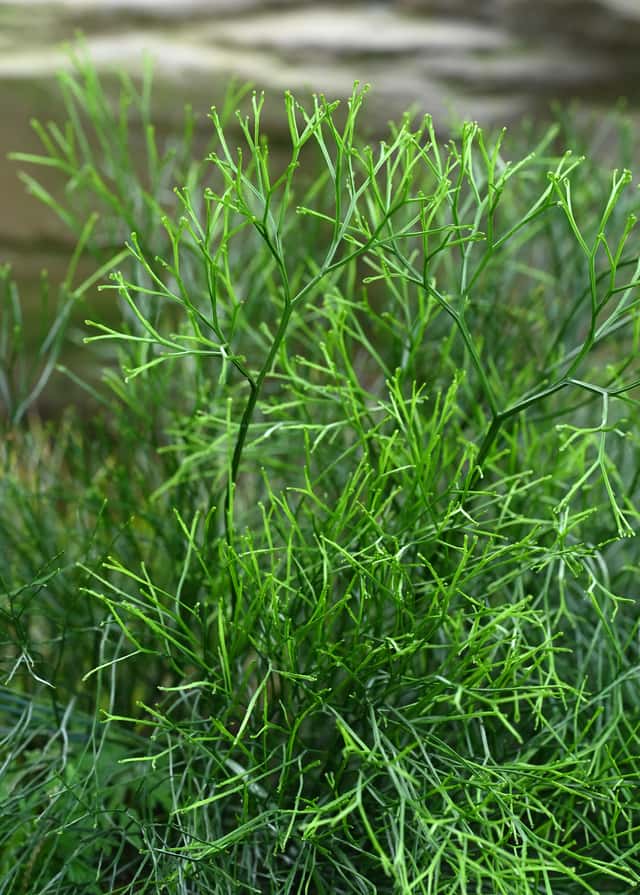
Psilotaceae
Whisk Fern: How to Care for Psilotum nudum
Psilotum nudum
A hardy plant preferring bright indirect light and high humidity. Keep the substrate lightly moist, mist regularly, and avoid waterlogging. Ideal for terrariums or humid environments.
Every 7 days
Partial shade
13° - 38°C
60% - 80%
Categories
What is Whisk Fern?
Whisk Fern (Psilotum nudum) is a medium-care plant from the Psilotaceae family. Psilotum nudum, commonly known as the Whisk Fern, is one of the most primitive vascular plants on Earth, with a lineage stretching back over 400 million years. Lacking true roots and leaves, it absorbs water and nutrients through its rhizomes and photosynthetic green stems. Native to pantropical reg...
Whisk Fern grows up to 51cm, spread of 76cm, watering every 7 days, 13°C – 38°C, 60–80% humidity. It is suitable for indoor environments and safe for pets.
Unlike many popular species, Whisk Fern is safe to keep around pets. Without adequate drainage, root rot can develop within 14 days.
How to Care for Whisk Fern?
TLDR: Whisk Fern needs Partial shade, watering every 7 days, and temperatures between 13-38°C with 60-80% humidity.
How Often Should You Water Whisk Fern?
Water every 7 days or when the top of the substrate feels slightly dry. Avoid standing water as it is sensitive to rhizome rot.
How Much Light Does Whisk Fern Need?
Prefers bright indirect light, such as near filtered windows. Avoid intense direct sun which can scorch the green stems.
What Is the Best Soil for Whisk Fern?
Use a well-draining mix: equal parts peat moss, perlite, and coarse sand. Ideal pH between 5.0 and 6.5.
What Pot Should You Use for Whisk Fern?
Terracotta or ceramic pot with drainage holes; glass terrariums with good ventilation are excellent options.
Care Schedule
Fertilize
Every 90 days
Misting
Every 4 days
Repot
Every 365 days
What Is Whisk Fern and Where Does It Come From?
Psilotum nudum, commonly known as the Whisk Fern, is one of the most primitive vascular plants on Earth, with a lineage stretching back over 400 million years. Lacking true roots and leaves, it absorbs water and nutrients through its rhizomes and photosynthetic green stems. Native to pantropical regions, it grows naturally in rock crevices and as an epiphyte.
How to Propagate Whisk Fern?
Spore Propagation
Germination is slow and requires a very humid environment. Avoid drafts and sudden temperature changes.
- 1 Collect yellow sporangia when mature
- 2 Sow on moist peat-based substrate
- 3 Cover with clear plastic to retain humidity
- 4 Keep in indirect light at 20-25°C
- 5 Wait for germination and prothallus formation
Materials needed:
Rhizome Division
Maintain high humidity after division to prevent dehydration.
- 1 Carefully remove plant from pot
- 2 Identify healthy rhizomes
- 3 Divide with clean scissors, ensuring at least one stem per section
- 4 Plant each division in moist, well-draining substrate
Materials needed:
How Big Does Whisk Fern Grow?
TLDR: Whisk Fern can reach up to 51cm tall with Slow growth rate.
Max height
51cm
Spread
76cm
Growth rate
Slow
Foliage
Evergreen
Warning: Toxic Plant
This plant can be toxic if ingested. Keep out of reach of:
Plant Uses
Ornamental
Great for decoration
Medicinal
Medicinal properties
Medicinal Uses
- Used in traditional Asian and Polynesian medicine to treat headaches and rheumatism
Is your plant showing symptoms?
Click on the symptom to discover possible causes:
What Diseases Commonly Affect Whisk Fern?
TLDR: Whisk Fern is susceptible to 7 known diseases. Monitor regularly for early detection.
Root Rot
Root rot is a serious fungal disease that affects the root system of plants, causing them to decay and die. It is primarily caused by overwatering, poor drainage, or soil-borne fungi such as Pythium, Phytophthora, Rhizoctonia, and Fusarium. The disease thrives in waterlogged conditions where roots are deprived of oxygen, making them susceptible to fungal infection.
Overwatering
Overwatering occurs when plants receive too much water, depriving roots of oxygen and causing root rot. This environmental stress is one of the most common causes of houseplant death, as waterlogged soil prevents roots from breathing and functioning properly.
Low Humidity Stress
Low humidity stress occurs when indoor air becomes too dry, causing plants to lose moisture faster than they can absorb it through their roots. This is especially common during winter heating periods, near radiators and heating vents, or in air-conditioned spaces. Tropical plants are particularly susceptible to low humidity damage.
Aphids
Aphids are small, soft-bodied, pear-shaped insects (1/16 to 1/8 inch long) that feed by sucking nutrient-rich sap from plants. They reproduce rapidly and can quickly weaken plants, causing distorted growth and transmitting plant viruses. Aphids come in various colors including green, black, red, yellow, brown, and gray. They secrete honeydew, a sticky substance that attracts ants and encourages sooty mold growth.
Meaning & Symbolism
Symbolizes antiquity and resilience — a living window into the earliest evolution of plant life on Earth.
Fun Facts
One of the oldest vascular plants on Earth, with ancestors that lived alongside dinosaurs 400 million years ago.
It has no true roots or leaves — it absorbs water and nutrients through its rhizomes and photosynthetic stems.
Grows naturally in rock crevices and as an epiphyte, requiring no traditional soil.
Its yellow fused sporangia in groups of three are its characteristic reproductive structure.
Frequently asked questions
How often should I water my Whisk Fern?
Can the Whisk Fern grow indoors?
Why is my Whisk Fern turning yellow?
How do I propagate a Whisk Fern?
Is the Whisk Fern toxic to pets?
Compare with similar plants
| Attribute | Difficulty | Light | Watering | Pet Safe |
|---|---|---|---|---|
| Dark Fieldcap | Medium | Low light | 2d | ⚠️ |
| Azalea | Medium | Partial shade | 3d | ⚠️ |
| Bougainvillea | Medium | Direct sun | 7d | ⚠️ |
| Wild Lettuce | Medium | Direct sun | 7d | ⚠️ |



