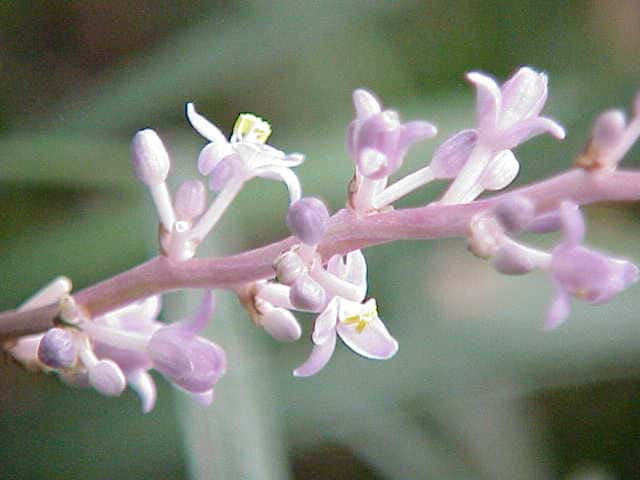
Asparagaceae
White Lilyturf: Ground Cover Plant
Ophiopogon jaburan
Grow in rich, well-draining soil kept lightly moist. Best in partial shade, though it tolerates full sun in cooler or coastal climates. Feed occasionally and divide clumps every few years to keep growth vigorous.
Every 7 days
Partial shade
7° - 32°C
40% - 70%
Categories
What is White Lilyturf?
White Lilyturf (Ophiopogon jaburan) is a easy-care plant from the Asparagaceae family. White lilyturf (Ophiopogon jaburan) is an evergreen perennial native to Japan and southern Korea, prized as a shade-tolerant groundcover and border plant. It forms dense clumps of long, arching, strap-like leaves — plain green or variegated with cream stripes — and sends up spikes of small white to...
White Lilyturf grows up to 75cm, spread of 45cm, watering every 7 days, 7°C – 32°C, 40–70% humidity. It is suitable for indoor environments and safe for pets.
Unlike many tropical plants, White Lilyturf tolerates watering mistakes. Best for beginners. Unlike many popular species, White Lilyturf is safe to keep around pets. Without adequate drainage, root rot can develop within 14 days.
How to Care for White Lilyturf?
TLDR: White Lilyturf needs Partial shade, watering every 7 days, and temperatures between 7-32°C with 40-70% humidity.
How Often Should You Water White Lilyturf?
Water regularly to keep soil evenly moist; let the top layer dry slightly between waterings to avoid root rot in soggy conditions.
How Much Light Does White Lilyturf Need?
Thrives in partial to dappled shade; can take full sun where summers are mild or coastal, as long as moisture stays consistent.
What Is the Best Soil for White Lilyturf?
Plant in humus-rich, well-draining soil. Working compost into the planting hole helps retain moisture without waterlogging the roots.
What Pot Should You Use for White Lilyturf?
Terracotta or ceramic pots with ample drainage holes work best, helping excess moisture escape from the root zone.
Care Schedule
Fertilize
Every 60 days
Repot
Every 730 days
What Is White Lilyturf and Where Does It Come From?
White lilyturf (Ophiopogon jaburan) is an evergreen perennial native to Japan and southern Korea, prized as a shade-tolerant groundcover and border plant. It forms dense clumps of long, arching, strap-like leaves — plain green or variegated with cream stripes — and sends up spikes of small white to pale lavender flowers in summer, followed by ornamental violet-black berries in fall. Low-maintenance and adaptable, it handles partial shade to full coastal sun and light frost.
How to Propagate White Lilyturf?
Clump division
- Divide in early spring or fall
- Use a sharp spade or knife to separate sections
- Each division should keep roots and a few leaves
- 1 Lift the clump
Carefully dig up the entire clump, keeping as much of the root system intact as possible.
- 2 Split sections
Separate the clump into smaller portions, each with healthy rhizome and roots.
- 3 Replant
Plant divisions into rich, well-draining soil and water thoroughly until established.
Materials needed:
How Big Does White Lilyturf Grow?
TLDR: White Lilyturf can reach up to 75cm tall with Medium growth rate.
Max height
75cm
Spread
45cm
Growth rate
Medium
Foliage
Evergreen
Plant Uses
Ornamental
Great for decoration
Ground Cover
Soil coverage
Is your plant showing symptoms?
Click on the symptom to discover possible causes:
What Diseases Commonly Affect White Lilyturf?
TLDR: White Lilyturf is susceptible to 4 known diseases. Monitor regularly for early detection.
Root Rot
Root rot is a serious fungal disease that affects the root system of plants, causing them to decay and die. It is primarily caused by overwatering, poor drainage, or soil-borne fungi such as Pythium, Phytophthora, Rhizoctonia, and Fusarium. The disease thrives in waterlogged conditions where roots are deprived of oxygen, making them susceptible to fungal infection.
Colletotrichum liriopes
Colletotrichum liriopes is a fungus that causes anthracnose on Liriope (often used as edging or groundcover). It thrives in warm, humid weather and spreads by splashing water, tight plant spacing, and contaminated tools. Look for tan to dark-brown leaf spots with darker edges, streaks that run along the leaves, and tip dieback. In very wet conditions you may see tiny salmon‑orange spore masses on the spots. Clumps can thin out and look scorched from the tips downward. Liriope is the main host, but closely related ornamental lilyturf and some similar edging grasses can show comparable symptoms.
Slugs and Snails
Slugs and snails are mollusks that feed on plant tissue, causing irregular holes in leaves and damage to young seedlings. They are most active at night and in moist conditions, leaving characteristic silvery slime trails. These pests can quickly devastate gardens, especially during wet seasons.
Scale Insects
Scale insects are small sap-sucking pests that appear as brown, shell-like bumps on plant stems and leaves. There are over 25 species, divided into armored (hard) and unarmored (soft) scales. They feed by piercing plant tissue and extracting sap, which weakens the plant and can lead to yellowing, stunted growth, and even death if left untreated. They also excrete honeydew, which attracts ants and promotes sooty mold growth.
Meaning & Symbolism
Valued as a symbol of quiet resilience — its dense, spreading clumps steadily cover and stabilize shaded ground where little else thrives.
Compare with similar plants
| Attribute | Difficulty | Light | Watering | Pet Safe |
|---|---|---|---|---|
| Field Maple | Easy | Bright indirect | 14d | ✓ |
| Silver Birch | Easy | Direct sun | 14d | ✓ |
| Cushion Bush | Easy | Direct sun | 14d | ✓ |
| Peruvian peppertree | Easy | Direct sun | 14d | ⚠️ |





