Oleaceae
Narrow-leaved Ash: Full Sun Plant
Fraxinus angustifolia
The narrow-leafed ash is a robust and fast-growing tree, ideal for large outdoor spaces. It prefers full sun, deep and fertile soils with good drainage, and regular watering during its first few years. Once established, it tolerates moderate drought periods well. Annual maintenance pruning helps maintain the shape and health of the canopy.
Every 10 days
Direct sun
-20° - 35°C
40% - 70%
Categories
What is Narrow-leaved Ash?
Narrow-leaved Ash (Fraxinus angustifolia) is a medium-care plant from the Oleaceae family. Fraxinus angustifolia, commonly known as narrow-leaved ash, is a medium to large deciduous tree native to Southern Europe, Northwest Africa, and Southwest Asia. It belongs to the family Oleaceae and can reach heights of 20 to 30 meters. Its pinnate leaves with slender, characteristic leaflets turn y...
Narrow-leaved Ash grows up to 30.0m, spread of 1200cm, watering every 10 days, -20°C – 35°C, 40–70% humidity. It is not suitable for indoor environments and safe for pets.
Unlike many popular species, Narrow-leaved Ash is safe to keep around pets.
How to Care for Narrow-leaved Ash?
TLDR: Narrow-leaved Ash needs Direct sun, watering every 10 days, and temperatures between -20-35°C with 40-70% humidity.
How Often Should You Water Narrow-leaved Ash?
Water regularly during the first 2 to 3 years after planting, especially during summer droughts. Once established, the tree accesses groundwater and only requires supplemental watering during prolonged dry spells.
How Much Light Does Narrow-leaved Ash Need?
Requires full sun for vigorous growth and proper canopy shape. It tolerates some partial shade, but growth will be less exuberant and the canopy less dense.
What Is the Best Soil for Narrow-leaved Ash?
Prefers loamy, deep, and fertile soils with good drainage. It tolerates clay, sandy, and calcareous soils. The ideal pH is between 5.5 and 7.5. Enrich poor soils with organic matter before planting.
Care Schedule
Fertilize
Every 90 days
What Is Narrow-leaved Ash and Where Does It Come From?
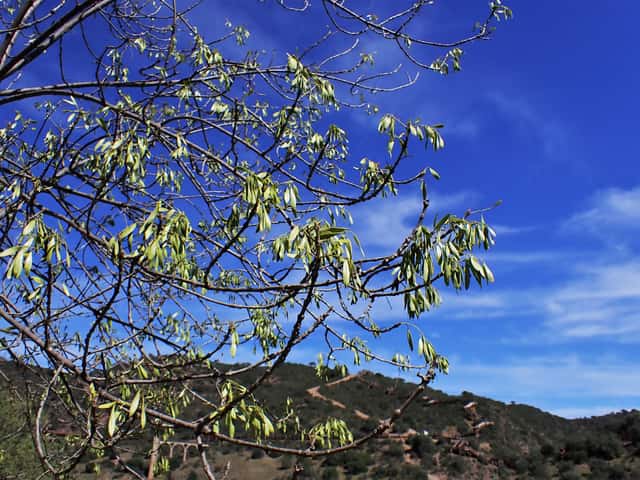
Fraxinus angustifolia, commonly known as narrow-leaved ash, is a medium to large deciduous tree native to Southern Europe, Northwest Africa, and Southwest Asia. It belongs to the family Oleaceae and can reach heights of 20 to 30 meters. Its pinnate leaves with slender, characteristic leaflets turn yellow and reddish in autumn. It flowers in spring before leaf emergence, producing small purplish-green flowers pollinated by wind.
How to Propagate Narrow-leaved Ash?
Sowing
Fresh seeds germinate more easily. Stored seeds require prolonged cold stratification. Protect seedlings from frost.
- 1 Collect mature seeds (samaras) in the autumn
- 2 Cold stratify for 2-3 months in moist sand at 4°C
- 3 Sow in seed trays with well-drained substrate in the spring
- 4 Keep moist and in a location with indirect light until germination
- 5 Prick out into larger pots when they reach 15-20 cm
Materials needed:
How Big Does Narrow-leaved Ash Grow?
TLDR: Narrow-leaved Ash can reach up to 30.0m tall with Fast growth rate.
Max height
30.0m
Spread
12.0m
Growth rate
Fast
Foliage
Deciduous
Plant Uses
Ornamental
Great for decoration
Is your plant showing symptoms?
Click on the symptom to discover possible causes:
What Diseases Commonly Affect Narrow-leaved Ash?
TLDR: Narrow-leaved Ash is susceptible to 10 known diseases. Monitor regularly for early detection.
Root Rot
Root rot is a serious fungal disease that affects the root system of plants, causing them to decay and die. It is primarily caused by overwatering, poor drainage, or soil-borne fungi such as Pythium, Phytophthora, Rhizoctonia, and Fusarium. The disease thrives in waterlogged conditions where roots are deprived of oxygen, making them susceptible to fungal infection.
Phytophthora Root Rot
Disease caused by fungus-like organisms (oomycetes) that live in soil and can survive for years. It affects roots, stem, and crown of plants, being especially severe in waterlogged or poorly drained soils. It is the second most common cause of root rot in trees and shrubs.
Canker
Canker is a disease caused by various fungi and bacteria that create necrotic, sunken areas on bark of branches, stems, and trunks. Pathogens enter through wounds and natural openings, especially when plants are stressed. Canker can gradually weaken or kill branches by disrupting water and nutrient flow.
Anthracnose
Anthracnose is a fungal disease caused by fungi in the genus Colletotrichum that affects many plants, including vegetables, fruits, and trees. The disease thrives in cool, wet conditions, causing dark, sunken lesions on leaves, stems, flowers, and fruits.
Meaning & Symbolism
In Norse mythology, the ash tree (Yggdrasil) was the sacred world tree. In Portugal and throughout Europe, the ash tree symbolizes strength, resilience, and longevity.
Compare with similar plants
| Attribute | Difficulty | Light | Watering | Pet Safe |
|---|---|---|---|---|
| Dark Fieldcap | Medium | Low light | 2d | ⚠️ |
| Azalea | Medium | Partial shade | 3d | ⚠️ |
| Bougainvillea | Medium | Direct sun | 7d | ⚠️ |
| Wild Lettuce | Medium | Direct sun | 7d | ⚠️ |



