Moraceae
Alii Fig: Perfect Indoor Houseplant
Ficus binnendijkii
Ficus Alii requires bright, indirect light, watering approximately every 9 days, and well-draining soil. It is sensitive to sudden environmental changes (moving, drafts, temperature fluctuations), which can cause leaf drop. It thrives in higher humidity of 40-50% and temperatures between 10-29 °C. Fertilize approximately every 3 weeks during the growing season.
Every 9 days
Bright indirect
10° - 29°C
40% - 50%
Categories
What is Alii Fig?
Alii Fig (Ficus binnendijkii) is a medium-care plant from the Moraceae family. Ficus Alii (Ficus binnendijkii) is an elegant evergreen ornamental tree from the Moraceae family, native to Southeast Asia. It is characterized by long, narrow, leathery willow-like leaves that hang from thin, flexible branches. It grows slowly and can reach a height of up to 300 cm indoors with a s...
Alii Fig grows up to 3.0m, spread of 150cm, watering every 9 days, 10°C – 29°C, 40–50% humidity. It is suitable for indoor environments and not safe for pets.
Without precautions, ingestion can cause irritation in pets. Keep out of reach of cats and dogs. Without adequate drainage, root rot can develop within 18 days.
How to Care for Alii Fig?
TLDR: Alii Fig needs Bright indirect, watering every 9 days, and temperatures between 10-29°C with 40-50% humidity.
How Often Should You Water Alii Fig?
Water approximately every 9 days, only once the top few centimeters of the soil have dried out. The plant is sensitive to watering (high sensitivity) - both overwatering and prolonged drought lead to yellowing and leaf drop. Ensure good drainage of excess water from the saucer under the pot.
How Much Light Does Alii Fig Need?
Place in a spot with bright, indirect light, such as near a window without direct sun. A lack of light will slow growth and may cause the canopy to thin, while direct midday sun will burn the leaves.
What Is the Best Soil for Alii Fig?
Use a well-draining potting mix for houseplants, ideally with added perlite or bark for better aeration and drainage. Avoid waterlogging the root ball.
What Pot Should You Use for Alii Fig?
Choose a pot with a drainage hole and a saucer, ideally made of terracotta or ceramic, which helps wick away excess moisture. Repot approximately every 2 years into a slightly larger pot.
Care Schedule
Fertilize
Every 21 days
Rotate
Every 7 days
Repot
Every 730 days
What Is Alii Fig and Where Does It Come From?
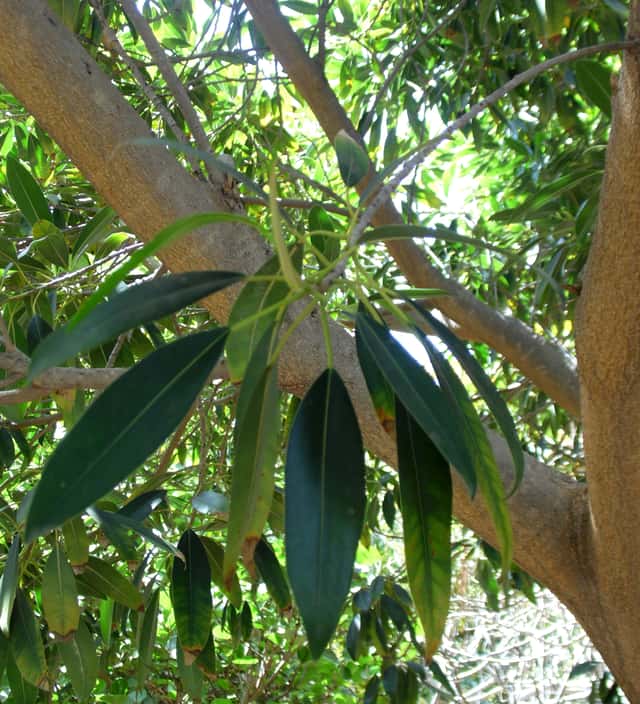
Ficus Alii (Ficus binnendijkii) is an elegant evergreen ornamental tree from the Moraceae family, native to Southeast Asia. It is characterized by long, narrow, leathery willow-like leaves that hang from thin, flexible branches. It grows slowly and can reach a height of up to 300 cm indoors with a spread of around 150 cm. Due to its upright, slender growth habit, it is popular as a specimen plant for room corners and is more resistant to fluctuating conditions than other Ficus species.
How to Propagate Alii Fig?
Stem Cuttings
- 1 Cut a 10-15 cm long cutting with 2-3 leaves from a semi-woody branch.
- 2 Let the cutting dry for a few hours to allow the latex sap to stop flowing.
- 3 Dip the end of the cutting into rooting hormone.
- 4 Plant in a moist substrate (e.g., perlite with peat) and maintain high humidity.
- 5 Roots typically form in 4-8 weeks at a temperature around 24 °C.
Air Layering
- 1 Make a shallow incision or remove a strip of bark at the chosen spot on the stem.
- 2 Wrap the wound with moistened sphagnum moss.
- 3 Cover with transparent plastic wrap and secure at both ends.
- 4 After 6-10 weeks, once new roots are visible, cut below them and plant in substrate.
How Big Does Alii Fig Grow?
TLDR: Alii Fig can reach up to 3.0m tall with Slow growth rate.
Max height
3.0m
Spread
1.5m
Growth rate
Slow
Foliage
Evergreen
Warning: Toxic Plant
This plant can be toxic if ingested. Keep out of reach of:
Plant Uses
Ornamental
Great for decoration
Air Purifying
Improves air quality
Is your plant showing symptoms?
Click on the symptom to discover possible causes:
What Diseases Commonly Affect Alii Fig?
TLDR: Alii Fig is susceptible to 14 known diseases. Monitor regularly for early detection.
Spider Mites
Spider mites are tiny arachnids (less than 1/20 inch long) related to spiders and ticks that feed on plant sap. They thrive in hot, dry conditions and can cause significant damage to ornamental and vegetable plants. During severe infestations, crop losses can reach 14% or higher as these pests disrupt vital plant processes including photosynthesis, carbon dioxide absorption, and transpiration.
Scale Insects
Scale insects are small sap-sucking pests that appear as brown, shell-like bumps on plant stems and leaves. There are over 25 species, divided into armored (hard) and unarmored (soft) scales. They feed by piercing plant tissue and extracting sap, which weakens the plant and can lead to yellowing, stunted growth, and even death if left untreated. They also excrete honeydew, which attracts ants and promotes sooty mold growth.
Mealybugs
Mealybugs are small, soft-bodied insects covered with a white, waxy, cottony material. They are common pests of houseplants and outdoor plants in mild climates. These sap-sucking insects feed on plant tissue, causing damage, stunted growth, and can lead to plant death if left untreated. They produce sticky honeydew which attracts sooty mold.
Whiteflies
Whiteflies are small, soft-bodied, winged insects closely related to aphids and mealybugs. They are moth-like in appearance, about 1/16 inch long, triangular in shape, and gray-white in color. These sap-sucking pests feed on plant tissue, causing yellowing, stunted growth, and wilting. They also excrete honeydew, which attracts ants and promotes sooty mold growth. Whiteflies can transmit serious plant viruses.
Meaning & Symbolism
Across cultures, the Ficus is associated with prosperity, abundance, peace, and wisdom—the sacred fig tree is revered in Buddhism and Hinduism as a symbol of enlightenment.
Compare with similar plants
| Attribute | Difficulty | Light | Watering | Pet Safe |
|---|---|---|---|---|
| Dark Fieldcap | Medium | Low light | 2d | ⚠️ |
| Azalea | Medium | Partial shade | 3d | ⚠️ |
| Bougainvillea | Medium | Direct sun | 7d | ⚠️ |
| Wild Lettuce | Medium | Direct sun | 7d | ⚠️ |



