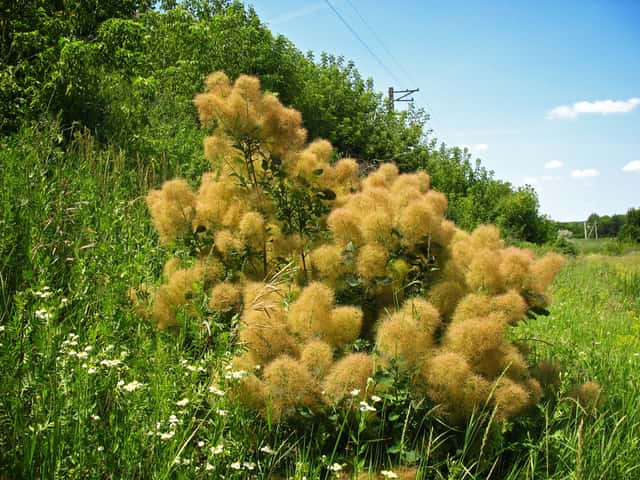
Anacardiaceae
Smoke tree: Full Sun Plant
Cotinus coggygria
The smoke tree is an extremely low-maintenance and hardy ornamental shrub. It thrives best in full sun, although it can tolerate partial shade—however, purple-leaved varieties may revert to green in the shade. Once established, it is drought-tolerant, requiring watering only during prolonged dry spells, approximately every 14 days. It performs well even in poor, rocky soils where other plants might struggle. Fertilizing once or twice a year is recommended, and the desired shape can be maintained with spring and summer pruning. It is hardy in USDA zones 4–8, withstanding temperatures as low as -34°C.
Every 14 days
Direct sun
-34° - 35°C
30% - 60%
Categories
What is Smoke tree?
Smoke tree (Cotinus coggygria) is a easy-care plant from the Anacardiaceae family. Cotinus coggygria, commonly known as the smoke tree or smokebush, is a deciduous ornamental shrub in the Anacardiaceae family, native to dry mountainous areas of Central and Southern Europe and Asia. It is named for its distinctive, smoke-like inflorescences that decorate the plant from mid-summer t...
Smoke tree grows up to 4.5m, spread of 450cm, watering every 14 days, -34°C – 35°C, 30–60% humidity. It is not suitable for indoor environments and safe for pets.
Unlike many tropical plants, Smoke tree tolerates watering mistakes. Best for beginners. Unlike many popular species, Smoke tree is safe to keep around pets.
How to Care for Smoke tree?
TLDR: Smoke tree needs Direct sun, watering every 14 days, and temperatures between -34-35°C with 30-60% humidity.
How Often Should You Water Smoke tree?
Water newly planted smoke trees twice a week during their first year to help roots establish. For established specimens, watering every 14 days during dry periods is sufficient—avoid standing water and heavy clay soil, as the roots are prone to rot. During rainy periods, watering can be skipped entirely.
How Much Light Does Smoke tree Need?
The smoke tree requires full sun—at least 6–8 hours of direct sunlight daily. It can survive in partial shade, but purple-leaved varieties may lose their characteristic color and turn green. The best flowering and autumn foliage color are achieved in a full sun location.
What Is the Best Soil for Smoke tree?
It prefers well-drained soil with a pH between 5.5 and 8.0. It thrives in rocky, stony, or poor-quality soils—it is unnecessary to plant it in nutrient-rich soil, as this promotes lush foliage at the expense of flowering. Definitely avoid heavy clay or waterlogged soils.
Care Schedule
Fertilize
Every 90 days
What Is Smoke tree and Where Does It Come From?
Cotinus coggygria, commonly known as the smoke tree or smokebush, is a deciduous ornamental shrub in the Anacardiaceae family, native to dry mountainous areas of Central and Southern Europe and Asia. It is named for its distinctive, smoke-like inflorescences that decorate the plant from mid-summer to autumn with silvery-pink, feathery puffs. The leaves are round-ovate, blue-green in summer, and turn spectacular shades of yellow, red, or purple in autumn. It can reach a height of 4–5 meters with a similar spread. It particularly prefers well-drained soil and full sun, requiring low maintenance due to its drought tolerance.
How to Propagate Smoke tree?
cutting
seed
layering
How Big Does Smoke tree Grow?
TLDR: Smoke tree can reach up to 4.5m tall with Fast growth rate.
Max height
4.5m
Spread
4.5m
Growth rate
Fast
Foliage
Deciduous
Plant Uses
Ornamental
Great for decoration
Medicinal Uses
- The bark and leaves of the smoketree have been used for centuries in leather tanning due to their high tannin content. In folk medicine, it has been used as an anti-inflammatory agent.
Is your plant showing symptoms?
Click on the symptom to discover possible causes:
What Diseases Commonly Affect Smoke tree?
TLDR: Smoke tree is susceptible to 7 known diseases. Monitor regularly for early detection.
Verticillium Wilt
Verticillium wilt is a soil-borne fungal disease caused primarily by the fungi Verticillium dahliae and V. albo-atrum. These pathogens infect plant roots and grow within the vascular tissues, blocking water and nutrient transport, resulting in wilting and eventual plant death. The disease affects over 350 plant species including vegetables, fruits, ornamental flowers, and trees. The fungi can survive in soil for more than 10 years as resistant structures called microsclerotia.
Powdery Mildew
Powdery mildew is a common fungal disease caused by various fungi species including Erysiphe, Podosphaera, Oïdium, and Leveillula. It affects over 10,000 plant species worldwide. The disease thrives in warm, dry climates with high humidity and appears as a distinctive white powdery coating on plant surfaces.
Aphids
Aphids are small, soft-bodied, pear-shaped insects (1/16 to 1/8 inch long) that feed by sucking nutrient-rich sap from plants. They reproduce rapidly and can quickly weaken plants, causing distorted growth and transmitting plant viruses. Aphids come in various colors including green, black, red, yellow, brown, and gray. They secrete honeydew, a sticky substance that attracts ants and encourages sooty mold growth.
Scale Insects
Scale insects are small sap-sucking pests that appear as brown, shell-like bumps on plant stems and leaves. There are over 25 species, divided into armored (hard) and unarmored (soft) scales. They feed by piercing plant tissue and extracting sap, which weakens the plant and can lead to yellowing, stunted growth, and even death if left untreated. They also excrete honeydew, which attracts ants and promotes sooty mold growth.
Compare with similar plants
| Attribute | Difficulty | Light | Watering | Pet Safe |
|---|---|---|---|---|
| Field Maple | Easy | Bright indirect | 14d | ✓ |
| Silver Birch | Easy | Direct sun | 14d | ✓ |
| Cushion Bush | Easy | Direct sun | 14d | ✓ |
| Peruvian peppertree | Easy | Direct sun | 14d | ⚠️ |





