Phyllanthaceae
Snow Bush (Breynia) Care Guide
Breynia
Give Breynia bright light, keep the soil evenly moist (never bone-dry, never soggy), and provide warm temperatures with decent humidity. It rewards attentive care with dense, colorful foliage, and sulks — wilting dramatically or reverting to plain green leaves — if light or water drops too low.
Every 3 days
Bright indirect
18° - 27°C
60% - 80%
Categories
What is Snow Bush?
Snow Bush (Breynia) is a medium-care plant from the Phyllanthaceae family. Breynia is a genus of around 35 evergreen shrubs in the Phyllanthaceae family, native to Southeast Asia, Australia and the western Pacific islands. The most widely grown ornamental species, Breynia disticha (snow bush), is prized for its small oval leaves splashed with white, pink and green in a mot...
Snow Bush grows up to 1.8m, spread of 150cm, watering every 3 days, 18°C – 27°C, 60–80% humidity. It is suitable for indoor environments and not safe for pets.
Without precautions, ingestion can cause irritation in pets. Keep out of reach of cats and dogs. Without adequate drainage, root rot can develop within 7 days.
How to Care for Snow Bush?
TLDR: Snow Bush needs Bright indirect, watering every 3 days, and temperatures between 18-27°C with 60-80% humidity.
How Often Should You Water Snow Bush?
Water as soon as the top inch of soil feels dry, roughly every 2-3 days in warm weather. Snow bush wilts fast when thirsty, so do not let it dry out completely, but avoid waterlogging the roots.
How Much Light Does Snow Bush Need?
Place in bright, indirect light or morning sun — a spot within a foot of a south-facing window is ideal indoors. Too little light causes the leaves to lose their white and pink variegation and revert to solid green.
What Is the Best Soil for Snow Bush?
Use a fertile, well-draining mix (potting soil, peat and perlite in roughly a 2:1:1 ratio) with a slightly acidic to neutral pH of 6.0-7.0. Good drainage is essential to avoid root rot.
What Pot Should You Use for Snow Bush?
A terracotta or plastic pot with ample drainage holes; terracotta helps prevent waterlogging.
Care Schedule
Fertilize
Every 21 days
Misting
Every 7 days
Repot
Every 730 days
What Is Snow Bush and Where Does It Come From?
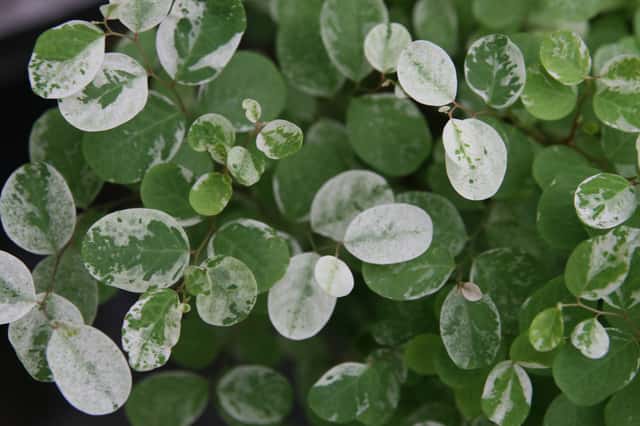
Breynia is a genus of around 35 evergreen shrubs in the Phyllanthaceae family, native to Southeast Asia, Australia and the western Pacific islands. The most widely grown ornamental species, Breynia disticha (snow bush), is prized for its small oval leaves splashed with white, pink and green in a mottled, almost hand-painted pattern. Grown as a houseplant, patio shrub, or clipped hedge in warm climates, it produces tiny inconspicuous flowers that are rarely the main attraction — the variegated foliage does all the work. It suckers and grows quickly, so regular pruning keeps it tidy and encourages the brightest new leaf color.
How to Propagate Snow Bush?
Stem cutting
Use clean, sharp tools and keep the growing medium consistently moist but not soggy; a plastic bag or humidity dome speeds rooting.
- 1 Cut a 4-6 inch (10-15 cm) softwood stem with 3-4 leaf nodes just below a node
- 2 Remove the lower leaves and dip the cut end in rooting hormone (optional but helpful)
- 3 Insert the cutting into a moist mix of perlite and peat, or place in water
- 4 Keep warm and humid with bright indirect light, using bottom heat if possible
- 5 Roots typically form in 3-4 weeks; pot up once roots are 1-2 inches long
Materials needed:
Sucker division
Suckers already have their own roots, so this method establishes faster than cuttings and is ideal since Breynia suckers profusely.
- 1 Locate a rooted sucker growing from the base of the parent plant
- 2 Dig around the sucker carefully to expose its own root system
- 3 Sever it from the parent with a clean cut, keeping roots intact
- 4 Transplant immediately into well-draining potting mix
- 5 Water thoroughly and keep in indirect light until established
Materials needed:
How Big Does Snow Bush Grow?
TLDR: Snow Bush can reach up to 1.8m tall with Fast growth rate.
Max height
1.8m
Spread
1.5m
Growth rate
Fast
Foliage
Evergreen
Warning: Toxic Plant
This plant can be toxic if ingested. Keep out of reach of:
Plant Uses
Ornamental
Great for decoration
Is your plant showing symptoms?
Click on the symptom to discover possible causes:
What Diseases Commonly Affect Snow Bush?
TLDR: Snow Bush is susceptible to 8 known diseases. Monitor regularly for early detection.
Aphids
Aphids are small, soft-bodied, pear-shaped insects (1/16 to 1/8 inch long) that feed by sucking nutrient-rich sap from plants. They reproduce rapidly and can quickly weaken plants, causing distorted growth and transmitting plant viruses. Aphids come in various colors including green, black, red, yellow, brown, and gray. They secrete honeydew, a sticky substance that attracts ants and encourages sooty mold growth.
Spider Mites
Spider mites are tiny arachnids (less than 1/20 inch long) related to spiders and ticks that feed on plant sap. They thrive in hot, dry conditions and can cause significant damage to ornamental and vegetable plants. During severe infestations, crop losses can reach 14% or higher as these pests disrupt vital plant processes including photosynthesis, carbon dioxide absorption, and transpiration.
Mealybugs
Mealybugs are small, soft-bodied insects covered with a white, waxy, cottony material. They are common pests of houseplants and outdoor plants in mild climates. These sap-sucking insects feed on plant tissue, causing damage, stunted growth, and can lead to plant death if left untreated. They produce sticky honeydew which attracts sooty mold.
Scale Insects
Scale insects are small sap-sucking pests that appear as brown, shell-like bumps on plant stems and leaves. There are over 25 species, divided into armored (hard) and unarmored (soft) scales. They feed by piercing plant tissue and extracting sap, which weakens the plant and can lead to yellowing, stunted growth, and even death if left untreated. They also excrete honeydew, which attracts ants and promotes sooty mold growth.
Fun Facts
The colorful mottled foliage is not caused by disease or nutrient stress — it is a natural genetic variegation.
Its fruit is a tiny bright red berry that contrasts strikingly against the white-and-pink leaves.
The species name disticha refers to its leaves growing in two flat opposite ranks along the stem.
It is a favorite bonsai subject in warm climates thanks to its small leaves and fast, bushy growth.
Frequently asked questions
Why is my Breynia losing its white and pink color?
How often should I water Breynia?
Is Breynia toxic to pets or humans?
Why does my snow bush keep wilting?
How do I keep my snow bush bushy instead of leggy?
Compare with similar plants
| Attribute | Difficulty | Light | Watering | Pet Safe |
|---|---|---|---|---|
| Dark Fieldcap | Medium | Low light | 2d | ⚠️ |
| Azalea | Medium | Partial shade | 3d | ⚠️ |
| Bougainvillea | Medium | Direct sun | 7d | ⚠️ |
| Wild Lettuce | Medium | Direct sun | 7d | ⚠️ |



