Asteraceae
Acanthus-leaved carline thistle: Edible Plant
Carlina acanthifolia
An extremely hardy and low-maintenance plant. Requires full sun and poor, well-drained, calcareous soil. Highly drought-tolerant, it cannot tolerate excess moisture. Do not fertilize. Avoid any root disturbance once established.
Every 21 days
Direct sun
-20° - 35°C
20% - 50%
Categories
What is Acanthus-leaved carline thistle?
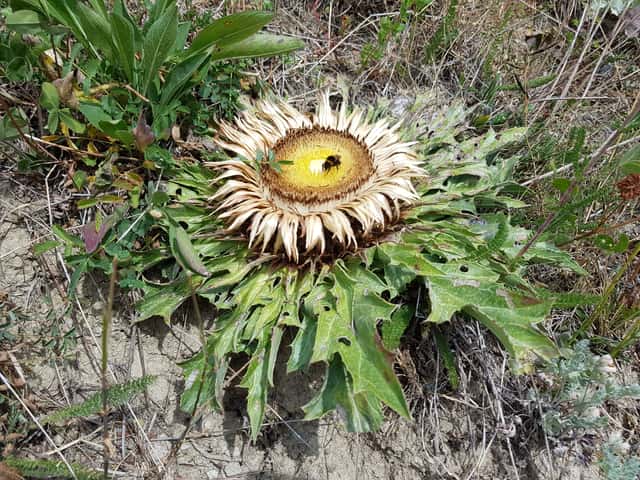
Acanthus-leaved carline thistle (Carlina acanthifolia) is a easy-care plant from the Asteraceae family. The Acanthus-leaved carline thistle (Carlina acanthifolia) is a stemless perennial native to European mountains, forming a rosette of large, spiny, pinnatifid leaves pressed against the ground. Its large solitary flower head, which can reach 15 cm in diameter, features pale golden-yellow inner bract...
Acanthus-leaved carline thistle grows up to 15cm, spread of 40cm, watering every 21 days, -20°C – 35°C, 20–50% humidity. It is not suitable for indoor environments and safe for pets.
Unlike many tropical plants, Acanthus-leaved carline thistle tolerates watering mistakes. Best for beginners. Unlike many popular species, Acanthus-leaved carline thistle is safe to keep around pets.
How to Care for Acanthus-leaved carline thistle?
TLDR: Acanthus-leaved carline thistle needs Direct sun, watering every 21 days, and temperatures between -20-35°C with 20-50% humidity.
How Often Should You Water Acanthus-leaved carline thistle?
Water moderately during the first few weeks after planting, then let nature take its course. The Carline thistle is extremely drought-tolerant; in summer, a light watering every 3 weeks is sufficient if there is no rain. Excess moisture is its main enemy and causes root rot.
How Much Light Does Acanthus-leaved carline thistle Need?
Expose to full direct sun, without even light shade. Insufficient exposure prevents flowering and weakens the plant. Ideal on a south-facing rocky slope.
What Is the Best Soil for Acanthus-leaved carline thistle?
Poor, stony, well-drained, and calcareous soil is essential. Avoid nitrogen-rich soils or heavy soils that retain moisture. A mixture of 2/3 soil and 1/3 sand is suitable for deep pot cultivation. Never fertilize.
What Pot Should You Use for Acanthus-leaved carline thistle?
In-ground cultivation is highly recommended due to its long taproot, which does not tolerate being moved. If necessary, use a very deep pot (minimum 40 cm) with a draining mineral substrate (coarse sand + limestone gravel).
What Is Acanthus-leaved carline thistle and Where Does It Come From?
The Acanthus-leaved carline thistle (Carlina acanthifolia) is a stemless perennial native to European mountains, forming a rosette of large, spiny, pinnatifid leaves pressed against the ground. Its large solitary flower head, which can reach 15 cm in diameter, features pale golden-yellow inner bracts that act as a natural hygrometer: they close when bad weather approaches and open in dry weather, earning it the nickname 'barometer thistle.' A protected species in France, it is typical of dry limestone grasslands, rocky areas, and mountain meadows up to 1,800 meters in altitude.
How to Propagate Acanthus-leaved carline thistle?
Sowing
- Absolutely avoid moving the plant once it is well established.
- Never fertilize: rich soil degrades the plant's natural appearance.
- Plants purchased at one year old bloom in their first season; spring sowings bloom the following year.
- 1 Cold stratification
Place the seeds in the refrigerator in a damp bag for 4 weeks before sowing to break dormancy.
- 2 Surface sowing
Sow the seeds on the surface of a mixture of sand and fine potting soil without burying them. Maintain at 15°C. Germination in 4-8 weeks.
- 3 Early transplanting
Transplant young seedlings very early to their final location to avoid breaking the taproot. Use biodegradable pots to avoid any root disturbance.
Materials needed:
How Big Does Acanthus-leaved carline thistle Grow?
TLDR: Acanthus-leaved carline thistle can reach up to 15cm tall with Slow growth rate.
Max height
15cm
Spread
40cm
Growth rate
Slow
Foliage
Semi-evergreen
Plant Uses
Ornamental
Great for decoration
Medicinal
Medicinal properties
Edible
Can be consumed
Medicinal Uses
- The root has diuretic and sudorific properties recognized in traditional medicine
- Historically used as a remedy for numerous ailments and skin conditions
- The plant's active compounds exhibit antimicrobial properties against certain fungi and bacteria
Culinary Uses
- The floral receptacle (the heart of the flower head) can be eaten cooked as a substitute for artichoke hearts, although it is smaller
- The young spiny leaves were formerly used to card wool, a craft use rather than a food use
Is your plant showing symptoms?
Click on the symptom to discover possible causes:
What Diseases Commonly Affect Acanthus-leaved carline thistle?
TLDR: Acanthus-leaved carline thistle is susceptible to 3 known diseases. Monitor regularly for early detection.
Overwatering
Overwatering occurs when plants receive too much water, depriving roots of oxygen and causing root rot. This environmental stress is one of the most common causes of houseplant death, as waterlogged soil prevents roots from breathing and functioning properly.
Root Rot
Root rot is a serious fungal disease that affects the root system of plants, causing them to decay and die. It is primarily caused by overwatering, poor drainage, or soil-borne fungi such as Pythium, Phytophthora, Rhizoctonia, and Fusarium. The disease thrives in waterlogged conditions where roots are deprived of oxygen, making them susceptible to fungal infection.
Slugs and Snails
Slugs and snails are mollusks that feed on plant tissue, causing irregular holes in leaves and damage to young seedlings. They are most active at night and in moist conditions, leaving characteristic silvery slime trails. These pests can quickly devastate gardens, especially during wet seasons.
Meaning & Symbolism
A symbol of protection and foresight in Alpine and Occitan traditions. Hung on the doors of sheepfolds and houses, it was believed to protect livestock and served as a natural barometer thanks to its hygroscopic flower head.
Compare with similar plants
| Attribute | Difficulty | Light | Watering | Pet Safe |
|---|---|---|---|---|
| Field Maple | Easy | Bright indirect | 14d | ✓ |
| Silver Birch | Easy | Direct sun | 14d | ✓ |
| Cushion Bush | Easy | Direct sun | 14d | ✓ |
| Wild Lettuce | Medium | Direct sun | 7d | ⚠️ |





