Araceae
Philodendron Radiatum (Split-leaf Philodendron) Care Guide
Philodendron radiatum
A vigorous climbing aroid that thrives in bright, filtered light and consistently moist (never soggy) well-draining soil. Provide a moss pole or trellis to support its natural climbing habit, plus high humidity to encourage larger, more deeply lobed leaves.
Every 7 days
Bright indirect
12.7° - 26.7°C
60% - 80%
Categories
What is Split-leaf Philodendron?
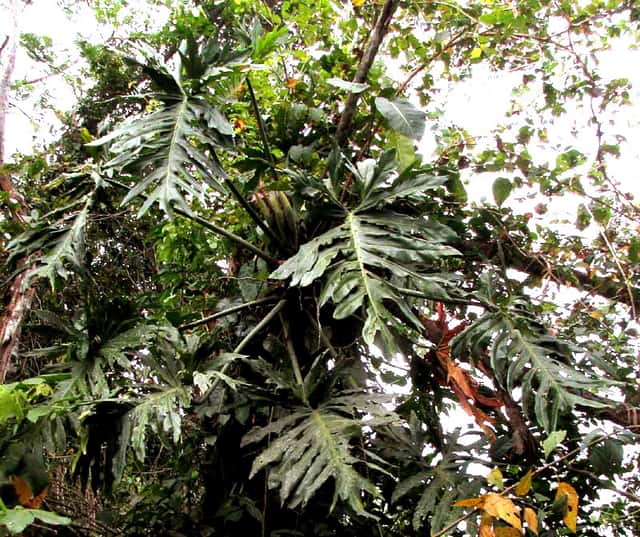
Split-leaf Philodendron (Philodendron radiatum) is a easy-care plant from the Araceae family. Philodendron radiatum is a robust, evergreen root-climbing aroid native to the rainforests of southern Mexico, Belize, Guatemala, Honduras, Nicaragua, Costa Rica and Panama. In the wild it lives as an epiphyte or hemiepiphyte, sending down long aerial roots that anchor onto tree trunks as the vine c...
Split-leaf Philodendron grows up to 25.0m, watering every 7 days, 12.7°C – 26.7°C, 60–80% humidity. It is suitable for indoor environments and not safe for pets.
Unlike many tropical plants, Split-leaf Philodendron tolerates watering mistakes. Best for beginners. Without precautions, ingestion can cause irritation in pets. Keep out of reach of cats and dogs. Without adequate drainage, root rot can develop within 14 days.
How to Care for Split-leaf Philodendron?
TLDR: Split-leaf Philodendron needs Bright indirect, watering every 7 days, and temperatures between 12.7-26.7°C with 60-80% humidity.
How Often Should You Water Split-leaf Philodendron?
Water thoroughly when the top inch (2-3 cm) of soil has dried out, then let excess water drain completely. This species is sensitive to overwatering, so avoid letting the pot sit in standing water.
How Much Light Does Split-leaf Philodendron Need?
Give it bright, filtered light, such as a spot within 6 feet (1.8 m) of a south- or east-facing window. It tolerates lower light but grows fastest and produces the most dramatic lobed leaves in brighter, indirect conditions. Avoid direct midday sun, which can scorch the foliage.
What Is the Best Soil for Split-leaf Philodendron?
Use a chunky, well-draining aroid mix of peat moss (or coco coir), perlite, and orchid bark, ideally with a slightly acidic pH of 5.1-6.
What Pot Should You Use for Split-leaf Philodendron?
A nursery pot with ample drainage holes works well; size up only when roots fill the current pot (roughly every 2-3 years). Because it is a climber, pair the pot with a moss pole or trellis so aerial roots have something to grip.
Care Schedule
Fertilize
Every 120 days
Repot
Every 900 days
What Is Split-leaf Philodendron and Where Does It Come From?
Philodendron radiatum is a robust, evergreen root-climbing aroid native to the rainforests of southern Mexico, Belize, Guatemala, Honduras, Nicaragua, Costa Rica and Panama. In the wild it lives as an epiphyte or hemiepiphyte, sending down long aerial roots that anchor onto tree trunks as the vine climbs toward the forest canopy, eventually reaching heights of 25 m (82 ft) or more. Its most striking feature is the mature foliage: large, triangular-ovate leaves up to 1 m long and 1 m wide at the base, so deeply lobed with radiating segments that they appear almost pinnate, which is the source of both its scientific epithet "radiatum" and its common name, Split-leaf Philodendron. Juvenile plants carry simpler, less-divided leaves that become progressively more dissected as the vine matures and climbs.
How to Propagate Split-leaf Philodendron?
Air Layering
Mist the moss every few days if it starts to dry out, and avoid disturbing the developing roots.
- 1 Choose a healthy node along a mature stem
- 2 Wrap moist sphagnum moss around the node and cover with plastic wrap to retain humidity
- 3 Keep the moss consistently moist until roots are visible through the wrap
- 4 Once roots form, cut the stem below the new root mass, keeping at least two leaves attached
- 5 Pot the rooted cutting in a well-draining aroid mix
Materials needed:
Water Propagation
Place the jar in bright, indirect light and avoid direct sun, which can overheat the water.
- 1 Take a 4-6 inch (10-15 cm) stem cutting with at least one node
- 2 Dip the cut end in rooting hormone
- 3 Submerge the bare node in a jar of filtered water, keeping leaves above the waterline
- 4 Change the water every two days
- 5 Transplant to soil once roots are a few centimeters long
Materials needed:
How Big Does Split-leaf Philodendron Grow?
TLDR: Split-leaf Philodendron can reach up to 25.0m tall with Medium growth rate.
Max height
25.0m
Growth rate
Medium
Foliage
Evergreen
Warning: Toxic Plant
This plant can be toxic if ingested. Keep out of reach of:
Plant Uses
Ornamental
Great for decoration
Is your plant showing symptoms?
Click on the symptom to discover possible causes:
What Diseases Commonly Affect Split-leaf Philodendron?
TLDR: Split-leaf Philodendron is susceptible to 9 known diseases. Monitor regularly for early detection.
Root Rot
Root rot is a serious fungal disease that affects the root system of plants, causing them to decay and die. It is primarily caused by overwatering, poor drainage, or soil-borne fungi such as Pythium, Phytophthora, Rhizoctonia, and Fusarium. The disease thrives in waterlogged conditions where roots are deprived of oxygen, making them susceptible to fungal infection.
Overwatering
Overwatering occurs when plants receive too much water, depriving roots of oxygen and causing root rot. This environmental stress is one of the most common causes of houseplant death, as waterlogged soil prevents roots from breathing and functioning properly.
Spider Mites
Spider mites are tiny arachnids (less than 1/20 inch long) related to spiders and ticks that feed on plant sap. They thrive in hot, dry conditions and can cause significant damage to ornamental and vegetable plants. During severe infestations, crop losses can reach 14% or higher as these pests disrupt vital plant processes including photosynthesis, carbon dioxide absorption, and transpiration.
Aphids
Aphids are small, soft-bodied, pear-shaped insects (1/16 to 1/8 inch long) that feed by sucking nutrient-rich sap from plants. They reproduce rapidly and can quickly weaken plants, causing distorted growth and transmitting plant viruses. Aphids come in various colors including green, black, red, yellow, brown, and gray. They secrete honeydew, a sticky substance that attracts ants and encourages sooty mold growth.
Fun Facts
In the wild, Philodendron radiatum can climb more than 25 m (82 ft) up rainforest trees.
Mature leaves can reach up to 1 m (3.3 ft) long and wide, among the largest in the genus Philodendron.
Its species name "radiatum" refers to the radiating, almost pinnate lobes of its mature leaves.
Young plants have simple, unlobed leaves that only develop their signature deep splits as the vine matures.
Frequently asked questions
Is Philodendron radiatum toxic to cats and dogs?
How often should I water Philodendron radiatum?
Does Philodendron radiatum need a moss pole?
Why are not my Philodendron radiatum leaves splitting?
Compare with similar plants
| Attribute | Difficulty | Light | Watering | Pet Safe |
|---|---|---|---|---|
| Field Maple | Easy | Bright indirect | 14d | ✓ |
| Silver Birch | Easy | Direct sun | 14d | ✓ |
| Common Blanketflower | Easy | Direct sun | 10d | ✓ |
| Cushion Bush | Easy | Direct sun | 14d | ✓ |
Choose & Compare
Sources & References
- Philodendron radiatum - Wikipedia
- Philodendron radiatum - Backyard Nature (Chiapas)
- Philodendron Radiatum Care from A to Z
- The Complete Philodendron Radiatum Plant Care Guide
- Split Leaf Philodendron Hardiness Zones
- Philodendron radiatum - Ecos del Bosque
- Filodendro - Philodendron radiatum - Flores e Folhagens





