Polygonaceae
Knotweed (Reynoutria): Care, Uses & Containment Guide
Reynoutria
Reynoutria thrives outdoors in full sun with minimal care. It is remarkably self-sufficient: it requires no fertilisation, no supplemental watering once established, and tolerates a wide range of soils and climates. The primary management task is containment — rhizome barrier installation and annual cutting-back are essential to prevent it from spreading beyond its intended space. Do not grow near buildings, drainage systems, or property boundaries without robust containment measures.
Every 7 days
Bright indirect
-35° - 35°C
40% - 80%
Categories
What is Knotweed?
Knotweed (Reynoutria) is a easy-care plant from the Polygonaceae family. Reynoutria is a genus of large, vigorous, deciduous perennial herbs in the family Polygonaceae, native to East Asia (Japan, China, Korea, Taiwan). The genus is best known for Reynoutria japonica (Japanese knotweed), one of the world's most aggressive invasive plants. Plants produce stout, bamboo-lik...
Knotweed grows up to 4.0m, spread of 600cm, watering every 7 days, -35°C – 35°C, 40–80% humidity. It is not suitable for indoor environments and safe for pets.
Unlike many tropical plants, Knotweed tolerates watering mistakes. Best for beginners. Unlike many popular species, Knotweed is safe to keep around pets.
How to Care for Knotweed?
TLDR: Knotweed needs Bright indirect, watering every 7 days, and temperatures between -35-35°C with 40-80% humidity.
How Often Should You Water Knotweed?
Once established, Reynoutria rarely needs supplemental watering — it is highly drought-tolerant and accesses deep soil moisture through its extensive rhizome network. In the first growing season, water weekly until well-established. During prolonged droughts, occasional deep watering is beneficial but not critical.
How Much Light Does Knotweed Need?
Prefers full sun (6+ hours of direct sun daily) for maximum growth and flowering. Tolerates partial shade but becomes less vigorous and produces fewer flowers. Avoid deep shade — plants will etiolate and weakening is significant under low light.
What Is the Best Soil for Knotweed?
Tolerates almost any soil including poor, compacted, sandy, clay, or chalky ground. Prefers moist, loamy soil with moderate fertility. Excellent drainage is not required — it can also tolerate waterlogged conditions for extended periods. pH range 5.5–7.5 is ideal, though it grows outside this range.
What Pot Should You Use for Knotweed?
Not recommended for pot culture — the plant's rhizome system is far too vigorous for containers and will destroy any pot. Grow only in open ground with physical rhizome barriers installed to a depth of at least 60 cm.
What Is Knotweed and Where Does It Come From?
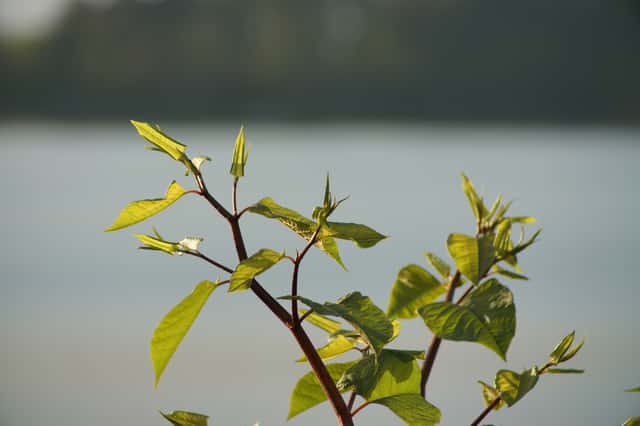
Reynoutria is a genus of large, vigorous, deciduous perennial herbs in the family Polygonaceae, native to East Asia (Japan, China, Korea, Taiwan). The genus is best known for Reynoutria japonica (Japanese knotweed), one of the world's most aggressive invasive plants. Plants produce stout, bamboo-like hollow stems that can reach 2–4 metres in height, broad heart-shaped leaves, and dense clusters of tiny creamy-white flowers in late summer and autumn. Rhizomes are extraordinarily persistent, surviving temperatures as low as -35°C and capable of penetrating concrete foundations, walls, and drainage systems. In its native range, the genus is valued medicinally — particularly as Hu Zhang (tiger's cane) in Traditional Chinese Medicine — and young shoots are eaten as a vegetable.
How Big Does Knotweed Grow?
TLDR: Knotweed can reach up to 4.0m tall with Fast growth rate.
Max height
4.0m
Spread
6.0m
Growth rate
Fast
Foliage
Deciduous
Plant Uses
Ornamental
Great for decoration
Edible
Can be consumed
Medicinal
Medicinal properties
Ground Cover
Soil coverage
Medicinal Uses
- Anti-inflammatory and antioxidant activity (resveratrol, emodin, stilbenoids)
- Cardiovascular support — lowers blood pressure and cholesterol
- Neuroprotective properties studied for neurodegenerative diseases
- Antimicrobial and antiviral action (active against Lyme disease co-infections)
- Hepatoprotective effects — traditional use for jaundice and gallstones
- Digestive support and mild laxative (anthraquinones)
- Respiratory support — clears phlegm, relieves cough
- Immune system modulation
- Metabolic regulation (insulin sensitivity, blood sugar management)
- Traditional burn and wound treatment in East Asia
- Rich natural source of resveratrol — a compound marketed globally in anti-aging supplements
Culinary Uses
- Young spring shoots (under 30 cm) eaten raw or cooked like asparagus or rhubarb
- Tart, rhubarb-like flavour used in crumbles, jams, chutneys, and desserts
- Shoots cooked in Japanese stir-fry dishes with sesame oil and tamari (itadori ryori)
- Older stems edible when boiled; seeds also edible as a grain
- Important nectar plant for honey bees — produces a distinctive monofloral honey
Is your plant showing symptoms?
Click on the symptom to discover possible causes:
What Diseases Commonly Affect Knotweed?
TLDR: Knotweed is susceptible to 4 known diseases. Monitor regularly for early detection.
Powdery Mildew
Powdery mildew is a common fungal disease caused by various fungi species including Erysiphe, Podosphaera, Oïdium, and Leveillula. It affects over 10,000 plant species worldwide. The disease thrives in warm, dry climates with high humidity and appears as a distinctive white powdery coating on plant surfaces.
Leaf Spot
Leaf spot is a common fungal disease caused by various pathogens including Alternaria, Ascochyta, Colletotrichum, Septoria, and Venturia. It primarily affects leaves, causing discolored spots that can lead to premature leaf drop if left untreated.
Aphids
Aphids are small, soft-bodied, pear-shaped insects (1/16 to 1/8 inch long) that feed by sucking nutrient-rich sap from plants. They reproduce rapidly and can quickly weaken plants, causing distorted growth and transmitting plant viruses. Aphids come in various colors including green, black, red, yellow, brown, and gray. They secrete honeydew, a sticky substance that attracts ants and encourages sooty mold growth.
Root Rot
Root rot is a serious fungal disease that affects the root system of plants, causing them to decay and die. It is primarily caused by overwatering, poor drainage, or soil-borne fungi such as Pythium, Phytophthora, Rhizoctonia, and Fusarium. The disease thrives in waterlogged conditions where roots are deprived of oxygen, making them susceptible to fungal infection.
Meaning & Symbolism
In Japan, knotweed (itadori) embodies resilience and the capacity to endure hardship. It was reportedly among the first plants to regrow after the atomic bombing of Hiroshima in 1945. In the West, it has become a symbol of invasive ecological force and serves as a powerful reminder of the consequences of introducing alien species into new environments.
Fun Facts
Reynoutria japonica can grow up to 8 cm per day — roughly 1 metre in just three weeks — making it one of the fastest-growing plants in the world.
Rhizomes can survive temperatures as low as -35°C and penetrate concrete and asphalt up to 8 cm thick, causing serious structural damage to buildings and roads.
It is one of the richest natural sources of resveratrol — the antioxidant compound studied for cardiovascular and anti-aging benefits — surpassing most other plant sources.
Japanese knotweed was reportedly one of the first plants to regrow after the atomic bombing of Hiroshima in 1945, earning it a reputation for near-indestructible resilience.
A single rhizome fragment as small as 1 cm can regenerate into a full plant — this is why legal regulations in many countries classify it as controlled waste that cannot be composted at home.
Compare with similar plants
| Attribute | Difficulty | Light | Watering | Pet Safe |
|---|---|---|---|---|
| Field Maple | Easy | Bright indirect | 14d | ✓ |
| Silver Birch | Easy | Direct sun | 14d | ✓ |
| Cushion Bush | Easy | Direct sun | 14d | ✓ |
| Peruvian peppertree | Easy | Direct sun | 14d | ⚠️ |
Choose & Compare
Sources & References
- Reynoutria japonica — Wikipedia
- Reynoutria japonica — NC Extension Gardener Plant Toolbox
- Reynoutria sachalinensis — Plants For A Future (PFAF)
- Japanese Knotweed: Uses, Safety, Benefits — Herbal Reality
- Japanese Knotweed — RHS Advice
- Reynoutria japonica as Promising Natural Agent — NCBI/PMC
- How To Grow Reynoutria japonica — EarthOne
- Reynoutria japonica Japanese Knotweed Invasive Species — Lyrae Nature Blog
- Is Japanese Knotweed Poisonous? — Japanese Knotweed Specialists
- Japanese Knotweed — USDA Invasive Species Info