Asteraceae
Osteospermum (African Daisy) Care Guide
Osteospermum
Give African daisies full sun, well-draining slightly acidic soil, and water only when the topsoil dries out. Deadhead spent blooms and feed monthly to keep the mounding habit dense and floriferous.
Every 7 days
Direct sun
18° - 32°C
% - %
Categories
What is African Daisy?
African Daisy (Osteospermum) is a easy-care plant from the Asteraceae family. Osteospermum, commonly called African daisy or Cape daisy, is a genus of roughly 70 species of daisy-like flowering plants native to South Africa and the surrounding region, belonging to the sunflower family (Asteraceae). Grown as mounding, spreading subshrubs or herbaceous perennials, they produce...
African Daisy grows up to 60cm, spread of 60cm, watering every 7 days, 18°C – 32°C. It is not suitable for indoor environments and safe for pets.
Unlike many tropical plants, African Daisy tolerates watering mistakes. Best for beginners. Unlike many popular species, African Daisy is safe to keep around pets.
How to Care for African Daisy?
TLDR: African Daisy needs Direct sun, watering every 7 days, and temperatures between 18-32°C with 40-70% humidity.
How Often Should You Water African Daisy?
Water deeply about once a week, letting the top inch of soil dry between waterings; soggy soil quickly leads to root rot.
How Much Light Does African Daisy Need?
Provide at least 6-8 hours of direct sun daily — insufficient light is the most common reason flowers stay closed or sparse.
What Is the Best Soil for African Daisy?
Plant in a well-draining, slightly acidic mix (pH 5.8-6.5); amend heavy soil with sand or perlite and avoid waterlogged beds.
What Pot Should You Use for African Daisy?
Choose a container with ample drainage holes; unglazed terracotta helps excess moisture evaporate and suits this drought-tolerant plant.
Care Schedule
Fertilize
Every 28 days
What Is African Daisy and Where Does It Come From?
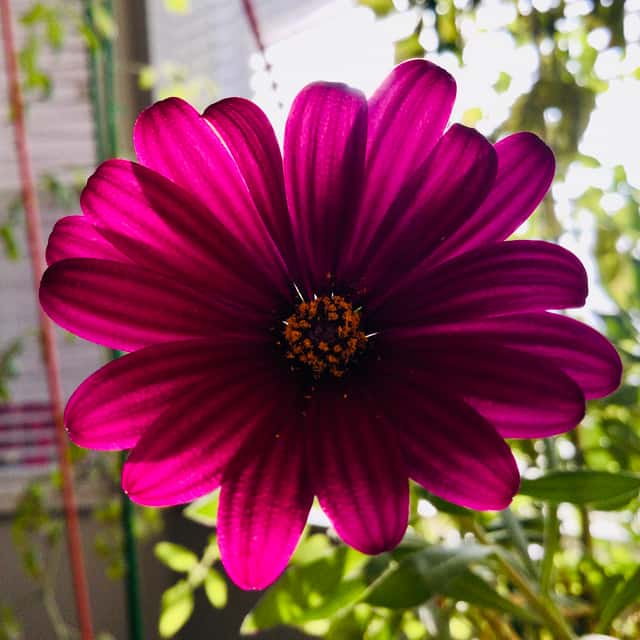
Osteospermum, commonly called African daisy or Cape daisy, is a genus of roughly 70 species of daisy-like flowering plants native to South Africa and the surrounding region, belonging to the sunflower family (Asteraceae). Grown as mounding, spreading subshrubs or herbaceous perennials, they produce abundant 5 cm blooms in white, yellow, orange, red, coral, pink and purple, often with a striking dark or iridescent-blue center disc. In warm climates (USDA zones 9-11) they behave as tender perennials that flower nearly year-round; in cooler regions they are grown as fast-growing annuals or overwintered indoors. Prized for heat and drought tolerance once established, African daisies are popular as border edging, container spillers and ground cover in sunny, well-drained garden beds.
How to Propagate African Daisy?
Softwood Stem Cutting
Cuttings root readily at almost any time of year; use fresh, sharp tools and keep humidity moderate to prevent rot.
- 1 Take a 7-10 cm softwood cutting just below a leaf node from a healthy, non-flowering stem.
- 2 Remove the lower leaves and dip the cut end in rooting hormone.
- 3 Insert the cutting into a moist, well-draining potting mix or perlite.
- 4 Keep in bright, indirect light and maintain even moisture until roots form.
Materials needed:
Seed Sowing
Most garden Osteospermum are hybrids, so seed-grown plants often differ from the parent plant; propagate named cultivars from cuttings instead.
- 1 Start seeds indoors 6-8 weeks before the last expected frost.
- 2 Sow seeds on the surface of moist seed-starting mix and cover lightly, since light aids germination.
- 3 Keep at around 18-21C until seedlings emerge in 2-4 weeks.
- 4 Transplant seedlings outdoors after the danger of frost has passed.
Materials needed:
How Big Does African Daisy Grow?
TLDR: African Daisy can reach up to 60cm tall with Fast growth rate.
Max height
60cm
Spread
60cm
Growth rate
Fast
Foliage
Evergreen
Plant Uses
Ornamental
Great for decoration
Ground Cover
Soil coverage
Is your plant showing symptoms?
Click on the symptom to discover possible causes:
What Diseases Commonly Affect African Daisy?
TLDR: African Daisy is susceptible to 12 known diseases. Monitor regularly for early detection.
Powdery Mildew
Powdery mildew is a common fungal disease caused by various fungi species including Erysiphe, Podosphaera, Oïdium, and Leveillula. It affects over 10,000 plant species worldwide. The disease thrives in warm, dry climates with high humidity and appears as a distinctive white powdery coating on plant surfaces.
Aphids
Aphids are small, soft-bodied, pear-shaped insects (1/16 to 1/8 inch long) that feed by sucking nutrient-rich sap from plants. They reproduce rapidly and can quickly weaken plants, causing distorted growth and transmitting plant viruses. Aphids come in various colors including green, black, red, yellow, brown, and gray. They secrete honeydew, a sticky substance that attracts ants and encourages sooty mold growth.
Thrips
Thrips are tiny cigar-shaped insects (1/25-inch long) that damage plants by sucking plant juices and scraping at fruits, flowers, and leaves. With over 6,000 species and rapid reproduction (lifecycle as short as 14 days), they can quickly infest plants and transmit viruses like tomato spotted wilt virus.
Whiteflies
Whiteflies are small, soft-bodied, winged insects closely related to aphids and mealybugs. They are moth-like in appearance, about 1/16 inch long, triangular in shape, and gray-white in color. These sap-sucking pests feed on plant tissue, causing yellowing, stunted growth, and wilting. They also excrete honeydew, which attracts ants and promotes sooty mold growth. Whiteflies can transmit serious plant viruses.
Fun Facts
The daisy-like flower head is actually a cluster of many tiny individual flowers packed into a single disc.
Many Osteospermum flowers close up at night and on overcast days, reopening once the sun returns.
The genus name comes from the Greek osteon (bone) and Latin spermum (seed), referring to its hard, bony seed coat.
Frequently asked questions
Is Osteospermum toxic to pets?
Why wont my African daisys flowers open?
How often should I water Osteospermum?
Is Osteospermum an annual or a perennial?
Compare with similar plants
| Attribute | Difficulty | Light | Watering | Pet Safe |
|---|---|---|---|---|
| Field Maple | Easy | Bright indirect | 14d | ✓ |
| Silver Birch | Easy | Direct sun | 14d | ✓ |
| Common Blanketflower | Easy | Direct sun | 10d | ✓ |
| Cushion Bush | Easy | Direct sun | 14d | ✓ |
Choose & Compare
Sources & References
- African Daisies (Osteospermum): How to Grow and Care - Almanac
- Complete care guide for Osteospermum African daisy - Jardineria On
- Osteospermum Plant Troubles
- How to Grow Osteospermum (Cape Daisy Care Guide) - DIY Garden
- How to Grow Cape Daisies (Osteospermum) - Gardener's Path
- African Daisy: How to Grow and Care with Success - Gardenia
- Osteospermum - planting, pruning, care - Nature and Garden
- African Daisy - How to Grow Osteospermum Plants - Garden Design





