Fabaceae
Strawberry Clover: How to Grow and Care for Trifolium fragiferum
Trifolium fragiferum
Plant in full sun in clay or loamy well-drained soils. Water weekly and allow the soil to dry slightly between waterings. Fertilisation is rarely needed as it fixes atmospheric nitrogen through symbiotic bacteria. Occasional mowing or pruning helps maintain shape.
Every 7 days
Bright indirect
-4° - 35°C
40% - 80%
Categories
What is Strawberry Clover?
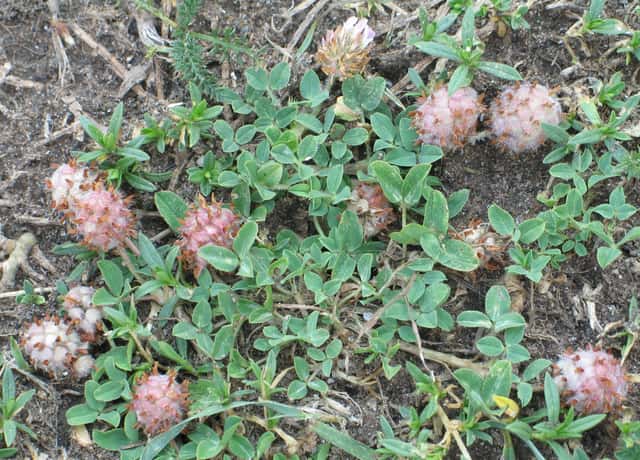
Strawberry Clover (Trifolium fragiferum) is a easy-care plant from the Fabaceae family. Trifolium fragiferum, commonly known as strawberry clover, is a perennial creeping legume native to the Eastern Mediterranean, Southwest Asia, and Northwest Africa, including mainland Portugal and Madeira. It is distinguished by its round, pale-pink flower heads that, after fruiting, inflate into st...
Strawberry Clover grows up to 40cm, spread of 80cm, watering every 7 days, -4°C – 35°C, 40–80% humidity. It is not suitable for indoor environments and safe for pets.
Unlike many tropical plants, Strawberry Clover tolerates watering mistakes. Best for beginners. Unlike many popular species, Strawberry Clover is safe to keep around pets.
How to Care for Strawberry Clover?
TLDR: Strawberry Clover needs Bright indirect, watering every 7 days, and temperatures between -4-35°C with 40-80% humidity.
How Often Should You Water Strawberry Clover?
Water once a week in temperate climates. During hot spells, increase to twice weekly. It tolerates short dry periods but performs best with consistently moderate soil moisture.
How Much Light Does Strawberry Clover Need?
Prefers full sun (6-8 hours/day) but tolerates partial shade. Full sun promotes more abundant flowering and denser ground cover formation.
What Is the Best Soil for Strawberry Clover?
Grows well in clay, loamy, and sandy soils. Tolerates alkaline soils (up to pH 9) and moderate salinity. Avoid prolonged waterlogging, though it can tolerate temporary flooding for up to 2 months.
What Pot Should You Use for Strawberry Clover?
Wide, shallow container suitable for ornamental cultivation; prefers direct in-ground planting for ground cover use.
Care Schedule
Fertilize
Every 30 days
What Is Strawberry Clover and Where Does It Come From?
Trifolium fragiferum, commonly known as strawberry clover, is a perennial creeping legume native to the Eastern Mediterranean, Southwest Asia, and Northwest Africa, including mainland Portugal and Madeira. It is distinguished by its round, pale-pink flower heads that, after fruiting, inflate into strawberry-like globes — giving rise to its common name. The plant spreads vigorously through creeping stolons that root at the nodes, forming a dense ground cover. It is one of the most salt-tolerant and waterlogging-tolerant clover species commercially available.
How to Propagate Strawberry Clover?
Direct seeding
Sow in spring after the last frost. Inoculation with the specific rhizobium (Rhizobium leguminosarum) enhances nitrogen fixation.
- 1 Obtain or harvest mature seeds
- 2 Soak in warm water for 24 hours to improve germination
- 3 Sow directly in the final location or in trays at 1-2 cm depth
- 4 Keep soil moist until germination
- 5 Transplant (if using trays) when seedlings reach 2-3 cm
Materials needed:
Stolon division
Fastest method to achieve ground cover. Each node on the stolons has rooting capacity.
- 1 In spring, cut stolon sections that have rooted nodes
- 2 Replant immediately in a prepared location
- 3 Water thoroughly after planting
- 4 Keep moist for 2 weeks
Materials needed:
How Big Does Strawberry Clover Grow?
TLDR: Strawberry Clover can reach up to 40cm tall with Fast growth rate.
Max height
40cm
Spread
80cm
Growth rate
Fast
Foliage
Semi-evergreen
Plant Uses
Ground Cover
Soil coverage
Medicinal
Medicinal properties
Ornamental
Great for decoration
Medicinal Uses
- Leaves used in folk medicine as a mild diuretic; traditionally used in European herbal medicine for mild respiratory complaints.
Culinary Uses
- Young leaves and flowers are edible raw in salads; flowers can garnish dishes. Mild, slightly sweet flavour.
Is your plant showing symptoms?
Click on the symptom to discover possible causes:
What Diseases Commonly Affect Strawberry Clover?
TLDR: Strawberry Clover is susceptible to 11 known diseases. Monitor regularly for early detection.
Root Rot
Root rot is a serious fungal disease that affects the root system of plants, causing them to decay and die. It is primarily caused by overwatering, poor drainage, or soil-borne fungi such as Pythium, Phytophthora, Rhizoctonia, and Fusarium. The disease thrives in waterlogged conditions where roots are deprived of oxygen, making them susceptible to fungal infection.
Powdery Mildew
Powdery mildew is a common fungal disease caused by various fungi species including Erysiphe, Podosphaera, Oïdium, and Leveillula. It affects over 10,000 plant species worldwide. The disease thrives in warm, dry climates with high humidity and appears as a distinctive white powdery coating on plant surfaces.
Fusarium Wilt
Fusarium wilt is a serious fungal disease caused by the soil-borne fungus Fusarium oxysporum. The fungus invades roots and blocks the water-conducting vessels (xylem) of the plant, causing progressive wilting and eventual death. Host-specific forms of the pathogen exist that attack different plant species.
Cercospora Leaf Spot
Cercospora leaf spot is a common fungal disease caused by Cercospora species that affects many plant types, particularly beets, roses, and leafy vegetables. The disease thrives in warm, humid conditions and can cause significant defoliation, reducing plant vigor and yield. It spreads rapidly through water splash, wind, and contaminated tools.
Meaning & Symbolism
Symbol of resilience and pastoral abundance; associated with European meadows and sustainable land use practices.
Fun Facts
The name 'strawberry' comes from the inflated seed heads after flowering, which visually resemble small strawberries.
It is one of the few clover species tolerant of saline soils, used in the rehabilitation of degraded lands.
Its root nodules host bacteria that fix atmospheric nitrogen, naturally fertilising the soil.
It can tolerate submersion for up to 2 months, thanks to the tropism-driven elevation of its stolons.
Frequently asked questions
Is strawberry clover toxic to pets?
How often should I water strawberry clover?
Does strawberry clover need fertiliser?
Can I use strawberry clover as ground cover?
When does strawberry clover bloom?
Compare with similar plants
| Attribute | Difficulty | Light | Watering | Pet Safe |
|---|---|---|---|---|
| Field Maple | Easy | Bright indirect | 14d | ✓ |
| Silver Birch | Easy | Direct sun | 14d | ✓ |
| Common Blanketflower | Easy | Direct sun | 10d | ✓ |
| Cushion Bush | Easy | Direct sun | 14d | ✓ |





