Thymelaeaceae
Struthiola (Cape Sprays): Complete Care Guide
Struthiola
A tough, drought-tolerant fynbos shrub suited to Mediterranean, coastal and xeric gardens. Requires full sun and excellent drainage. Water sparingly once established and prune lightly to maintain shape.
Every 10 days
Bright indirect
5° - 35°C
30% - 60%
Categories
What is Cape Sprays?
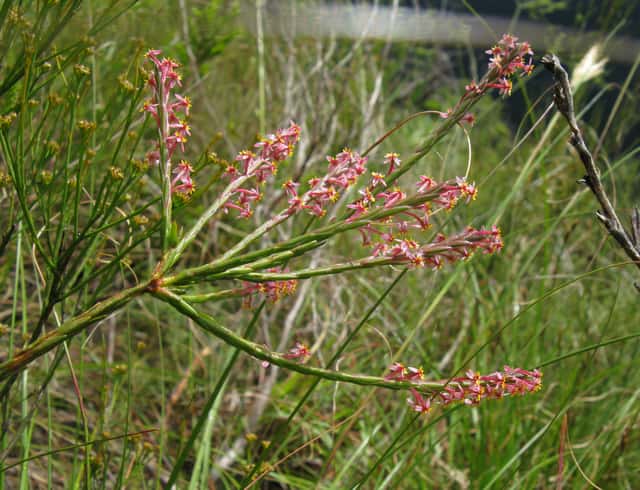
Cape Sprays (Struthiola) is a medium-care plant from the Thymelaeaceae family. Struthiola is a genus of approximately 31 species of ericoid shrubs in the family Thymelaeaceae, native to the fynbos biome of South Africa's Cape Floral Region. These evergreen shrublets are renowned for their sweetly scented tubular flowers at dusk and their remarkable drought tolerance in sandy,...
Cape Sprays grows up to 2.0m, spread of 100cm, watering every 10 days, 5°C – 35°C, 30–60% humidity. It is not suitable for indoor environments and safe for pets.
Unlike many popular species, Cape Sprays is safe to keep around pets.
How to Care for Cape Sprays?
TLDR: Cape Sprays needs Bright indirect, watering every 10 days, and temperatures between 5-35°C with 30-60% humidity.
How Often Should You Water Cape Sprays?
Water every 10 days during the growing season. Once established, Cape Sprays are highly drought-tolerant and prefer to dry out between waterings. Overwatering causes root rot.
How Much Light Does Cape Sprays Need?
Full sun is essential — at least 6 hours of direct sunlight daily. Plants flower most profusely in open, sunny positions. Avoid shaded spots.
What Is the Best Soil for Cape Sprays?
Use sandy or well-draining soil with pH 5.5–6.7. Avoid clay or compacted soils. A mix of coarse sand and garden soil replicates the natural fynbos substrate.
What Pot Should You Use for Cape Sprays?
Terracotta or stone pot with drainage hole. Avoid plastic containers that retain moisture.
Care Schedule
Fertilize
Every 30 days
What Is Cape Sprays and Where Does It Come From?
Struthiola is a genus of approximately 31 species of ericoid shrubs in the family Thymelaeaceae, native to the fynbos biome of South Africa's Cape Floral Region. These evergreen shrublets are renowned for their sweetly scented tubular flowers at dusk and their remarkable drought tolerance in sandy, well-drained soils.
How to Propagate Cape Sprays?
Stem Tip Cutting
Use sterile tools. Maintain rooting temperature at 25-27°C. Avoid disturbing cuttings during rooting.
- 1 Take a healthy 8-10 cm tip cutting in spring or early summer
- 2 Apply rooting hormone to the cut base
- 3 Plant in moist, well-draining medium on a heated bench at 25-27°C
- 4 Keep in semi-shade until rooted (4-6 weeks)
- 5 Transplant carefully as roots are sensitive to disturbance
Materials needed:
Seed Propagation
Smoke treatment significantly improves germination in this fire-adapted species.
- 1 Collect mature seeds in autumn
- 2 Apply smoke treatment to improve germination rates
- 3 Sow in sandy, well-draining substrate
- 4 Keep moist and cool until germination
Materials needed:
How Big Does Cape Sprays Grow?
TLDR: Cape Sprays can reach up to 2.0m tall with Medium growth rate.
Max height
2.0m
Spread
1.0m
Growth rate
Medium
Foliage
Evergreen
Plant Uses
Ornamental
Great for decoration
Aromatic
Pleasant fragrance
Is your plant showing symptoms?
Click on the symptom to discover possible causes:
What Diseases Commonly Affect Cape Sprays?
TLDR: Cape Sprays is susceptible to 5 known diseases. Monitor regularly for early detection.
Root Rot
Root rot is a serious fungal disease that affects the root system of plants, causing them to decay and die. It is primarily caused by overwatering, poor drainage, or soil-borne fungi such as Pythium, Phytophthora, Rhizoctonia, and Fusarium. The disease thrives in waterlogged conditions where roots are deprived of oxygen, making them susceptible to fungal infection.
Aphids
Aphids are small, soft-bodied, pear-shaped insects (1/16 to 1/8 inch long) that feed by sucking nutrient-rich sap from plants. They reproduce rapidly and can quickly weaken plants, causing distorted growth and transmitting plant viruses. Aphids come in various colors including green, black, red, yellow, brown, and gray. They secrete honeydew, a sticky substance that attracts ants and encourages sooty mold growth.
Thrips
Thrips are tiny cigar-shaped insects (1/25-inch long) that damage plants by sucking plant juices and scraping at fruits, flowers, and leaves. With over 6,000 species and rapid reproduction (lifecycle as short as 14 days), they can quickly infest plants and transmit viruses like tomato spotted wilt virus.
Scale Insects
Scale insects are small sap-sucking pests that appear as brown, shell-like bumps on plant stems and leaves. There are over 25 species, divided into armored (hard) and unarmored (soft) scales. They feed by piercing plant tissue and extracting sap, which weakens the plant and can lead to yellowing, stunted growth, and even death if left untreated. They also excrete honeydew, which attracts ants and promotes sooty mold growth.
Meaning & Symbolism
Nocturnal beauty and resilience in harsh fynbos environments
Fun Facts
Struthiola flowers are pollinated by small moths with fine proboscises, attracted by their nocturnal scent
About 25 of the 31 Struthiola species are endemic to South Africa's fynbos biome
These plants are fire-adapted and can regenerate rapidly after wildfires through underground root systems
The Afrikaans name "soetgonna" means "sweet gonna", a reference to the flowers' characteristic sweet evening fragrance
Frequently asked questions
How often should I water Struthiola?
Does Struthiola need full sun?
Is Struthiola toxic to pets?
How do I propagate Struthiola?
When does Struthiola flower?
Compare with similar plants
| Attribute | Difficulty | Light | Watering | Pet Safe |
|---|---|---|---|---|
| Dark Fieldcap | Medium | Low light | 2d | ⚠️ |
| Azalea | Medium | Partial shade | 3d | ⚠️ |
| Bougainvillea | Medium | Direct sun | 7d | ⚠️ |
| Wild Lettuce | Medium | Direct sun | 7d | ⚠️ |



