Bromeliaceae
Sky Plant: Pet-Safe Plant
Tillandsia ionantha
Easy care plant, ideal for beginners. Requires good indirect light, weekly water immersion, and good air circulation. Does not need substrate or pot.
Every 3 days
Partial shade
10° - 30°C
50% - 80%
Categories
What is Sky Plant?
Sky Plant (Tillandsia ionantha) is a easy-care plant from the Bromeliaceae family. Tillandsia ionantha is a fascinating epiphytic plant from the bromeliad family, native to Central America and Mexico. Known as the air plant, it does not need soil to grow, absorbing water and nutrients directly from the air through its silver trichome-covered leaves. During flowering, its central l...
Sky Plant grows up to 8cm, spread of 10cm, watering every 3 days, 10°C – 30°C, 50–80% humidity. It is suitable for indoor environments and safe for pets.
Unlike many tropical plants, Sky Plant tolerates watering mistakes. Best for beginners. Unlike many popular species, Sky Plant is safe to keep around pets. Without adequate drainage, root rot can develop within 7 days.
How to Care for Sky Plant?
TLDR: Sky Plant needs Partial shade, watering every 3 days, and temperatures between 10-30°C with 50-80% humidity.
How Often Should You Water Sky Plant?
Submerge completely in water for 15-20 minutes, 1-2 times weekly. In summer, mist every 2-3 days. Always shake after watering to prevent water accumulation in leaves.
How Much Light Does Sky Plant Need?
Prefers bright indirect light. Can tolerate soft morning or late afternoon sun, but avoid intense direct sunlight that can burn leaves. Ideal near windows with sheer curtains.
What Is the Best Soil for Sky Plant?
Does not require substrate. Can be mounted on wood, stone, glass, or shells. Avoid copper supports, which are toxic to tillandsias.
What Pot Should You Use for Sky Plant?
Does not need a pot. Ideal on wood, glass, ceramic, or stone mounts. Avoid copper.
Care Schedule
Fertilize
Every 30 days
Misting
Every 3 days
What Is Sky Plant and Where Does It Come From?
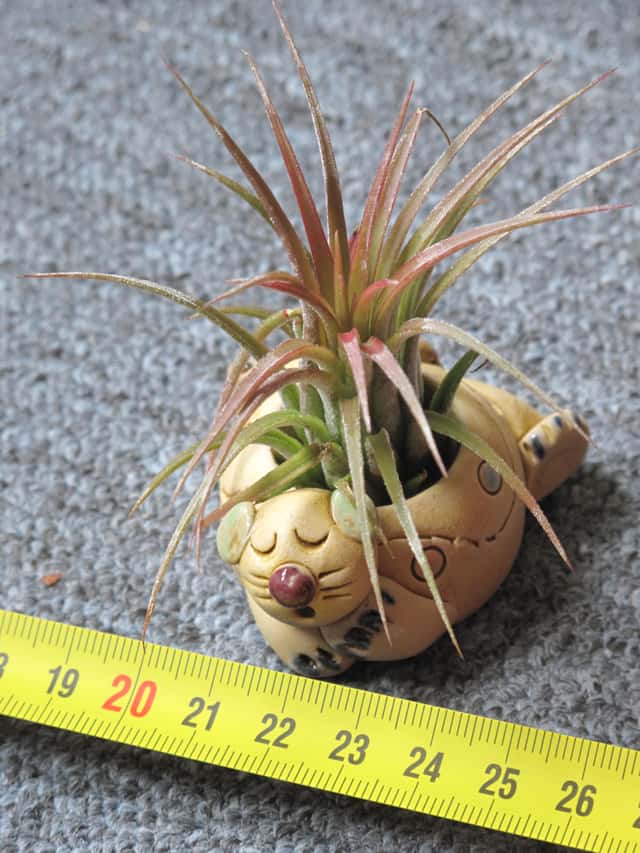
Tillandsia ionantha is a fascinating epiphytic plant from the bromeliad family, native to Central America and Mexico. Known as the air plant, it does not need soil to grow, absorbing water and nutrients directly from the air through its silver trichome-covered leaves. During flowering, its central leaves turn vivid red, contrasting with the delicate purple flowers.
How to Propagate Sky Plant?
Division
Pups naturally appear after the mother plant flowers
- 1 Wait for pup formation after flowering
- 2 Let pups grow to half the size of the mother plant
- 3 Gently separate the pups
- 4 Mount on new support
Materials needed:
How Big Does Sky Plant Grow?
TLDR: Sky Plant can reach up to 8cm tall with Slow growth rate.
Max height
8cm
Spread
10cm
Growth rate
Slow
Foliage
Evergreen
Plant Uses
Ornamental
Great for decoration
Air Purifying
Improves air quality
Is your plant showing symptoms?
Click on the symptom to discover possible causes:
What Diseases Commonly Affect Sky Plant?
TLDR: Sky Plant is susceptible to 40 known diseases. Monitor regularly for early detection.
Crown Rot
Crown rot is a serious fungal disease that attacks the crown (base) of the plant where the stem meets the soil. It is caused by various fungal pathogens including Phytophthora, Fusarium, and Rhizoctonia. The disease thrives in waterlogged conditions and can quickly spread to kill the entire plant if not addressed promptly.
Gray Mold (Botrytis Blight)
Gray mold, caused by the fungus Botrytis cinerea, is one of the most common fungal diseases in plants. It affects over 200 plant species, including ornamentals, vegetables, fruits, and houseplants. The disease thrives in cool, humid conditions with poor air circulation, causing grayish spots and soft rot on infected tissues.
Gray Mold (Botrytis Blight)
Gray mold, caused by the fungus Botrytis cinerea, is a widespread necrotrophic pathogen affecting over 1,400 plant species. It thrives in cool, humid conditions and attacks weakened or aging plant tissues, causing soft rot and characteristic gray fuzzy growth.
Poor Air Circulation
Poor air circulation is an environmental stress condition that occurs when plants lack adequate airflow around their foliage and stems. Stagnant air creates a microenvironment that promotes moisture buildup, depletes available CO2, and weakens plant defenses against fungal diseases and pests. This is especially common with densely packed indoor plants or plants placed in corners with limited ventilation.
Meaning & Symbolism
Symbolizes freedom, creativity, and adaptability due to its ability to live without soil
Compare with similar plants
| Attribute | Difficulty | Light | Watering | Pet Safe |
|---|---|---|---|---|
| Field Maple | Easy | Bright indirect | 14d | ✓ |
| Silver Birch | Easy | Direct sun | 14d | ✓ |
| Cushion Bush | Easy | Direct sun | 14d | ✓ |
| Peruvian peppertree | Easy | Direct sun | 14d | ⚠️ |