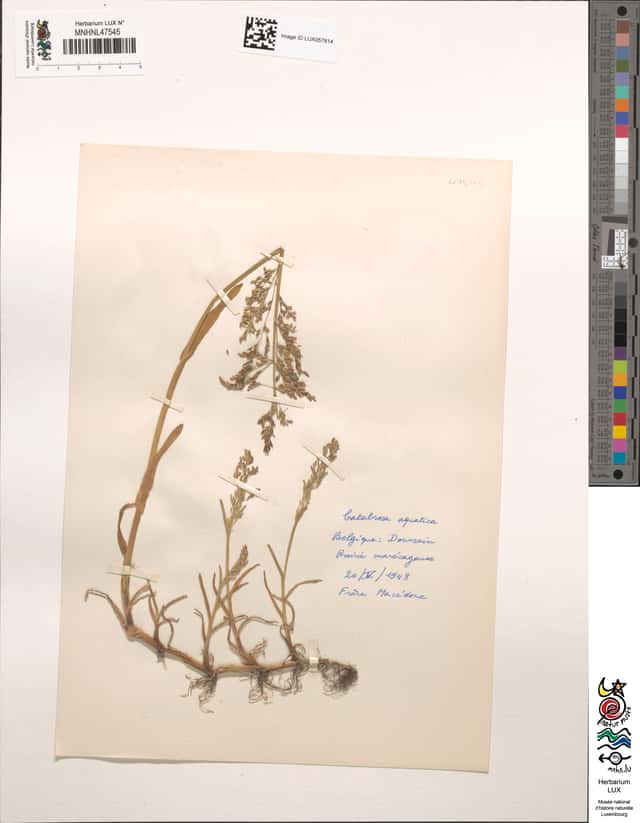
Poaceae
Water Whorlgrass: Edible Plant
Catabrosa aquatica
Grow it as a marginal aquatic or bog plant: roots and lower stems should sit permanently in shallow water or waterlogged soil. Give full sun to light shade and keep the crown wet year-round; it dies back in hard frost but regrows from the submerged rootstock.
Every 1 days
Bright indirect
5° - 24°C
60% - 100%
Categories
What is Water Whorlgrass?
Water Whorlgrass (Catabrosa aquatica) is a medium-care plant from the Poaceae family. Water whorlgrass is a low, stoloniferous semi-aquatic grass native to wet meadows, stream margins and pond edges across the temperate Northern Hemisphere. It forms creeping mats of pale green, glossy blades and sends up loose, airy flower panicles in summer. Because it roots readily at the nodes, it...
Water Whorlgrass grows up to 70cm, spread of 60cm, watering every 1 days, 5°C – 24°C, 60–100% humidity. It is not suitable for indoor environments and safe for pets.
Unlike many popular species, Water Whorlgrass is safe to keep around pets.
How to Care for Water Whorlgrass?
TLDR: Water Whorlgrass needs Bright indirect, watering every 1 days, and temperatures between 5-24°C with 60-100% humidity.
How Often Should You Water Water Whorlgrass?
Never let this grass dry out - keep it standing in a few centimetres of water or constantly saturated soil at all times; a dry spell will quickly kill it back.
How Much Light Does Water Whorlgrass Need?
Thrives in full sun to light dappled shade; more sun means denser growth and better flowering.
What Is the Best Soil for Water Whorlgrass?
Not fussy about soil texture (sandy, loamy or clay all work) as long as it stays waterlogged; mildly acid to mildly alkaline pH is fine.
What Pot Should You Use for Water Whorlgrass?
Marginal pond basket or bog-garden bed; avoid pots without a saucer or liner since it needs standing water.
Care Schedule
Fertilize
Every 14 days
Misting
Every 3 days
Rotate
Every 7 days
Repot
Every 365 days
What Is Water Whorlgrass and Where Does It Come From?
Water whorlgrass is a low, stoloniferous semi-aquatic grass native to wet meadows, stream margins and pond edges across the temperate Northern Hemisphere. It forms creeping mats of pale green, glossy blades and sends up loose, airy flower panicles in summer. Because it roots readily at the nodes, it spreads steadily along muddy banks and shallow water, making it a useful marginal or bog-garden species rather than a houseplant.
How to Propagate Water Whorlgrass?
Division
- Lift a rooted stolon clump in spring
- Keep divisions wet at all times until re-established
- 1 Lift clump
In spring, lift a section of rooted stolon from the parent mat.
- 2 Separate
Tease apart into smaller rooted pieces by hand.
- 3 Replant
Set divisions directly into shallow water or saturated soil at the final position.
Materials needed:
Seed
- Surface sow, do not bury seed
- Keep pot standing in a shallow water tray
- 1 Sow
Surface-sow seed onto wet compost in a pot standing in a tray of shallow water.
- 2 Prick out
When seedlings are large enough to handle, transplant into individual wet pots.
- 3 Plant out
Move rooted seedlings to their permanent wet position in summer.
Materials needed:
How Big Does Water Whorlgrass Grow?
TLDR: Water Whorlgrass can reach up to 70cm tall with Fast growth rate.
Max height
70cm
Spread
60cm
Growth rate
Fast
Foliage
Semi-evergreen
Plant Uses
Ornamental
Great for decoration
Edible
Can be consumed
Medicinal
Medicinal properties
Medicinal Uses
- Traditional decoction used as a stimulant and tonic
Culinary Uses
- Small seeds historically ground into flour or piñole and used to thicken soups, stews, or make cakes and bread
Is your plant showing symptoms?
Click on the symptom to discover possible causes:
Compare with similar plants
| Attribute | Difficulty | Light | Watering | Pet Safe |
|---|---|---|---|---|
| Dark Fieldcap | Medium | Low light | 2d | ⚠️ |
| Azalea | Medium | Partial shade | 3d | ⚠️ |
| Bougainvillea | Medium | Direct sun | 7d | ⚠️ |
| Wild Lettuce | Medium | Direct sun | 7d | ⚠️ |



