Boraginaceae
Viper's Bugloss: Edible Plant
Echium vulgare
Viper's Bugloss is a low-maintenance, sun-loving, and drought-tolerant plant suitable for rock gardens, butterfly and bee borders, or dry slopes. It thrives best in poorer, well-draining soil in full sun and requires almost no fertilization or watering once established. Overly rich, heavily fertilized soil tends to lead to excessive leaf growth at the expense of flowers.
Every 12 days
Bright indirect
-30° - 35°C
% - %
Categories
What is Viper's Bugloss?
Viper's Bugloss (Echium vulgare) is a easy-care plant from the Boraginaceae family. Viper's Bugloss (Echium vulgare) is a biennial to perennial herb from the borage family (Boraginaceae), naturally growing in meadows, field margins, embankments, and dry habitats throughout Europe, including the Czech Republic. It forms a basal rosette of hairy leaves, from which an upright, densely...
Viper's Bugloss grows up to 90cm, spread of 45cm, watering every 12 days, -30°C – 35°C. It is not suitable for indoor environments and not safe for pets.
Unlike many tropical plants, Viper's Bugloss tolerates watering mistakes. Best for beginners. Without precautions, ingestion can cause irritation in pets. Keep out of reach of cats and dogs.
How to Care for Viper's Bugloss?
TLDR: Viper's Bugloss needs Bright indirect, watering every 12 days, and temperatures between -30-35°C with 40-70% humidity.
How Often Should You Water Viper's Bugloss?
Water sparingly – once established, it tolerates drought very well, and excessive moisture is more detrimental. Allow the soil to dry out completely between waterings and only water during prolonged dry spells.
How Much Light Does Viper's Bugloss Need?
Requires full sun, ideally at least 6–8 hours of direct light daily. In partial shade, it flowers poorly, and the stems become leggy.
What Is the Best Soil for Viper's Bugloss?
Prefers poor to moderately fertile, well-draining soil – sandy, loamy, or stony, tolerating slightly acidic to alkaline pH. Avoid heavy, constantly wet clay soils, where root rot is a risk.
What Pot Should You Use for Viper's Bugloss?
Viper's Bugloss is commonly grown directly in the garden, but it can also be planted in a wider, well-draining terracotta pot with drainage holes and gravel at the bottom, placed in a sunny location.
What Is Viper's Bugloss and Where Does It Come From?
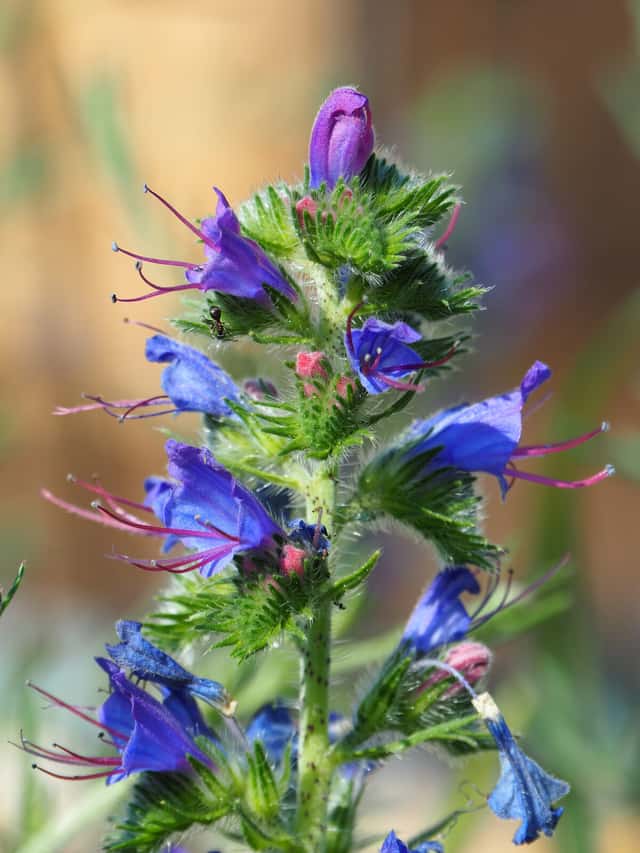
Viper's Bugloss (Echium vulgare) is a biennial to perennial herb from the borage family (Boraginaceae), naturally growing in meadows, field margins, embankments, and dry habitats throughout Europe, including the Czech Republic. It forms a basal rosette of hairy leaves, from which an upright, densely bristly stem, 30–90 cm tall, emerges in the second year. From May to September, it blooms with small, funnel-shaped flowers that open pink and gradually turn blue – a typical characteristic of the entire Echium genus. The flowers are sought after by bees and bumblebees, making the plant valued as an important melliferous herb. It tolerates drought, poor sandy and stony soil, and is low-maintenance, but the entire plant contains pyrrolizidine alkaloids, and its bristly hairs can irritate the skin.
How to Propagate Viper's Bugloss?
Sowing Seeds
Viper's Bugloss has a long taproot and tolerates transplanting poorly, so it's best to sow seeds directly in their final location.
- 1 Choose a sunny location with poorer, well-draining soil.
- 2 Sow seeds directly in place in spring (April–May) or autumn.
- 3 Sow shallowly, covering lightly with soil; seeds need light to germinate.
- 4 Keep the soil moderately moist until germination, then water sparingly.
- 5 Thin out excess seedlings to a distance of about 30 cm.
Materials needed:
How Big Does Viper's Bugloss Grow?
TLDR: Viper's Bugloss can reach up to 90cm tall with Medium growth rate.
Max height
90cm
Spread
45cm
Growth rate
Medium
Foliage
Deciduous
Warning: Toxic Plant
This plant can be toxic if ingested. Keep out of reach of:
Plant Uses
Ornamental
Great for decoration
Medicinal
Medicinal properties
Edible
Can be consumed
Medicinal Uses
- traditionally, the root was used as a poultice for snakebites and wounds
- leaves and flowers used in folk medicine as a mild diuretic and laxative for coughs
- modern use is not recommended due to the presence of liver-toxic pyrrolizidine alkaloids
Culinary Uses
- young leaves can be cooked in small quantities as a spinach substitute
- flowers are edible and used for decorating dishes and salads
- due to the content of alkaloids and bristly hairs, frequent or large consumption is not recommended
Is your plant showing symptoms?
Click on the symptom to discover possible causes:
What Diseases Commonly Affect Viper's Bugloss?
TLDR: Viper's Bugloss is susceptible to 5 known diseases. Monitor regularly for early detection.
Powdery Mildew
Powdery mildew is a common fungal disease caused by various fungi species including Erysiphe, Podosphaera, Oïdium, and Leveillula. It affects over 10,000 plant species worldwide. The disease thrives in warm, dry climates with high humidity and appears as a distinctive white powdery coating on plant surfaces.
Rust
Rust is a common fungal disease caused by fungi in the order Pucciniales that affects a wide variety of plants. The disease gets its name from the characteristic orange, yellow, or reddish-brown pustules that appear on leaves, resembling metal rust. This obligate fungal parasite requires living plants to survive and can cause significant economic losses in agricultural crops.
Leaf Spot
Leaf spot is a common fungal disease caused by various pathogens including Alternaria, Ascochyta, Colletotrichum, Septoria, and Venturia. It primarily affects leaves, causing discolored spots that can lead to premature leaf drop if left untreated.
Root Rot
Root rot is a serious fungal disease that affects the root system of plants, causing them to decay and die. It is primarily caused by overwatering, poor drainage, or soil-borne fungi such as Pythium, Phytophthora, Rhizoctonia, and Fusarium. The disease thrives in waterlogged conditions where roots are deprived of oxygen, making them susceptible to fungal infection.
Meaning & Symbolism
According to the ancient doctrine of signatures, the spotted stem of Viper's Bugloss resembled snake skin, and thus the plant's root was traditionally used in folk medicine as a protective remedy against snakebite – hence both its Czech and scientific names. The plant therefore symbolizes protection and courage.
Compare with similar plants
| Attribute | Difficulty | Light | Watering | Pet Safe |
|---|---|---|---|---|
| Field Maple | Easy | Bright indirect | 14d | ✓ |
| Silver Birch | Easy | Direct sun | 14d | ✓ |
| Common Blanketflower | Easy | Direct sun | 10d | ✓ |
| Cushion Bush | Easy | Direct sun | 14d | ✓ |





